Gateway Arch Weather Control: Key Points
-
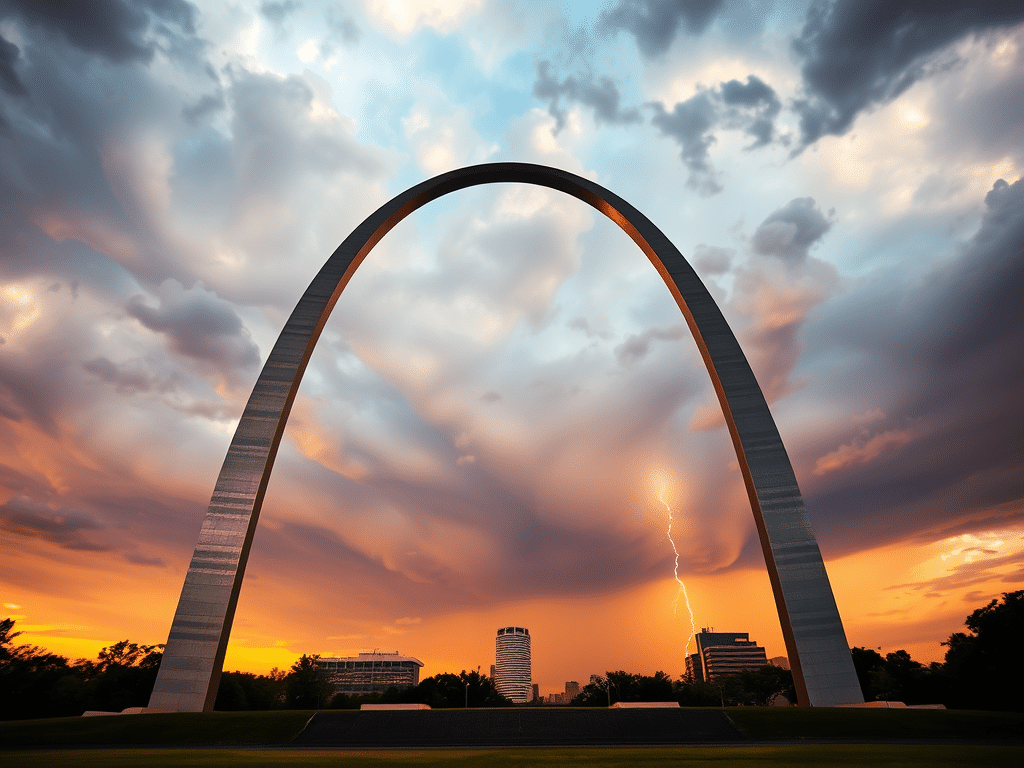
The Gateway Arch is a 630-foot stainless steel monument in St. Louis, completed in 1965 to commemorate westward expansion.
-
Stories emerged about the arch affecting local weather, including unusual cloud formations, wind patterns, and frequent lightning strikes.
-
Theories range from plausible ideas about localized atmospheric effects to conspiracy claims about government weather modification programs.
-
Meteorologists are skeptical due to lack of evidence, and the National Park Service denies any weather-related purpose.
-
The weather control stories have added mystery to the arch’s cultural legacy while sometimes overshadowing its historical significance.
-
The arch remains primarily an architectural triumph, with weather control theories largely confined to speculation and urban legend.

Introduction
The Gateway Arch in St. Louis, Missouri, is a defining American landmark. While it’s often considered a tribute to the westward push, some intriguing and contentious theories have emerged, suggesting it might also be connected to weather manipulation. This shining stainless steel monument, rising 630 feet above the Mississippi, has captivated countless visitors since its completion in 1965. While most people appreciate it for its architectural beauty and historical importance, some observers have long wondered if this large metal structure might affect local weather, either on purpose or by accident. These theories, ranging from plausible scientific ideas to outright conspiracy theories, have created a unique intersection of architectural history and weather-related mysteries. This intersection continues to intrigue both researchers and those who are skeptical.
The Gateway Arch
Eero Saarinen, a Finnish-American architect, conceived the Gateway Arch, a triumph of engineering. His design became the defining vision after being chosen from a pool of 172 submissions in a national competition in 1947. The structure’s design is based on a catenary arch, which means its shape follows the curve of a hanging chain but flipped to stand upright. Construction kicked off in 1963, wrapping up on October 28, 1965. The project demanded some fairly inventive engineering to create the hollow, triangular shape. It starts at a broad 54 feet across at the bottom and narrows down to a mere 17 feet at the top. The arch’s design features stainless steel on the outside, with carbon steel on the inside, and concrete reinforcement extending up to 300 feet. This combination confers it remarkable durability and electrical conductivity, in addition to being the tallest man-made monument in the United States. The surface, a mirror to the sky, shifts with the weather, offering a constantly evolving visual display that transforms from dawn to dusk and with the changing seasons.
The Gateway Arch isn’t just a lovely sight; it’s also a feat of engineering. This shape is a suitable example of a “flattened catenary,” a term defined by mathematician Robert Osserman (Lewis, 2016; Osserman, 2010). This design choice ensures that the arch effectively transfers loads straight down, making it a suitable example for studying arch mechanics. Studies highlight that Saarinen’s use of mathematical modeling in design was groundbreaking, significantly influencing architectural structures worldwide (Shawkat, 2022; Lewis, 2016). The arch’s height affects how we see it. Research indicates that the surroundings influence how people perceive the arch, making it seem taller than its width would suggest (Hamburger & Hansen, 2010).
The Gateway Arch’s historical significance is deeply rooted in St. Louis’s identity as the “Gateway to the West.” This monument commemorates the city’s role in the Louisiana Purchase and the westward expansion of the United States. President Franklin D. Roosevelt gave his blessing to the Jefferson National Expansion Memorial in 1935. However, the arch’s construction was postponed for almost thirty years, thanks to World War II and other setbacks. The memorial aimed to pay tribute to Thomas Jefferson and the early settlers of the American West. The arch, a striking and contemporary take on this history, was central to the design.
The idea for the Gateway Arch first took shape in 1948. That year, a design competition was launched, seeking a memorial to Thomas Jefferson and the westward push across the continent. Saarinen’s design won the competition, presenting a new structure that symbolized the idea of a “gateway” to the western United States (Graebner, 1993). Construction kicked off in 1963, with the arch finally finished in 1965. Soaring to a height of 630 feet, it was built from stainless steel—a relatively new material for structures of this scale back then. The arch’s shape is based on a catenary curve, which is naturally stable when bearing its own weight (Giordano, 2024; Shawkat, 2022). Hooke’s law, first described by Robert Hooke in the late 1600s, is crucial for an arch’s stability. It allows the arch to support its weight without needing extra internal support, which defines its innovative design (Shawkat, 2022; Osserman, 2010).
During the construction, workers faced many challenges. A major difficulty was making sure the two parts would fit together perfectly at the top. This job required very precise calculations and careful monitoring of temperature. The steel’s expansion and contraction due to temperature changes made the process even more complex. Firefighters doused the south leg with water on October 28, 1965, during the installation of the final piece. The goal was to cool and contract it just enough so the keystone could be set. This initial act underscored the structure’s immediate dependence on the weather.
Weather Control
Almost immediately after its completion, rumors began to circulate about the Gateway Arch’s influence on the weather. People living nearby began noticing strange cloud shapes, odd wind currents, and unusual electrical occurrences around the monument. Certain witnesses insist they’ve seen clouds coalescing around the arch’s peak under particular weather circumstances. Furthermore, others have noted a peculiar tendency for lightning to hit the structure more often than usual during storms. These observations led to the idea that the large conductive structure might be creating localized electromagnetic fields or thermal updrafts. These, in turn, could influence how moisture condenses and how air moves. Some more complex theories suggest that the arch’s unique shape and the materials it’s made of could act like a large antenna. These properties might allow it to receive or send signals that could be used to change the atmosphere. Whispers of government experiments began circulating, all centered on the arch’s observation deck. Some folks even suggested that the structure housed secret technology, installed during its initial build, which could unleash electromagnetic pulses. The goal? The goal could be to disrupt clouds or potentially push storm systems away from the city.
The ideas about weather control related to the Gateway Arch range from scientifically plausible to highly speculative, including both natural atmospheric effects and deliberate weather manipulation. Supporters of more moderate viewpoints point out that large metal structures can affect local microclimates. They can create heat islands, change wind patterns, and build up electrical charges. These changes could then have an effect on how clouds form and how much rain falls. The arch’s towering presence and its ability to conduct electricity make it a prime candidate for a lightning rod. Some scientists have even speculated that the electrical activity it draws in during a storm could, in theory, ionize the air nearby, potentially influencing the local weather. Controversial theories propose that the construction of the arch was a component of a broader program to modify weather patterns. Various governments conducted experiments in atmospheric manipulation during the 1960s and 1970s, potentially linking this idea to the Cold War. Some conspiracy theorists have gone so far as to link the arch to HAARP, the High-frequency Active Auroral Research Program, and other ionospheric research initiatives. They argue that St. Louis’s central position, coupled with the arch’s distinctive characteristics, positions it perfectly within a supposed weather control system.
Weather-related conspiracy theories often suggest that a small group has the ability and desire to manipulate societal events for their gain. The “chemtrail” theory is an example of this idea. It says that governments and military groups secretly change the weather. These beliefs stem from a distrust of authority and institutions, reflecting broader concerns about how transparent and accountable governments are (Baker & Maddox, 2022). The conspiracy theory about chemtrails suggests that the trails left by planes are not just water vapor. Instead, they are supposedly intentional releases meant to change the weather, often linked to ideas about mind control. Furthermore, studies indicate that individuals who believe in these conspiracy theories often experience feelings of powerlessness and social isolation (Nichols, 2025). People who hold these beliefs often see themselves as victims of a large-scale deception, allegedly planned by powerful groups. This aligns with Baker and Maddox’s psychological model, which describes conspiracism as a worldview marked by a distrust of the integrity and motives of societal institutions (Baker & Maddox, 2022). If the weather manipulation at the Arch were genuine, it’s difficult to imagine it being a negative development. This situation doesn’t fit the usual pattern of conspiracy theories.
The Gateway Arch’s resonance can be affected by external weather conditions. Recent studies have shown how changes in weather conditions can affect the vibrational properties of structures. For example, research has shown that changes in temperature and humidity can affect the resonance frequency of natural structures like rock arches. Therefore, it’s reasonable to think that similar effects could happen with the Arch (Geimer et al., 2022). Specifically, prolonged exposure to moisture can change a structure’s mechanical properties, potentially affecting how it resonates. The situation illustrates the value of taking into account weather conditions in the engineering and maintenance plans for the Gateway Arch (Kim et al., 2022).
As climate change alters weather patterns, structures like the Gateway Arch become more vulnerable. Climate models are forecasting warmer temperatures and shifts in rainfall, potentially exacerbating weather-related pressures on the Arch. Studies suggest that climate change will likely cause more frequent and intense weather events, such as storms and flooding. These events could structurally and aesthetically affect the Arch (Herath & Plale, 2011). Moreover, changes in atmospheric conditions can alter extreme precipitation events, which then affect soil moisture and how quickly erosion happens. Geological studies have documented changes caused by climate events, such as shifts in ocean conditions. This suggests that the Gateway Arch could be affected by climate change in a similar way (Hutchinson et al., 2020). However, the Gateway Arch itself would not cause any of these climate changes.
Meteorologists, engineers, and historians frequently voice skepticism regarding these weather control theories. They point to the lack of reliable evidence and the scientific problems with most of the claims made. Meteorologists agree that while large buildings can certainly affect very specific conditions, like wind patterns near the ground, the idea that a single structure could significantly change regional weather goes against the basic principles of atmospheric science. The architects and the National Park Service have repeatedly stated that the arch serves no weather-related function. They maintain that its only roles are as a memorial and a draw for visitors. The only specialized features are elevators, maintenance systems, and standard observation areas. Confirmation bias, according to critics of weather control theories, can explain many reported events. This phenomenon is when people notice unusual weather near the arch because they are looking for it, while similar conditions in other places are ignored. Furthermore, scientific studies of the arch’s environmental impact have primarily focused on its foundation, structural integrity, and tourist safety. We have found no peer-reviewed research to support claims of significant weather-related effects.
Tales of weather manipulation have unexpectedly shaped the cultural legacy of the Gateway Arch. These stories instill a sense of mystery and fascination, attracting some visitors. However, they also risk tarnishing the monument’s historical and architectural integrity. These theories have both positive and negative effects on St. Louis’s tourism sector. They draw in both conspiracy theorists and the merely curious, but they can also obscure the monument’s real historical and architectural value. The ongoing speculation has, in turn, fostered heightened public engagement with meteorology and atmospheric science. Consequently, local educational institutions and science centers have, on occasion, employed the arch as a pedagogical instrument. This approach aims to facilitate students’ comprehension of the interactions between substantial structures and their surroundings, while also cultivating their capacity for critical evaluation of unconventional assertions. Media coverage of weather control theories has varied widely. It includes serious investigative journalism that examines the scientific possibilities, as well as sensationalist documentaries that present speculation as fact. This process has contributed to ongoing public confusion about what is plausible and what is purely imaginary. These narratives have become integral to St. Louis’s local identity, as evidenced by their incorporation into urban legends, science fiction narratives, and local customs. These stories, which often blur the line between reality and imagination, mirror wider American concerns regarding technological advancement and governmental opacity.

Impact
Beyond its impressive design, the Gateway Arch carries considerable cultural weight. This structure serves as a symbol of the exploration and progress that characterized the westward expansion of the United States in the 1800s (Morgan & Hwang, 2014). The Jefferson National Expansion Memorial, overseen by the National Park Service, attracts nearly 2.5 million visitors each year, highlighting its importance as a tourist destination (Morgan & Hwang, 2014; Mehrhoff, 1991). This example highlights how architecture and historical storytelling are connected. The Gateway Arch, in this case, is more than just a building; it’s a way to tell a story that represents important themes in American culture. Weather conspiracies find a comfortable home within the broader spectrum of American conspiracy theories. The arch has also been widely discussed in both academic and public settings. This structure, as a cultural symbol, has fostered regional pride and a sense of identity while also serving as a standard for architectural design. The Gateway Arch’s construction was funded through a combination of public and private sources, reflecting its importance in community development and urban renewal efforts (Thomson, 2020; Morgan & Hwang, 2014).
Believing in conspiracy theories about weather control significantly affects how people participate in society and how they act politically. Ardèvol-Abreu and his team found that people who believe in conspiracy theories often participate in politics in different ways, showing both unusual and typical forms of political involvement. Therefore, the evidence suggests that conspiracy theories reflect existing societal anxieties and actively influence how people engage with their civic duties (Ardèvol‐Abreu et al., 2020). Moreover, these results have important implications for public trust in scientific research and the creation of policies. Studies have shown that people who believe in conspiracy theories often doubt established scientific knowledge, especially in areas like climate science and public health. Skepticism can hinder collaborative efforts to address important global issues, like climate change. This, in turn, can lessen the effectiveness of policies designed to reduce environmental risks (Chapman, 2023).
Effectively managing the Gateway Arch’s condition, especially considering changing weather, requires using technology. Using Internet of Things (IoT) technologies can improve monitoring capabilities, providing real-time data on environmental factors like temperature, humidity, and storm activity. For example, low-power wide-area networks (LPWAN), such as LoRaWAN, can be used to send data from weather stations placed around the Arch. This allows for a quick response to adverse weather (Yadav et al., 2024). The combination of better sensor networks and advanced forecasting models can help us understand how weather affects the Gateway Arch’s structural integrity. This understanding can then guide necessary engineering work (Mojamed, 2022). Those explanations don’t really shed light on the weather conspiracy theories, do they?
Conclusion
The Gateway Arch, at its core, is a masterpiece of mid-century modern design, a potent emblem of America’s westward push. This holds true, even with the various weather control theories that have swirled around it for years. While the structure interacts with its environment, leading to intriguing localized effects, there’s no solid proof of intentional or significant weather modification. As a result, most of these ideas are considered speculative or part of urban legends. These narratives, however, have become an essential part of the arch’s cultural significance, demonstrating how important structures can inspire both imagination and discussion that goes beyond their original purpose. Regardless of whether one considers weather control theories to be intriguing avenues for research or unfounded conspiracy theories that detract from a genuine understanding of the monument, these theories undeniably mirror the human inclination to perceive enigma within the monumental and to scrutinize the official accounts associated with the technological wonders we produce. Therefore, the Gateway Arch serves not just as a physical entrance to the West, but also as a way to understand how we create myths about our creations. We assign these structures meanings and purposes that reveal our shared hopes, fears, and imagination, as much as they describe the structures themselves.
References
Ardèvol‐Abreu, A., Zúñiga, H. G. d., & Gámez, E. (2020). The influence of conspiracy beliefs on conventional and unconventional forms of political participation: The mediating role of political efficacy. British Journal of Social Psychology, 59(2), 549-569. https://doi.org/10.1111/bjso.12366
Baker, S. A. and Maddox, A. (2022). From COVID-19 Treatment to Miracle Cure. M/C Journal, 25(1). https://doi.org/10.5204/mcj.2872
Chapman, N. e. a. (2023). Who to Trust? Christian Belief in Conspiracy Theories. Perspectives on Science and Christian Faith, 75(2), 128-130. https://doi.org/10.56315/pscf9-23chapman
Geimer, P. R., Finnegan, R., & Moore, J. R. (2022). Meteorological Controls on Reversible Resonance Changes in Natural Rock Arches. Journal of Geophysical Research: Earth Surface, 127(10). https://doi.org/10.1029/2022jf006734
Giordano, S. (2024). Variational approaches to the elasticity of deformable strings with and without mass redistribution. ZAMM – Journal of Applied Mathematics and Mechanics / Zeitschrift Für Angewandte Mathematik Und Mechanik, 104(8). https://doi.org/10.1002/zamm.202400057
Graebner, W. (1993). Gateway to Empire: An Interpretation of Eero Saarinen’s 1948 Design for the St. Louis Arch. Prospects, 18, 367-399. https://doi.org/10.1017/s0361233300004956
Hamburger, K. and Hansen, T. (2010). Analysis of individual variations in the classical horizontal-vertical illusion. Attention, Perception, & Psychophysics, 72(4), 1045-1052. https://doi.org/10.3758/app.72.4.1045
Herath, C. and Plale, B. (2011). Programming Abstraction for Resource Aware Stream Processing for Scientific Workflows. 2011 IEEE Seventh International Conference on E-Science Workshops. https://doi.org/10.1109/esciencew.2011.20
Hutchinson, D. K., Coxall, H. K., Lunt, D. J., Steinthorsdottir, M., de Boer, A. M., Baatsen, M., von der Heydt, A., Huber, M., Kennedy-Asser, A. T., Kunzmann, L., Ladant, J.-B., Lear, C. H., Moraweck, K., Pearson, P. N., Piga, E., Pound, M. J., Salzmann, U., Scher, H. D., Sijp, W. P., Śliwińska, K. K., Wilson, P. A., & Zhang, Z. (2021). The Eocene–Oligocene transition: A review of marine and terrestrial proxy data, models and model–data comparisons. Climate of the Past, 17(1), 269–315. https://doi.org/10.5194/cp-17-269-2021
Kim, J., Minagawa, D., Saito, D., Hoshina, S., & Kanda, K. (2022). Development of KOSEN Weather Station and Provision of Weather Information to Farmers. Sensors, 22(6), 2108. https://doi.org/10.3390/s22062108
Lewis, W. (2016). Mathematical model of a moment-less arch. Proceedings of the Royal Society A: Mathematical, Physical and Engineering Sciences, 472(2190), 20160019. https://doi.org/10.1098/rspa.2016.0019
Mehrhoff, W. A. (1991). The New Frontier: A Case Study of Cultural Tourism. Canadian Review of American Studies, 22(2), 251-262. https://doi.org/10.3138/cras-022-02-08
Mojamed, M. A. (2022). Smart Mina: LoRaWAN Technology for Smart Fire Detection Application for Hajj Pilgrimage. Computer Systems Science and Engineering, 40(1), 259-272. https://doi.org/10.32604/csse.2022.018458
Morgan, M. and Hwang, G. (2014). Perception of Thematic-Based Interpretation at the Jefferson National Expansion Memorial: A Study of Korean Visitors. Journal of Interpretation Research, 19(2), 25-37. https://doi.org/10.1177/109258721401900203
Nichols, L. D. (2025). Generational Detectives. M/C Journal, 28(1). https://doi.org/10.5204/mcj.3136
Osserman, R. (2010). How the Gateway Arch Got its Shape. Nexus Network Journal, 12(2), 167-189. https://doi.org/10.1007/s00004-010-0030-8
Shawkat, S. (2022). Lookout – Catenary Curve in Architecture. Proceedings of DARCH 2022 November – 3rd International Conference on Architecture & Design. https://doi.org/10.46529/darch.202241
Thomson, D. E. (2020). Philanthropic Funding for Community and Economic Development: Exploring Potential for Influencing Policy and Governance. Urban Affairs Review, 57(6), 1483-1523. https://doi.org/10.1177/1078087420926698
Yadav, N., Pattabiraman, B., Tummuru, N. R., Soundharajan, B., Kasiviswanathan, K. S., Adeloye, A. J., … & Vijayalakshmanan, S. (2024). Toward improving water-energy-food nexus through dynamic energy management of solar powered automated irrigation system. Heliyon, 10(4), e25359. https://doi.org/10.1016/j.heliyon.2024.e25359



Leave a Reply