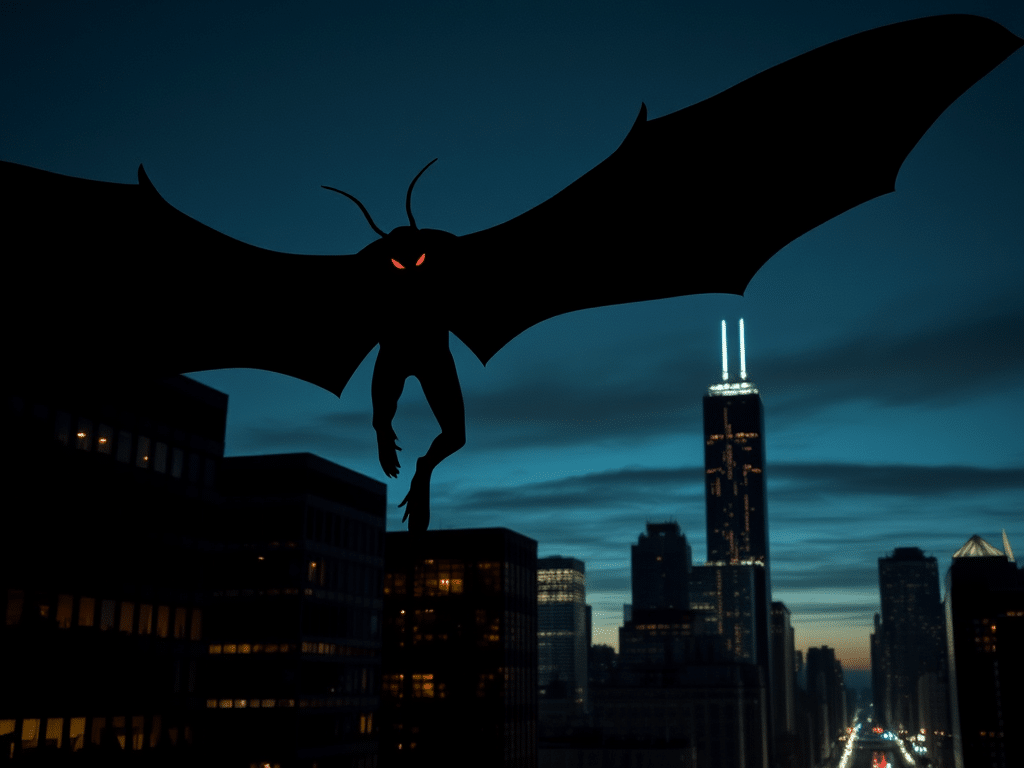
Mothman in Chicago: Key Points
-
The Mothman legend originated in Point Pleasant, West Virginia, in 1966-1967, featuring a winged humanoid with glowing red eyes that became associated with the deadly Silver Bridge collapse.
-
Chicago became an unexpected Mothman hotspot in 2017, with over fifty sightings of winged humanoids reported throughout the metropolitan area near waterways and neighborhoods.
-
The creature is described as six to ten feet tall with enormous wings, glowing red eyes, and the ability to fly at highway speeds while typically observing rather than attacking humans.
-
Similar winged humanoid sightings have been reported worldwide, including before the Chernobyl disaster and in cities across America, Japan, Brazil, and Europe.
-
Theories range from misidentified large birds like sandhill cranes to psychological phenomena, undiscovered species, or more speculative supernatural and extraterrestrial explanations.
-
The phenomenon’s consistency across different times and places continues to challenge easy explanation, maintaining cultural fascination with the unknown despite modern technology.

Introduction
The Mothman tale is one of America’s longest-running cryptozoological mysteries. It has captivated people for decades with its mix of supernatural horror and strange events that no one can explain. In the 1960s, several sightings of the creature in Point Pleasant, West Virginia, first made it famous. However, recently, there have been a surprising number of reports of sightings in Chicago, Illinois, making the Windy City an unexpected hotspot for this mysterious being. These new reports have started new arguments about what the Mothman is and why it exists. They have made both believers and skeptics think about what else might be hiding in the shadows of cities across America.
The figure gained fame in the 1960s after numerous sightings in Point Pleasant. This resulted in the collapse of the Silver Bridge in 1967, which some believed had a connection to the figure (DeMello, 2024). Folklore can shape community stories, creating both shared myths and unique identities. The connection between a local tale and a real-life tragedy demonstrates the potential for such interactions. In the field of cryptozoology, the Mothman is known as a monster that looks like a human-sized moth but has huge wings and glowing red eyes. According to DeMello (2024), books like Bigfoot to Mothman show how the creature fits in with other cryptids and how it is used in cultural mythologies. It’s captivating because it’s a mix of fear and curiosity, showing how complicated the relationship between people and the unknown is.
In November 1966, two young couples driving near an empty TNT plant outside of Point Pleasant said they saw a big, gray creature with bright red eyes and huge wings. This was the start of the Mothman legend. Over the next thirteen months, dozens of witnesses came forward to talk about their encounters with the strange being after the first sighting. The saddest part of the event happened on December 15, 1967, during rush hour, when the Silver Bridge between Point Pleasant and Ohio fell, killing 46 people. Many people in the area thought that the Mothman reports were related to this disaster and saw the creature as either a sign of terrible things to come or somehow to blame for the disaster itself. This link to tragedy and disaster became a central part of the Mothman legend, turning it from a simple sighting of a cryptid into a sign of coming disaster. The story became more well-known after John Keel’s 1975 book The Mothman Prophecies and the 2002 movie based on it. These events solidified the creature’s place in American myth.
Physical Characteristics and Behavioral Patterns
Physical descriptions of the Mothman have stayed remarkably constant across different sightings and times. This suggests that the creature is either a real thing or a deeply rooted cultural myth. A humanoid-shaped being that witnesses say is between six and seven feet tall is what most of them describe. However, some reports say it is ten feet or taller. One of the most recognizable things about the creature is its bright, big red eyes, which witnesses often describe as hypnotic or scary, able to make people feel scared and unable to move. The creature is said to have huge wings that can fold against its body when it’s not flying. The length is said to be between ten and fifteen feet. In contrast to normal birds, the Mothman is usually described as being gray or brown, and some witnesses say it feels like moth fur or rubbery skin. Notably, most reports say that the creature doesn’t seem to have a clear head. It has an unsettling, almost extraterrestrial appearance instead, with its glowing eyes positioned where the neck and shoulders meet.
The Mothman is thought to be a creature that likes to watch others more than attack, but its presence always makes people scared. Witnesses often say that the creature follows or paces vehicles going fast, sometimes over 70 miles per hour without any obvious problems. This suggests that it has amazing flying skills. The Mothman usually shows up at night and is most often seen in industrial areas, near bridges, abandoned buildings, or bodies of water. It likes places that are just on the edge of human society. When the creature is challenged or approached, it usually runs away instead of attacking, but its presence and penetrating gaze seem to be enough to make people feel uncomfortable. Some reports say the creature makes a sound that sounds like a high-pitched squeal or a low humming noise, but these sounds aren’t always consistent with visual descriptions. Some researchers are wondering if the thing has supernatural powers beyond just being able to fly because it seems to be able to appear and leave without warning.

The Chicago Mothman Phenomenon and Urban Folklore
In the spring and summer of 2017, many people in the Chicago metropolitan area reported seeing a large, winged humanoid creature. This was the start of Chicago’s surprising rise as a Mothman hotspot. Reports of sightings in Chicago came from all over the city, not just Point Pleasant. They came from popular spots like O’Hare International Airport, the shoreline of Lake Michigan, the Chicago River, and different neighborhoods from the Near North Side to the suburbs (Holliday, 2025). In April 2017, a witness said they saw a huge winged creature with glowing red eyes near the Adler Planetarium. They said it was “at least seven feet tall” and moving at “incredible speed.” That year, the Mutual UFO Network (MUFON) and paranormal investigator Lon Strickler recorded over fifty reports of winged humanoid sightings in the Chicago area, which was a higher number than ever before and was compared to the original Point Pleasant flap. Witnesses included both single people and groups of several people. Some sightings happened during the day, which went against the creature’s reputation for being active at night. According to Pfeifle (2025), many witnesses in Chicago said they felt overwhelming fear and had nightmares or worry after seeing the Mothman. This sentiment is similar to what other witnesses said about their mental health.
The reports in Chicago showed some intriguing patterns that were similar to and different from normal Mothman sightings. These patterns gave the phenomenon more depth. A lot of the reports came from places near big amounts of water, like the shores of Lake Michigan and the Chicago River. This evidence suggests that the creature might like being near water. Several people reported seeing the creature sitting on top of radios or tall buildings, and at times, it would spread its huge wings before taking off, resembling a large bird of prey surveying its surroundings. Some Chicago sightings were during the day, so witnesses learned more about the creature’s appearance, but they still couldn’t identify it. In Point Pleasant, sightings happened before a specific disaster. In Chicago, on the other hand, sightings didn’t happen before a disaster, though some experts have tried to connect them to different tragedies and accidents in the area. Sightings slowly stopped after 2017, but they continued on and off in the years that followed, with reports still coming in from time to time from the greater Chicago metropolitan area (Estep & Wayland, 2025).
In Chicago, the Mothman has become part of a larger group of urban tales. There are many ghost stories and myths in the city, including the famous story of Resurrection Mary, which is an example of urban folklore with themes of loss and memory (Hołda, 2025). These stories and myths often reflect societal worries and cultural changes. The Mothman’s appearance in Chicago is an example of how a rural tale has been reinterpreted in a city setting, making the supernatural fit into modern city life. Scholars like Ramrez (2023) link Mothman stories to white colonialism and the Midwest’s haunted landscape. This phenomenon is especially important because cities are often a patchwork of different cultural stories that overlap. The Mothman isn’t just a single legend; it’s a bigger comment on how settler-centered stories push Indigenous stories to the background.
Global Sightings and Theoretical Explanations
In addition to Point Pleasant and Chicago, reports of Mothman and other winged humanoid creatures have been made all over the world. This suggests that either this is a widespread phenomenon or people tend to think of unknown flying entities in the same way (Estep & Wayland, 2025). People in Chernobyl, Ukraine, said they saw a “Black Bird” or “Black Angel” in the days before the terrible nuclear accident in 1986. This is a clear connection to the fall of the bridge in Point Pleasant. Russia and Eastern Europe have been reporting similar creatures for decades. Some experts think they are related to Slavic myths about beings who can see the future. In 2018, reports of sightings in other American towns seemed to be similar to those in Chicago. People in Los Angeles, Houston, and Detroit all said they had seen large, winged beings with glowing eyes. Reports have come in from all over the world, including Japan, England, Mexico, and Brazil. People in each culture have used their myths and folklore to explain the sightings. Some researchers have found similarities between tales of the Mothman and older stories about flying people, such as the “Orang Bati” from Malaysia, the “Owlman” from Cornwall, and different stories about “bat-people” from different indigenous traditions. These reports from around the world make me wonder if people are seeing the same kind of thing, if they are misidentifying known animals in strange situations, or if they are tapping into a common psychic archetype that shows up in different cultures.
There are many different theories trying to explain the Mothman phenomenon. These theories range from the everyday to the supernatural, and each one interprets the evidence in a different way. The most skeptical explanations say that known big birds were mistakenly identified. Sandhill cranes are often suggested as a possibility because of their huge wingspan, height when standing, and the way light can reflect off their eyes. Other researchers have said that barn owls, great horned owls, or even very big herons might be responsible for some sightings, especially when seen in low light or other unusual situations that could change how people see things. More unusual biological ideas talk about an unknown species of large bird or bat, possibly a living fossil from a long time ago or an animal that hasn’t been found yet and has managed to avoid being recorded by scientists. Psychological reasons include mass hysteria, suggestion, and the power of expectation to change how people see things. They point out that initial reports can lead later witnesses to perceive unclear things similarly. Some researchers think that witnesses may be having hallucinations because of infrasound, electromagnetic fields, or other things in the surroundings that could affect the brain in ways that make illusions happen over and over again. Some theories about the Mothman go into supernatural or extraterrestrial territory. They say that it could be a being from another dimension, an alien-made biological robot, a tulpa or thought-form that takes shape through belief, or even a modern version of ancient gods or demons.
The discussion surrounding the Mothman and similar monsters raises significant questions about cultural history and the portrayal of Indigenous identities. Ramrez’s (2023) work views “paranormal heritage” as a contemporary concept that frequently overlooks or oversimplifies Indigenous stories and experiences. Instead of being considered holy histories, these stories are often taken over by settler groups or watered down to make them more interesting. This takes away their meaning and makes Indigenous Peoples seem like characters in settler stories. Cities like Chicago, where modern urban legends such as Mothman sightings can obscure the true histories and presences of Indigenous people, particularly resonate with this criticism. This analysis forces us to rethink how these kinds of legends are told and understood, effectively creating a place for Indigenous recognition while criticizing the dominant stories that downplay or ignore these points of view.
Looking at reports of Mothman sightings shows a few recurring patterns that make it harder to just brush off as a coincidence and also make it harder to accept that the creature is biological. The striking similarity in physical descriptions across different times, places, and cultures suggests that these descriptions are not just made up. They could also be a sign of a shared cultural template based on media coverage and tradition. It’s still not clear from a statistical perspective whether the link between sightings and disasters that followed is important or just a case of confirmation bias and selective memory. Investigators have noticed that many witnesses seem to have been seriously traumatized by what they saw, showing signs of mental distress that don’t seem to fit with a simple bird misidentification. However, some critics say the phenomenon could be because of culturally conditioned fear reactions. Biologically, the claimed physical abilities of the creature, particularly its ability to fly at highway speeds and perform aerial maneuvers beyond the capabilities of known birds, are difficult to accept. However, multiple independent witnesses have reported these abilities. Modern technology and the widespread use of cameras have not produced definitive photographic evidence of the creature. Skeptics say that this lack of evidence undermines claims of frequent sightings, while believers say that the lack of clear images could be due to the creature’s nocturnal habits and apparent fear of humans.
Conclusion
Researchers, doubters, and believers are all still interested in the Mothman phenomenon, especially its most recent appearance in Chicago. It represents our fears about the unknown and the unexplained. People’s fears and interests in animals that blur the lines between the natural and supernatural are stirred up by sightings of what might be misidentified wildlife, psychological phenomena, new species, or something truly supernatural. Reports of sightings in Chicago demonstrate that the Mothman tale persists, adapting to new cities and modern situations while maintaining its fundamental elements of fear and mystery. As we track and study our world more thoroughly, mysterious events like these continue to occur. They say some mysteries are hard to explain, and they make us think that the limits of what we know might not be as solid as we think. The Mothman is more than just a mystery animal. It’s also a cultural phenomenon that shows how we deal with things we can’t explain, how we balance belief and skepticism, and how we keep room for wonder in a time of scientific rationalism.
References
DeMello, M. (2024). Bigfoot to Mothman: A global encyclopedia of legendary beasts and monsters. Bloomsbury Academic. https://doi.org/10.5040/9798216170877
Estep, R., & Wayland, T. (2025). Mothman: Sightings and Investigations of the Iconic Flying Cryptid. Llewellyn Worldwide.
Hasken, E. A. (2022). The Migration of a Local Legend: The Case of Mothman. Indiana University.
Hołda, R. (2025). Kto straszy w Chicago? O duchach i klasycznych legendach miejskich [Who haunts in Chicago? On ghosts and classic urban legends]. In M. Banaszkiewicz, K. Golemo, A. Duda, F. Czech, & M. Banaś (Eds.), Peregrynacje międzykulturowe: Księga jubileuszowa dedykowana prof. Tadeuszowi Palecznemu (pp. 373–389). Księgarnia Akademicka Publishing. https://doi.org/10.12797/9788383683003.24
Holliday, D. (2025, November 3). Hundreds report seeing ‘Mothman’ across Illinois—See the map. 100.9 The Eagle. https://101theeagle.com/illinois-mothman-sightings/
Pfeifle, T. (2025, October 16). Chicago Mothman. Astonishing Legends. https://astonishinglegends.com/astonishing-legends/2025/10/15/chicago-mothman
Ramírez, P. (2023). Building Silver Bridges: Paranormal Apparitions, Settler Heritage, and Indigenous Erasure in the Ohio River Valley. American Indian Culture and Research Journal, 46(2). https://doi.org/10.17953/aicrj.46.2.ramirez




Leave a Reply