Treants: Key Points
-
Treants are massive, tree-like beings in fantasy literature that serve as ancient guardians of forests, possessing both the physical characteristics of trees and humanoid intelligence.
-
Treants, patient and peaceful protectors of woodlands, possess the ability to animate and control other trees, transforming into formidable defenders when their forests face threats.
-
J.R.R. Tolkien’s Ents in The Lord of the Rings established the archetypal portrayal of treants, with their march on Isengard becoming an iconic moment in fantasy literature.
-
Treants symbolize ecological consciousness and represent nature’s voice in environmental narratives, embodying the “Green Man” archetype and critiquing modern society’s emphasis on speed over wisdom.
-
In games like Dungeons & Dragons and films like Peter Jackson’s The Lord of the Rings, treants have become iconic figures that challenge audiences to consider their relationship with nature.
-
Treants have become symbols for environmental activism and conservation efforts, reflecting humanity’s fascination with the idea that nature possesses its consciousness and agency.

Introduction
Treants are some of the most interesting creatures in fantasy books and role-playing games. They show how deeply connected the natural world is to conscious beings. Many stories about these huge, tree-like beings show them as ancient forest guardians who have the bodies of trees and the intelligence and wisdom of long-lived humanoid animals. In fantasy stories, their presence is a strong reminder of nature’s power, calm, and ability to both help plants grow and destroy enemies when they feel threatened. For decades, readers and players have been fascinated by the idea of treants. They have become an iconic part of fantasy worldbuilding that shows how complicated our relationship with nature is.
Tolkien’s Ents: The Foundation of Tree-Being Mythology
One of J. R. R. Tolkien’s most famous and unique creations is the Ents, who are old beings that look like trees and watch over the forests of Middle-earth. These creatures, which are sometimes called “treants” in pop culture and other fantasy traditions, are one of Tolkien’s most original and philosophically rich additions to the fantasy genre. They were not made by chance; Tolkien’s extensive training in philology, his interest in medieval sources, his personal love of trees, and his larger project of building an English mythology led to their creation (Spracklen, 2018; Cohen, 2009).
Scholars have always said that Tolkien’s interest in trees wasn’t just a plot device but a real personal interest of his. Cohen pointed out that there is no doubt that J. R. R. Tolkien was interested in, knew a lot about, and cared about trees. Many scholars say that Tolkien’s love of the environment may have helped to shape a bigger moral code, but it was also just one of his many interests. Like literature, family, and tasty beer, trees were a big part of Tolkien’s life. They were especially important when he was writing The Lord of the Rings (Cohen, 2009). His close bond with trees was both personal and artistic, influencing all his work.
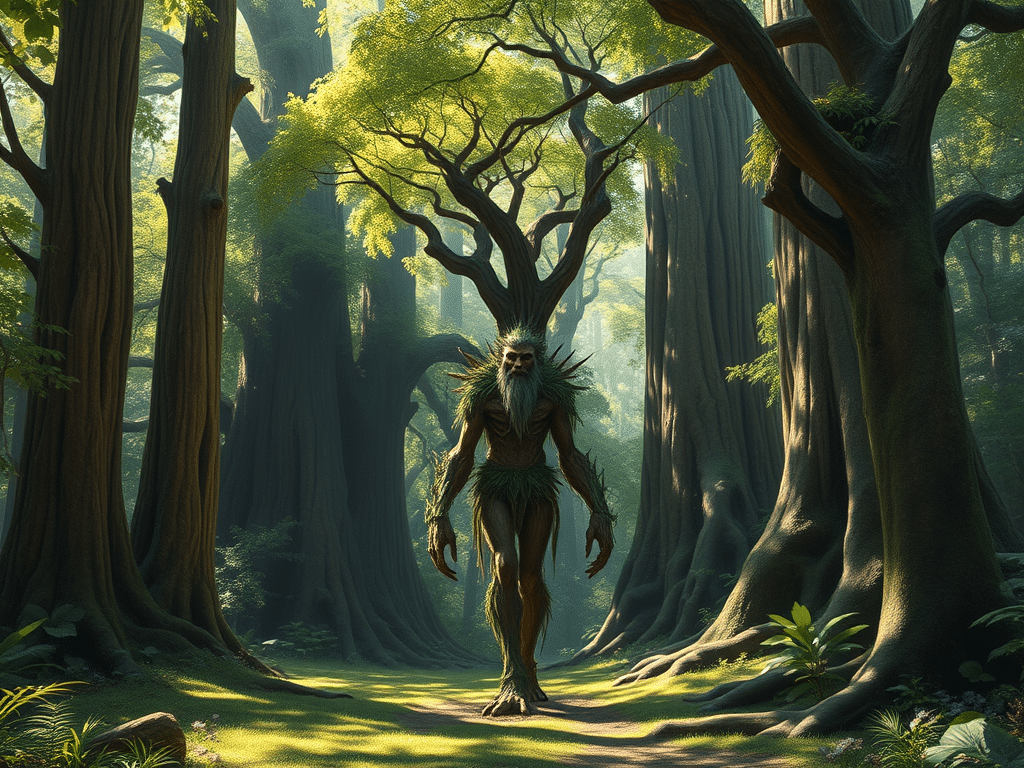
Treants are usually shown as huge creatures that look a lot like the trees they guard, with skin that looks like bark, arms that look like branches, and feet that are made of roots. They look different based on what kind of tree they are, from twisted oaks to tall pines. Their trunk-like bodies often have facial features subtly carved into them, and their eyes shine with ancient wisdom. These monsters can be anywhere from fifteen to thirty feet tall, and even though they are strong, they move slowly and deliberately, which shows how patient they are. Some accounts say that they have moss, lichens, and even small plants growing on their bodies, which makes it even harder to tell the difference between a living organism and a living ecosystem. People often say that their voices are deep, resonant, and creaky, like wind through trees or old wood groaning under stress.
Treants act in a way that shows they are the guardians and shepherds of woods, showing a strong bond with all the plants that live in their territory. Most of the time, they are in a state of sleep or reflection, where they are completely still and can’t be told apart from normal trees. They only move when their forest is in danger or when they want to talk to other beings. Treants are usually calm and peaceful, and they like living alone in the woods where things grow slowly and quietly. But when they have to defend their area against people who want to hurt the forest by cutting down trees, starting fires, or doing other harmful things, they can be very tough opponents. They can bring other trees to life and direct them, telling them to trap enemies or make living wood barriers that can’t be crossed. Whenever they get together, their social structure is usually open and not very formal. The oldest and biggest treants are often the ones in charge because they have the most experience and knowledge.
In J.R.R. Tolkien’s The Lord of the Rings, treants make their most important literary appearance. Tolkien called them Ents, a name that comes from Old English and was used in later fiction works to describe tree-beings. Treebeard is the oldest Ent in Middle-earth. He is the perfect example of a treant because of his ancient wisdom, slow speech, and final rising to action when Saruman’s destruction of Fangorn Forest becomes intolerable. Tolkien’s Ents have their language called Entish. Entish is said to be very long and thoughtful, requiring a significant amount of time to express anything important. This scene perfectly shows how patient and thoughtful the Ents are. The Ents’ march on Isengard is one of the most memorable scenes in the trilogy. It demonstrates the immense power nature can unleash when it reaches its limits. In addition to Tolkien’s work, treants have been in many other fantasy books, from Terry Brooks’ Shannara series to different Dungeons & Dragons game settings. Each version of the character adds new details to the basic idea of tree-beings protecting natural areas.

Philological and Mythological Roots
Tolkien’s attitude to trees, like all of his other creative work, was tied to his job as a philologist. Cohen (Cohen, 2009) cites Gilliver, Marshall, and Weiner to assert the complete and irreversible connection between Tolkien’s writing and philology. This connection may be stronger than that of any other writer or philologist. This means that Tolkien’s tree-beings were not just made up in his head; they were based on his research into language, etymology, and medieval textual customs. This interest in language led to the Ents, their language (Entish), and even their names. This evidence shows that Tolkien thought language and story were naturally linked (Drout, 2004).
According to Tolkien, Anglo-Saxon and Norse myths were more important to him than Celtic ones. Tolkien had a “distaste” for Celtic mythology in general, says Spracklen. He was more interested in Anglo-Saxon mythology and Old English as a language for studying literature (Spracklen, 2018). He was deeply interested in and kept up a relationship with Scandinavian and Germanic mythology. As Spencer pointed out, Tolkien and Gollancz both saw Scandinavian and Germanic mythology as essential to their imaginations (Spencer, 2017). The Norse world-tree Yggdrasil is a cosmic ash tree that stands at the center of the Norse universe. It’s one of the most potent tree symbols in Tolkien’s myths, and its influence is felt in how people treat trees in Middle-earth.
The works by Tolkien have a lot about Ents. They are some of the most theoretically complicated characters in The Lord of the Rings. They are so old that it’s hard to believe. They are slow to talk and act, but when they get riled up, they can be very powerful. The fact that they move slowly makes a literary and philosophical point: in a story driven by urgency and the threat of annihilation, the Ents show a different way of thinking about time and awareness. Cohen’s in-depth look at the trees in The Lord of the Rings shows that Tolkien worked hard to make his tree-beings different from other characters in literature. Tolkien’s Ents are not simply people who have grown trees, unlike the talking trees in The Chronicles of Narnia, which C. S. Lewis describes as “huge people, yet still like trees” (Cohen, 2009). They have a language, a past, and a way of connecting with the world that is uniquely based on trees.
The Ents’ final march on Isengard is one of the most famous scenes in The Lord of the Rings, and it has been seen by many as a metaphor for the environment. Schnurbein says that “plants and trees in particular are shown as animated” in Tolkien’s work. This imagery is what led scholars like Patrick Curry to say that “the religious ideas at the base of The Lord of the Rings are a kind of nature religion modified by Christianity” (Schnurbein, 2016). The Ents’ destruction of Saruman’s industrial fortress, Isengard, serves as a mythical illustration of nature’s reaction to industrial pollution, a theme that resonated with environmental concerns during the 20th century (Schnurbein, 2016; Cohen, 2009).
Theoretical Interpretations and Cultural Significance
Many theories and analyses have explored the meaning of treants in fantasy writing and their relationship to culture in general. Literary critics and people who study the environment often see treants as symbols of ecological awareness, speaking for nature in stories that look at how people interact with the environment and what happens when we damage it. From a psychological perspective, treants can be considered representations of the “Green Man” archetype that can be found in many cultures. This connects them to old pagan beliefs about nature spirits and the animistic view that all living things have awareness. Some analysts say that treants’ deliberate, slow behavior is a criticism of modern society’s fixation on speed and instant gratification, providing an alternative that values patience, long-term thinking, and the knowledge that comes from living a long life. The fact that treants can both guard and destroy indicates the dual nature of the natural world, which can support life while also having the power to take back what people have built.
Treants have a big effect on fantasy literature and pop culture, even when they don’t show up in stories directly. They change the way writers and readers think about the relationship between people and nature. Treants are a common enemy in role-playing games like Dungeons & Dragons. They make players think about how their characters interact with nature and what happens when they do things in wild places. The way treants look has inspired many artists, filmmakers, and game designers. For example, Treebeard and the Ents in Peter Jackson’s movie version of The Lord of the Rings set a new bar for how these creatures are shown in modern media.
Environmentalists and teachers use the idea of treants as a metaphor for conservation efforts. They use the image of the forest guardian to push for the protection of old-growth forests and ecosystems that are in danger of disappearing. People have always been interested in the idea that nature may have its own awareness and agency and that it might react to our actions in both amazing and scary ways. This is shown by how popular treants are.
Treants in Dungeons & Dragons and Gaming Culture
Dungeons & Dragons (D&D) was created by Gary Gygax and Dave Arneson and released for the first time in 1974 (Cooper et al., 2024). Players create characters and explore a shared imaginary world that is controlled by rules, dice rolls, and the leader of the story, called a Dungeon Master (DM) (Bean & Connell, 2023). One of the things that makes this game unique is its large collection of monsters and other animals, which is listed in the Monster Manual (Stang & Trammell, 2019). The treant is one of the most famous and environmentally themed monsters in the D&D canon. It shows how fantasy world-building, ecological thought, and the game’s roots in classic fantasy literature all come together. The sources we have access to don’t give a complete and scholarly look at treants, but they do give us a good idea of how to understand them in the bigger picture of D&D’s monster design philosophy, bestiary mechanics, fantasy aesthetics, and the game’s cultural history.
A lot of the monsters in D&D come from the sword-and-sorcery and high fantasy books that Gygax and Arneson read as kids (Sich, 2012). Many people believe that the treant was based on the Ents from J.R.R. Tolkien’s The Lord of the Rings. The Ents are ancient, walking trees that serve as forest guardians. It fits with D&D’s larger debt to fantasy literature, since the game was based on the same imaginative tradition that includes Tolkien, Robert E. Howard, and Michael Moorcock (Sich, 2012). The people who helped make the game used these sources to fill their made-up worlds with typical fantasy characters and animals (Gillespie & Crouse, 2012).
This fact is part of a larger trend called “fantasy realism,” which uses well-known fantasy media to build the world of the game (Berge, 2023) and includes Tolkien’s creatures. Treants, as Tolkien-derived creatures, exemplify this process of fantasy realism: they are recognizable to players familiar with the literary tradition, and their presence in the Monster Manual reinforces D&D’s position within that tradition (Berge, 2023).
Conclusion
Treants aren’t just silly fantasy creatures; they’re deep questions about awareness, the environment, and where people fit in the natural world. From their roots in folklore and Tolkien’s definitive shaping to their current status as famous fantasy beings, treants continue to change, but they still have the same core identity as old, wise, and powerful forest guardians. Their appearance in fairy stories is both a warning and an inspiration, as it reminds readers that nature has its will and will eventually react to how people treat it, even if it is patient and often quiet. Environmental issues are becoming more and more important to people around the world. The symbolic power of treants as nature’s voice and protectors of the wild is likely to keep them intriguing and relevant for many years to come.
References
Bean, A., & Connell, M. (2023). The rise of the use of TTRPGs and RPGs in therapeutic endeavors. Journal of Psychology and Psychotherapy Research, 10, 1-12. https://doi.org/10.12974/2313-1047.2023.10.01
Berge, P. (2023). The table and the tomb: Positioning trans power and play amid fantasy realism in Dungeons & Dragons. Games and Culture, 20(3), 335-354. https://doi.org/10.1177/15554120231204145
Cohen, C. (2009). The unique representation of trees in The Lord of the Rings. Tolkien Studies, 6(1), 91-125. https://doi.org/10.1353/tks.0.0041
Cooper, R., Chowdhury, M., Donaldson, J., & Mitchell, J. (2024). Dungeons & Dragons in the literature classroom. International Journal of Designs for Learning, 15(2), 92-102. https://doi.org/10.14434/ijdl.v15i2.36322
Drout, M. (2004). The problem of transformation: The use of medieval sources in fantasy literature. Literature Compass, 1(1). https://doi.org/10.1111/j.1741-4113.2004.00101.x
Gillespie, G., & Crouse, D. (2012). There and back again. Games and Culture, 7(6), 441-470. https://doi.org/10.1177/1555412012465004
Lewis, C. S. (1994). The chronicles of Narnia. Harper Collins.
Maley, C., & Seyedi, S. (2022). The life history theory of The Lord of the Rings: A randomized controlled trial of using fact versus fiction to teach life history theory. Evolution: Education and Outreach, 15(1). https://doi.org/10.1186/s12052-022-00160-8
Schnurbein, S. (2016). Germanic Neopaganism – A Nordic art-religion? In Norse revival: Transformations of Germanic neopaganism (pp. 298-350). Brill. https://doi.org/10.1163/9789004309517_011
Sich, D. (2012). Dungeons and downloads: Collecting tabletop fantasy role-playing games in the age of downloadable PDFs. Collection Building, 31(2), 60-65. https://doi.org/10.1108/01604951211229854
Spencer, H. (2017). The mystical philology of J.R.R. Tolkien and Sir Israel Gollancz: Monsters and critics. Tolkien Studies, 14(1), 9-32. https://doi.org/10.1353/tks.2017.0004
Spracklen, K. (2018). Leisure, popular culture and memory: The invention of Dark Age Britain, Wales, England, and Middle-Earth in the songs of Led Zeppelin. International Journal of the Sociology of Leisure, 1(2), 139-152. https://doi.org/10.1007/s41978-018-0009-7
Stang, S., & Trammell, A. (2019). The ludic bestiary: Misogynistic tropes of female monstrosity in Dungeons & Dragons. Games and Culture, 15(6), 730-747. https://doi.org/10.1177/1555412019850059
Tolkien, J. R. R. (1954-1955). The Lord of the Rings. George Allen & Unwin.
Leave a Reply