Fire Giants: Key Points
-
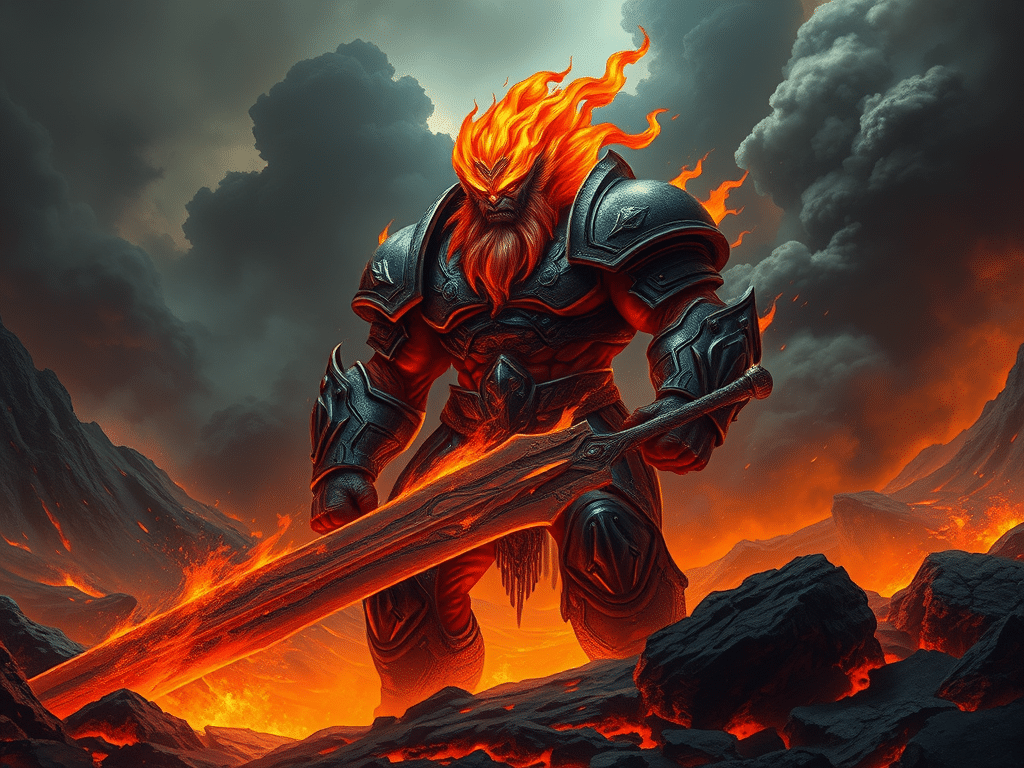
Fire giants are twelve- to eighteen-foot-tall humanoids with glowing coal-black to red skin who radiate dangerous heat and wield massive weapons.
-
Fire giant societies are strict military hierarchies valuing combat prowess and craftsmanship, often enslaving weaker beings.
-
Fire giants view frost giants as enemies, despise hill giants, and grudgingly respect storm giants at the top of the giant social order.
-
In Norse mythology, fire giant Surtr will set the world ablaze during Ragnarök, embodying primordial destruction.
-
In Dungeons & Dragons, fire giants are powerful opponents who combine tactical intelligence with strength and inhabit volcanic fortresses.
-
Fire giants symbolize volcanic forces, unchecked ambition, and the dual nature of fire as a creative tool and destructive force.

Introduction
In mythology and fantasy literature, fire giants are some of the most frightening and intimidating creatures. They represent the destructive power of fire mixed with immense physical strength and martial skill. For thousands of years, these huge humanoids have caught people’s imaginations. They were used as world-threatening forces in Norse mythology, and they are still used as tough enemies in modern fantasy games. The fact that they are strong, have a complex society, and are connected to the elements makes them fascinating to study in many different areas of their lives, including their cultural significance, their roles in mythology, and their representation in contemporary media. To understand fire giants, you must consider their appearance, behavior, relationships with other giants, mythological origins, modern interpretations, and the various theories about their role in fantasy worlds.
Physical Characteristics and Appearance
According to Caldwell (2024), fire giants are enormous and frightening-looking. They are usually between 12 and 18 feet tall, with huge, strong bodies made for fighting and working with fire and forge. Their skin can be coal black, dark red, or burnt orange, and it often looks like it glows with heat or shimmers like metal that has been heated. Their hair usually grows in shades of flame, like bright orange, red, or even white-hot yellow. Often, their eyes appear ablaze, and at times, they emit a glow akin to embers or molten metal. Many pictures of them show faces that look like they have been exposed to high heat for a long time and have scars or hardened skin as a result. Fire giants usually wear armor made of blackened steel or rare metals that can withstand high temperatures. They also wield weapons that are so big that they would crush normal people, like huge greatswords, war hammers, and other tools that show off how strong they are. Their bodies give off heat, which makes being close to them uncomfortable or even dangerous for smaller animals. Some stories say that their touch can burn or ignite things that are flammable.
How people translate and understand the word “giant” also affects how people understand fire giants. Studies on translation show that the word “giant” can be used to describe different types of myths. These factors can change how readers understand fire giants in translated fiction stories (Raestad & Worm, 2022). This shows how important audience and editorial choices are when making choices about how to show fire giants in different forms. Giants are a more general term, but fire giants are unique because they are connected to fire. Studies in literature and translation emphasize that giants exist in various shapes and sizes, and the term “giant” can encompass various elemental types. For example, fire giants are known for their heat, volcanic powers, and often beautiful, magma-charged looks.

Social Structure and Behavior
Fire giants act in a way that shows how their society is based on martial arts, craftsmanship, and strict hierarchies that value both strength and skill equally. It is common for these beings to form military societies where rank is won by showing outstanding combat skills and exceptional metalworking or weapon-crafting skills. These societies work like permanent military forces. Fire giants tend to be law-abiding and follow strict rules of behavior and lines of command. However, their laws prioritize their own interests and disregard those they perceive as weak or inferior. They spend a lot of time getting ready for battle, making weapons and armor in their volcanic forges, and planning invasions or raids against nearby lands because they can’t get enough of showing how much better they are at fighting. Even though they have a reputation for being violent, fire giants have brilliant minds that can come up with complicated strategies, plans for buildings, and new ways to work with metal that make weapons and armor of the highest quality. Smaller humanoids are often made to work as slaves in their societies, which shows that the fire giants think it’s their natural right to dominate less powerful beings through strength and skill.
Fire giants are representations of changing elements and can be both good and bad. Their fire allows forgework, metalcraft, and other processes that change economies in fantasy worlds, but it can also threaten ecosystems or cities by spreading out of control. Carrigan and Larkin (2024) say that this dual role is related to the study of fantasy’s imaginative structures and how elemental beings help build worlds and give them meaning. Fire giants are often bad guys or challenges that the main characters have to beat, either by fighting them or working together with other elemental powers. When they are present, they frequently initiate quests, guard holy forges, and safeguard areas vulnerable to volcanic or lava attacks. Studies of dream form and the story functions of mythical beings (Sipos, 2024) and (Carroll & Larkin, 2024) all talk about fire as a force that needs to be understood or tamed.
The way fire giants interact with other types of giants shows how complicated the social structure is within the giant species. Giants can work together or compete with each other based on their shared interests and philosophical differences, such as their views on the use of elemental powers and their roles within the giant hierarchy. Fire giants usually see frost giants as their main foes and enemies because they are from different elemental forces and are competing for power in the giant hierarchy set by the ordning, which is the giant society’s social ranking system. They usually have a mix of respect and dislike for stone giants. They admire their skill but think the stone giants are too passive and alone to be a real threat to their power and resources. Fire giants don’t know how to judge cloud giants because their special powers and high homes make them hard to reach. However, fire giants may be displeased with the cloud giants’ claims of superiority over them in the hierarchy, as they feel that their own strength and military capabilities should grant them a higher status among the giants. Fire giants only slightly respect storm giants because they are so powerful and because storm giants are generally considered the most important people in giant society. However, fire giants may want to change the situation by using their military power. Fire giants look down on hill giants and think they are stupid brutes who shouldn’t be taken seriously as members of giant society. They sometimes enslave them or just chase them away from areas they want, believing that their superior strength and intelligence justify such actions against what they perceive as lesser beings.
Ice giants, storm beings, and rock/earth elementals are different from fire giants. Fire beings are often associated with purification, destructive trials, and forging. On the other hand, ice or water beings can represent stagnation or rebirth through dissolution. It has been said that “anthropocene fantasy” changes the way infrastructure is imagined. Fire giants help with this reimagining by showing both human- and world-scale fires and how they are managed (Carroll & Larkin, 2024)—this reflects modern worries about climate change and how humans are affecting natural disasters, particularly in the context of increasing wildfire occurrences and their devastating impacts on ecosystems and communities.
Mythological Origins and Modern Interpretations
According to legend, especially Norse mythology, the jötnar of Muspelheim are fire giants who are the first destructive forces that will end the world at Ragnarök. In Norse mythology, Surtr is the most famous fire giant. He rules over Muspelheim, the realm of fire that existed before the world was made and will eventually devour it (Ganeri, 2010). Surtr carries a fiery sword. In Norse stories, Surtr and his family of fire giants will come out at the end of the world. Surtr’s job is to kill the god Freyr and set the world on fire, turning everything into ash before a new world rises from the ashes. These mythical fire giants are symbols of chaos and entropy. They show how everything will eventually return to the original flame and how life in the universe works in cycles. In addition to Norse mythology, other cultures have also had giant beings connected to fire and volcanoes, like the Cyclopes in Greek mythology who worked at Hephaestus’ forges. However, these beings are not always considered fire giants in the modern sense of the word, as they may represent different aspects of fire or craftsmanship in their respective mythologies rather than fitting the contemporary archetype of a fire giant, which typically emphasizes their destructive power and dominance over flames.
Fire giants have been reimagined as smart enemies in modern games, especially Dungeons & Dragons. They blend brute strength with tactical intelligence and impressive craftsmanship. Fire giants in D&D are usually a task for mid- to high-level adventuring parties. They have strong combat statistics, such as high armor class, many hit points, and strong melee attacks that can be augmented by the ability to throw boulders at faraway enemies. In the game, fire giants inhabit volcanic areas or reside in large fortresses constructed from obsidian and basalt, and they also maintain their forges and foundries in underground structures near magma flows. According to D&D lore, they have a strict military order and are ranked below cloud and storm giants but above stone, frost, and hill giants. Their behavior makes it clear that they want to prove their worth and move up in the ranks. In many D&D adventures, the main bad guys are fire giant kings or jarls who rule over troops of enslaved creatures and make deals with other evil beings to achieve their goals of dominance and conquest. Fantasy games, ranging from video game RPGs to tabletop wargames, interpret fire giants in similar ways. They can be strong enemies or friends, but at their core, they are still considered skilled warriors and smiths who live in fiery realms.
Theoretical Interpretations and Cultural Significance
There are many ideas and interpretations about what fire giants in fantasy and mythology really mean and what they stand for. These interpretations provide various perspectives on the significance of fire giants in our stories. Some researchers think that fire giants are representations of volcanic activity and the deadly power of geological forces. The fact that they lived in mountains and were linked to magma shows how ancient people felt about volcanoes, which was both fear and awe (Bane, 2016). According to psychological theories, fire giants represent unchecked ambition and the destructive parts of industry and war. This is because they are obsessed with making weapons and showing they are better at fighting, which is similar to how people tend to be militaristic and use technology in violent ways, reflecting a broader commentary on the consequences of human ambition and the potential for destruction in society. As villains in stories, fire giants are great because they are both physically dangerous and well-organized. They are neither mindless monsters nor purely magical threats; instead, they represent a culture that both mirrors and flips human society’s values, showcasing the duality of human progress and destruction, much like the ancient worries about fire as both a tool and a threat. According to environmental readings of fire giant myths, they are linked to ancient worries about how fire could be both a tool for human progress and a destructive force, representing the tension between using natural forces in a controlled way and losing control in a catastrophic way. Some fantasy theorists say that the different kinds of giants, like fire giants, reflect different parts of nature and human nature. For example, fire giants are thought to represent passion, ambition, craftsmanship, and destructive fury at their most extreme and dangerous.
Depending on the work, fire giants can evoke fear, awe, or sorrow. When the story focuses on the scary or beautiful sides of fire, it can have gothic or monster-like undertones (see Gothic themes in fiction discussions) (Mercer, 2010; Myers, 2022). However, the sources show that not all fantasy literature is based on supernatural elements; some may use “fire giants” as metaphors or symbols instead of real creatures, showing that modern fantasy authors have different ideas about what is scary (Mercer, 2010). For example, in some stories, fire giants may stand for human feelings like anger or destruction, which shows how complicated it is to represent them.
Conclusion
In the end, fire giants are one of the most popular and enduring types of fiction characters. They combine elemental violence with advanced technology in ways that keep people interested across all media and times, such as in video games, movies, and literature, where their portrayal often reflects deeper themes of conflict and transformation. Their change from Norse mythological omens of the end of the world to complex bad guys in modern games shows how versatile and popular these huge warriors of flame are. People have always seen fire giants as both scary and intriguing. They can be considered real threats in a fantasy game, as symbols of destructive forces in mythology, or as metaphors for human ambition and militarism. Their appearance in stories evokes thoughts about the strength of natural forces, the risks of uncontrolled martial pride, and the complex relationship between creation and destruction, as illustrated by master smiths crafting weapons for an endless war.
References
Bane, T. (2016). Encyclopedia of giants and humanoids in myth, legend and folklore. McFarland.
Caldwell, S. (2024). Gods and monsters: The myths and legends of ancient worlds. Hachette UK.
Carroll, S., & Larkin, E. (2024). Anthropocene fantasy and infrastructures of exploitation. PMLA, 139(2), 238-251. https://doi.org/10.1632/s0030812924000142
Ganeri, A. (2010). Giants and ogres. The Rosen Publishing Group, Inc.
Mercer, E. (2010). Monstrous identities: Critical realism and gothic fantasy in Maurice Gee’s The Fire-Raiser. The Journal of Commonwealth Literature, 45(1), 23-35. https://doi.org/10.1177/0021989409359548
Myers, C. (2022). “Play with me or I’ll break your arm”: Giant babies, philosophy, and images. Global Studies of Childhood, 12(3), 224-234. https://doi.org/10.1177/20436106221117574
Ræstad, M., & Worm, G. (2022). To English and back again. MTI, 1(1). https://doi.org/10.36399/mti.1.1.33
Sipos, N. (2024). Joseph Rex Young: George R.R. Martin and the fantasy form, New York: Routledge, 2019. PP, 2(1), 155-158. https://doi.org/10.69706/pp.2024.2.1.10

Leave a Reply