Hill Giants: Key Points
-
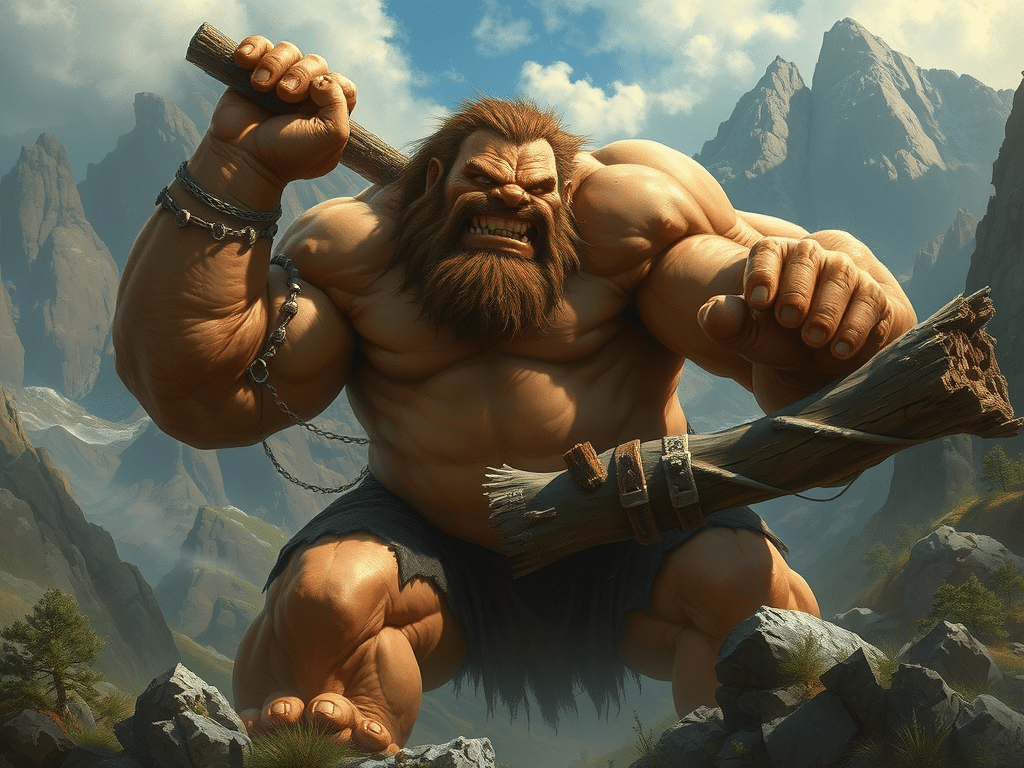
Hill giants are massive humanoids standing twelve to sixteen feet tall with thick, warty skin, immense strength, and crude features reflecting their primitive nature.
-
These giants are driven by insatiable appetites and territorial instincts, living in small clans where the strongest rules through physical dominance.
-
Hill giants occupy the lowest position in giant hierarchies, viewed with contempt by more sophisticated giants, though sometimes serving them as laborers or warriors.
-
Mythological precedents appear in Norse, Celtic, and Greek traditions, featuring primitive wilderness-dwelling giants with savage and often cannibalistic tendencies.
-
In Dungeons & Dragons and modern games, hill giants serve as iconic mid-level encounters, first appearing in original materials and remaining consistent across gaming systems.
-
Theories suggest hill giants represent environmental adaptation, evolutionary stability, hidden intelligence, or degenerate descendants of fallen giant civilizations.
Introduction
Hill giants are some of the most basic and brutish. In both contemporary fantasy games and ancient mythology, they hold a special place. These huge humanoids have fascinated people for generations because they are strong, cunning, and always hungry. Hill giants are less intelligent than their larger relatives, but they are still fascinating and frightening figures in global folklore, literature, and games.
Physical and Cultural Characteristics
Hill giants are part of a larger tradition of huge characters in European folklore and myth. They are often connected to the places they live. In several sources, giants serve as guardians or barriers associated with specific geographies (e.g., hills, mountains, or upland terrains) and cultural perceptions of scale, power, and nature (Заболотська, 2021). This aspect is in accordance with the traditional role of legendary entities in molding readers’ sense of place and danger, as they often embody the fears and values associated with the landscapes they inhabit. Hill giants are part of a series of mythic creatures that anchor fantasy realms in familiar arcana while allowing for imaginative growth (Eason, 2007).
Hill giants are big creatures that usually stand between twelve and sixteen feet tall, but some really big ones can be even taller. Their skin is thick and warty, and it can be tan to reddish brown. It typically looks dirty and worn out because they live in such tough surroundings. These giants have huge, strong bodies, arms that are too long, and hands that are big enough to swing tree trunks like clubs. Their features include heavy brows, flat noses, and mouths full of yellowed, broken teeth. They usually have dirty, matted hair and smell like sweat, dirt, and food that has been left over. Hill giants are quite big and strong, but they are also pretty swift for their size. They can move quickly when they are hungry or angry.
Hill giants are known for their huge appetites and territorial disposition. They spend much of their lives hunting, eating, and protecting the terrain they claim. These animals aren’t very smart; they act on instincts and simplistic logic that puts getting what they want right away ahead of making plans for the future. Hill giants live in loosely organized family groupings or small clans. They usually live in caves, primitive shelters, or old buildings that they take by force. The strongest giant is in charge of their civilization, and anyone who opposes this power faces death. Food is so important to hill giants that they will devour almost anything they can catch, including cattle, wild animals, and even travelers who get too close to their territory.
Hierarchical Positioning Among Giants
When it comes to their relationships with other gigantic species, hill giants occupy the lowest position in the vast social hierarchy. Their more advanced kin often look down on them. Stone giants consider hill giants to be embarrassing family members, while ice giants and fire giants consider them to be uncivilized brutes that hurt the reputation of giant-kind. Cloud giants usually ignore hill giants unless necessary, believing they are the best of all giants. Although they are not very powerful, hill giants sometimes serve more powerful giants as workers or shock troops. In exchange for security and regular food, they give up their strength and loyalty. This subordinate relationship strengthens the idea that hill giants are the most primitive and least developed branch of the giant family tree. However, some scholars say that hill giants just chose a different path of evolution that focused on survival through raw physical strength instead of cultural growth, suggesting that their adaptation may have been a strategic response to their environment rather than a sign of inferiority.
Mythological and Cultural Origins
There are several kinds of hill giants in myths and tales from around the world. In old stories and legends, they often mix with other gigantic traditions. There are beings in Norse mythology that are similar to what we now term hill giants. For example, the more primitive jötnar lived in mountains and untamed locations far from the civilized realms of gods and mortals. Some giants in Celtic traditions who lived in hills and mounds could be considered the ancestors of modern hill giants, who were very strong but not very smart and protected their domains fiercely (Motz, 1985). These mythological examples set the stage for many of the main traits that would later be written down in fantasy books and games. These traits include being connected to wild places, having a lot of physical power, and not being refined or civilized, which makes them different from both humans and more advanced types of giants.
There are also primeval giants in Greek mythology, like the Laestrygonians, who were notorious for being savage and cannibalistic, which is quite similar to how hill giants are shown today. The Laestrygonians are a dramatic challenge that Odysseus faces on his journey home. They are one of the events that test the hero’s leadership, ingenuity, and endurance. In the Homeric epic, these kinds of events help the hero deal with new places and dangers, ultimately shaping their character and reinforcing the themes of the narrative. They also help the epic look at the differences between civilization and barbarism, order and chaos, and the risks of traveling by water. This placement fits in with bigger talks about Greek myth and epic stories, where monsters and people from other countries live in liminal regions that explore the cultural and political fears of the Greek world. Refer to analyses of Greek mythology and the connections among myth, ritual, and epic narrative (Hernández, 2010; Leeming, 2003; Brown, 2019; Hernández, 2010; Leeming, 2003; Brown, 2019).
Most myth encyclopedias don’t focus on the Laestrygonians, but their role as a strong, non-Greek threat in Odyssean geography fits in with other Greek mythological studies that look at how “monstrous others” fill maps of the known world and serve as moral and political foils in epics. Comparative analyses of myth and landscape in Greek mythology reveal how landscapes in myth convey cultural psychology and political significance, a trend evident in the depiction of the Laestrygonians in epic geography (Junker et al., 2012). The Laestrygonians’ cannibalism theme corresponds with classical motifs of punishment, peril, and the boundary between civilization and chaos, a prevalent topic in the analysis of Greek mythology and iconography. The specific ritualistic significance of the Laestrygonians is not extensively analyzed in the selected sources; however, examinations of torture, punishment, and underworld motifs in Greek mythology provide contextual parallels for understanding the symbolic economy of monstrous races and their perilous domains in myth (Painesi, 2014).
Modern Gaming and Cultural Impact
Hill giants have become one of the most famous low- to mid-level giant encounters in modern games, especially Dungeons & Dragons. They are a bridge between smaller humanoid dangers and genuinely legendary huge foes. Hill giants have been in every version of D&D since the first one. They are powerful and have many hit points. They throw rocks as ranged weapons and usually fight groups of adventurers between levels five and nine. The well-known Giant series of adventure modules, especially Steading of the Hill Giant Chief, set many rules for how hill giants act in groups. They showed how rough their society is and how they might interact with other creatures, such as forming alliances with other monstrous beings or engaging in conflict with adventurers who threaten their territory. Other gaming systems and video games have used similar images of hill giants. For example, they show up in World of Warcraft, Skyrim, and many other fantasy role-playing games, where they are tough enemies who require both tactical thought and a lot of firepower to beat. The way hill giants are shown in games has made some parts of their lore more solid, including how dumb they are, how much they appreciate simple things like eating and fighting, and how they tend to live in open places where they may hunt freely.
If hill giants were genuine creatures in a functioning fantasy environment, there would be several theories about what their ecological and evolutionary niche would be. One idea suggests that hill giants are well-suited to tough environments where food is hard to find, as their big appetites drive them to develop good hunting skills, and their large size helps them catch prey that smaller predators can’t. Another perspective says that hill giants are the most stable type of giant since they don’t use magic or elemental powers as their cousins do. Instead, they focus on keeping their physical strength, which works well in every situation, allowing them to thrive in their environments and effectively compete with other predators. Some game designers and fantasy writers think that hill giants might be smarter than they seem. They think other races might dismiss them as dumb until it’s too late. A more sinister myth that comes up in fantasy books is that hill giants are what happens when a gigantic society falls apart. These beings are the degenerate progeny of once-great giant nations that have become barbaric over many centuries.
Conclusion
Hill giants still intrigue people because they show the contradiction between raw force and basic simplicity. They remind us that strength does not always mean sophistication or cultural achievement. In fantasy settings, they provide us a chance to think about the interplay between nature and society, the link between physical might and intelligence, and the complicated hierarchies that exist even among monsters. Hill giants, whether in old mythology, fantasy books, or video games, make people face their weaknesses and show that even the strongest animals can be brought down by smart thinking and working together. As fantasy games and books keep changing, hill giants will probably always be a part of these made-up worlds. They may become more complex in how they are shown, but they will always be huge, hungry, and dangerous creatures that live in wild places where civilization hasn’t yet taken hold.
References
Brown, A. R. (2019). MYTHS AND LANDSCAPES – (G.) Hawes (ed.) Myths on the Map. The Storied Landscapes of Ancient Greece. Pp. xviii + 332, ills, maps. Oxford: Oxford University Press, 2017. Cased, £75, US$105. ISBN: 978-0-19-874477-1. The Classical Review, 69(2), 618-621. https://doi.org/10.1017/s0009840x19000295
Eason, C. (2007). Fabulous creatures, mythical monsters, and animal power symbols. https://doi.org/10.5040/9798400649370
Hernández, P. (2010). Mythology. https://doi.org/10.1093/obo/9780195389661-0036
Junker, K., Künzl-Snodgrass, A., & Snodgrass, A. (2012). Interpreting the images of Greek myths: An introduction. Choice Reviews Online, 50(02), 50-0671-50-0671. https://doi.org/10.5860/choice.50-0671
Leeming, D. (2003). Greek mythology (pp. 39-60). https://doi.org/10.1093/oso/9780195143614.003.0003
Motz, L. (1985). Oðinn and the Giants: A Study in Ethno-Cultural Origins. Mankind Quarterly, 25(4), 387.
Painesi, A. (2014). Objects of Torture in Hades. A Literary and Iconographic Study. Gaia Revue Interdisciplinaire Sur La Grèce Archaïque, 17(1), 157-180. https://doi.org/10.3406/gaia.2014.1628
Paranyuk, D. and Tychinina, A. (2023). Intertextuality of the Personosphere as a Factor of Meta-Genre (Clifford Simak “Shakespeare’s Planet”). Pitannâ Lìteraturoznavstva, (107), 216-237. https://doi.org/10.31861/pytlit2023.107.216
Заболотська, О. (2021). MEANS OF IMAGINARY WORLD FORMATION IN FANTASY TEXTS. South Archive (Philological Sciences), (87), 46-52. https://doi.org/10.32999/ksu2663-2691/2021-87-7

Leave a Reply