Far Darrig in Irish Folklore: Key Points
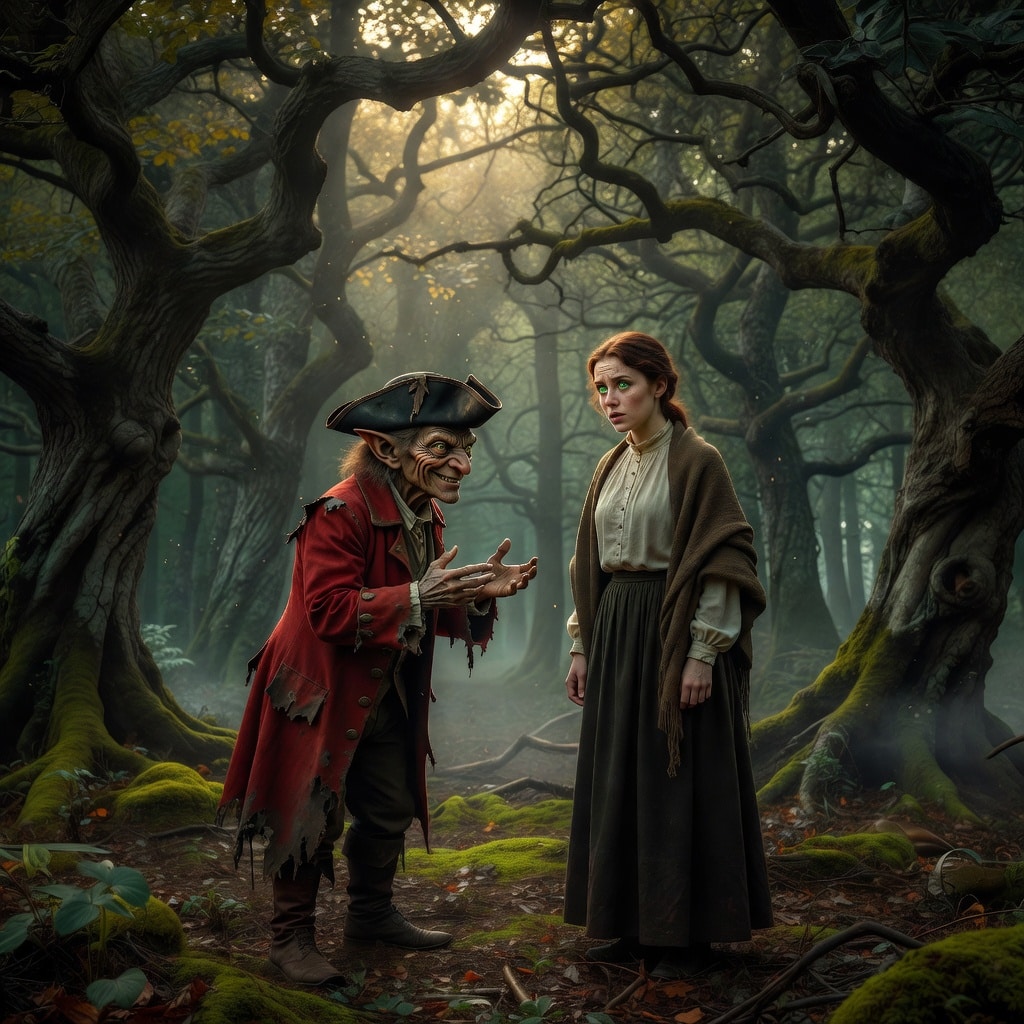
- The Far Darrig, whose name means “Red Man,” is a small, stout, often old figure dressed entirely in red, from his cap to his coat, with an uncanny quality that marks him as clearly nonhuman.
- He is a trickster whose pranks lean toward the macabre, associated with bad dreams and psychological torment, yet he can be appeased or even turned generous through courtesy and hospitality.
- His tales, recorded by collectors like Thomas Crofton Croker, often involve him entering a home on a wild night, demanding strange favors, and carrying victims through gruesome dreamlike scenes that blur reality and nightmare.
- He is a solitary fairy grouped loosely with the leprechaun and clurichaun through their shared red coloring, but his cruel, fear-driven nature sets him apart from these and from the sociable trooping fairies.
- He gave a recognizable face to the fear of nightmares and misfortune while reinforcing the social value of hospitality, serving as both a bogeyman and a moral lesson.
- Scholars variously connect him to diminished pre-Christian deities, to the supernatural symbolism of the color red, and to folk explanations for sleep paralysis, suggesting his origins blend ancient memory, social function, and human psychology.

Introduction
The Far Darrig is one of the strangest and most disturbing characters in the rich fabric of Irish tradition, a single fairy whose name is the English equivalent of the Irish “Red Man.” The Far Darrig, belonging to the solitary rather than the trooping class of fairies, has a curious place in the magical imagination of Ireland. He is a trickster, a practical joker, and sometimes something much darker, a creature whose humor often lapses into brutality. Understanding the Far Darrig requires an understanding of a specific strain of Irish belief, where the distinction between mischief and menace is extremely subtle. This essay analyzes his physical attributes, his conduct, tales about him, his connection with other fairy beings, his position in folklore and suggestions made by researchers to interpret him.
Physical Description
The Far Darrig is most typically characterized as a tiny, stocky humanoid clad entirely in red. His name reflects his red hue, which is evident in all aspects of his appearance. His dress is a red cap, a red coat, sometimes red trousers, and in many stories, even his complexion or hair is rosy. He is often called an elderly man with a sly and wrinkled face. Some legends depict him as chubby and cheerful, others as emaciated and terrible. He is the size of an aged man or giant child, but he is never mistaken for a human for long. There is something wrong with him, an unearthly quality that anybody who meets him can feel immediately. His eyes are often described as brilliant or piercing, and his laughter, when it comes, is rarely a comfort.
The Far Darrig is frequently associated with a fairy figure of Irish folklore, clad in red, who generally appears in local legends and oral tales. The motif of a red-haired or red-dressed supernatural creature is present in various Irish fairy lore anthologies and scholarly discussions of the céilí or sídhe traditions (Dugan, 2008; Dowd, 2018; Bokshan et al., 2019). The character is generally included in the wider pan-Celtic fairy repertory, where the rural world is populated with “elf” or “fairy” figures and incorporated in moral and social life (e.g., warning, mischief, and moral lessons) (Carrasi, 2017).

Behavior and Tales
It is the behavior of the Far Darrig that really makes him. He is a mischief-maker who takes delight in playing jokes on mortals. Unlike some fairies, though, his jokes veer more toward horrific than mild pranks. He likes dark humor, scaring travelers, sending people astray, and nightmares. The truth was that Far Darrig was connected with evil dreams in the old days, and some people thought he could go into the mind of a sleeping man and afflict him with horrible sights. He also has connections with changelings and the disturbing practice of messing with human homes. But for all his ferocity, the Far Darrig was considered to respond favorably to civility. A person who treated him well and was hospitable might let them be or even wish them well. His ambivalence, which encompassed both tormenting and rewarding behaviors, necessitated extreme care in handling him.
In local tradition, figures of the Far Darrig type are agents of mischief or caution, usually in daily landscapes, and they exemplify how society navigates the boundary between the natural and supernatural. This accords with the basic function of fairy beings in Irish folklore as moralized beings rooted in social life and the wider pattern of elf/dart/artefact lore explored in the marine memorates and fairy-legend literature (Dowd, 2018; Bokshan et al., 2019; Fomin, 2011). The stories may differ, but the themes are the same.
This whimsical disposition is in keeping with the tales related to Far Darrig. In a famous story type documented by Irish folklore enthusiasts in the nineteenth century, the Far Darrig visits a home on a wild night and wants to be let in to warm himself at the fire. The worried family, sensing his true nature, dares not refuse him. And then he asks them to do some bizarre favor, like to roast meat for him, and the flesh that he gives them is some kind of hideous or impossible item. The Far Darrig is part of a scary story told by writers like Thomas Crofton Croker and later mentioned by W. B. Yeats, about a man who is taken through the night to see or join in horrifying events, only to be let go with a mysterious instruction to say, “Roast the meat,” or something like that. The stories blur the border between dream and reality, leaving both the character and the listener unsure of what actually transpired. The horror is usually psychic distress, not physical assault; it is a sense of having touched something very wrong.
Relationship with Other Fairies
The Far Darrig is otherwise fair in his dealings with the other fairies. He is one of the solitary fairies, like the leprechaun and the clurichaun, and prefers his own company to that of the large fairy hosts. Some folklorists have even put him with the leprechaun and clurichaun as a sort of trinity of red-capped lonely beings, as all three are linked with the color red in various versions. His fury, however, sets him apart even from the leprechaun and clurichaun. The leprechaun is an artisan and a hoarder of gold; the clurichaun, a drinker who haunts wine cellars; but the Far Darrig is a tormentor whose currency is terror rather than treasure or drink. He does not march with the trooping fairies, the social hosts that ride forth in procession, and he shows little of the courtly elegance that is credited to the Sidhe of the giant mounds. He embodies menace, existing apart, unanswerable to any court, and adhering only to his own dreadful whim.
Folklore Significance and Cultural Context
The appearance of the Far Darrig in folklore can be seen as a manner of giving form to certain concerns. He is the dread of the night, of nightmares, of the unexplainable. In a land where sickness, nightmares, and tragedy had to be accounted for, the Far Darrig was a face put on the forces that seemed to work with a malicious intellect. He also inculcated fundamental social principles, especially the obligation of hospitality. The moral that runs through many of his tales is simple: that to be unpleasant to strangers, especially terrifying ones, may have dire results and that it is better to be kind and generous. Thus, he served the double purpose of a bugbear and a moral instrument, of frightening and instructing. To entertain, to warn, to make sense of a world of invisible perils—that’s his presence in stories spoken around the fire.
There are several ideas as to the origin and significance of the Far Darrig. Some historians link him to earlier pre-Christian gods or natural spirits whose strength waned and darkened as Christianity spread across Ireland, transforming formerly mighty entities into mischievous fairies. Others relate his use of red to blood, death, and the other realm, as red was a color with magical importance in Celtic tradition. The association with nightmares has led some to view him as a folk explanation for sleep paralysis and the frightening experiences that sometimes accompany it, a phenomenon that is recorded in numerous civilizations under different names. There is also the idea that entities like the Far Darrig embody the psychological impulse to externalize fear, to give the chaos of dreams and disaster a familiar shape that may, in theory, be placated or avoided. All these theories are non-exclusive, and the truth probably contains some element of ancient memory, social function, and human psychology.
The Far Darrig lies in a Celtic renaissance and nationalist environment that draws on faerie lore to express Irish identity. Yeats, via his work as collector and editor, made Irish fairy lore a matter of cultural importance and symbolic power, a framing that endures in current research. The literature on Yeats stresses the role of fairies in the formation of national myth, as well as the contradictions between real folklore and its modern reinterpretation (Creed, 2017; Karim, 2012; Ameer, 2010; Carrasi, 2017). A common thread among the texts is the degree to which fairies are considered independent, local actors rather than being reimagined in nationalist or occult terms. Krämer stresses the continued separation in Ireland of the belief in fairies from the demonization of witchcraft, allowing for a relatively independent fairy figure such as Far Darrig. A Yeatsian study, on the other hand, demonstrates the potential for the mobilization of such beings in service of national cultural ambitions. In addition, the maritime literature broadens the range of the fairy figures’ appearances, emphasizing their adaptability as folklore themes in many social circumstances (Krämer, n.d.; Fomin, 2011; Bokshan et al., 2019).
Conclusion
The Far Darrig is still one of the more puzzling characters in the world of Irish fairies, a small red figure with something of cruelty in his laughter. He is a trickster and a menace at once, a lone wanderer who enjoys nasty pranks but rewards the courteous. His oddity of body, his disturbing actions, the scary stories that follow him, and his unique position among fairies made him a container of horror and a teacher of hospitality for centuries of storytellers. Theories attempting to explain the Far Darrig reveal insights into human nature as well as Irish beliefs. Ultimately the Far Darrig survives because he draws on something ageless: that sense of dread that lurks at the edge of slumber and the knowing that not all visitors to the door have friendly intent.
References
Ameer, S. A. (2010). Mythology in W. B. Yeast’s Early Poetry. Kufa Journal of Arts, 1(6), 27–46. https://doi.org/10.36317/kaj/2010/v1.i6.6110
Bokshan, H. I., Ilinska, N. I., Keba, O., Pomohaibo, J. O., Shtepenko, O., & Vysotsky, A. A. (2019). World literature at the intersection of cultures and civilizations. https://doi.org/10.36059/978-966-397-139-1
Carrasi, V. (2017). Between Folk and Lore: Performing, Textualising and (mis)Interpreting the Irish Oral Tradition. Estudios Irlandeses, 2(12), 32–46. https://doi.org/10.24162/ei2017-7554
Creed, D. (2017). W. B. Yeats and Folklore: The Search for an Irish Identity. The Yeats Journal of Korea, 53, 183–210. https://doi.org/10.14354/yjk.2017.53.183
Dowd, M. (2018). Bewitched by an Elf Dart: Fairy Archaeology, Folk Magic and Traditional Medicine in Ireland. Cambridge Archaeological Journal, 28(3), 451–473. https://doi.org/10.1017/s0959774318000124
Dugan, F. M. (2008). Fungi, folkways and fairy tales: mushrooms & mildews in stories, remedies & rituals, from Oberon to the Internet. North American Fungi, 23–72. https://doi.org/10.2509/naf2008.003.0074
Fomin, M. (2011). Maritime Memorates and Contemporary Legends of Storm Apparitions and Storm Making in Folklore Traditions of Ireland and Scotland. Armenian Folia Anglistika, 7(2 (9)), 154–162. https://doi.org/10.46991/afa/2011.7.2.154
Karim, S. (2012). Celtic Tradition: The Guiding Force of William Butler Yeats. Iiuc Studies, 6, 53–64. https://doi.org/10.3329/iiucs.v6i0.12248
Krämer, W. (n.d.). Filid, fairies and faith: The effects of Gaelic culture, religious conflict and the dynamics of dual confessionalisation on the suppression of witchcraft accusations and witch-hunts in early modern Ireland, 1533 – 1670. https://doi.org/10.15368/theses.2010.96
Leave a Reply