Cumberland Dragon: Key Points
- The Cumberland Dragon, also called Goosefoot, is known from just one account published in the Caledonian Mercury on December 4, 1794, describing an encounter in the Cumberland Mountains of what is now East Tennessee.
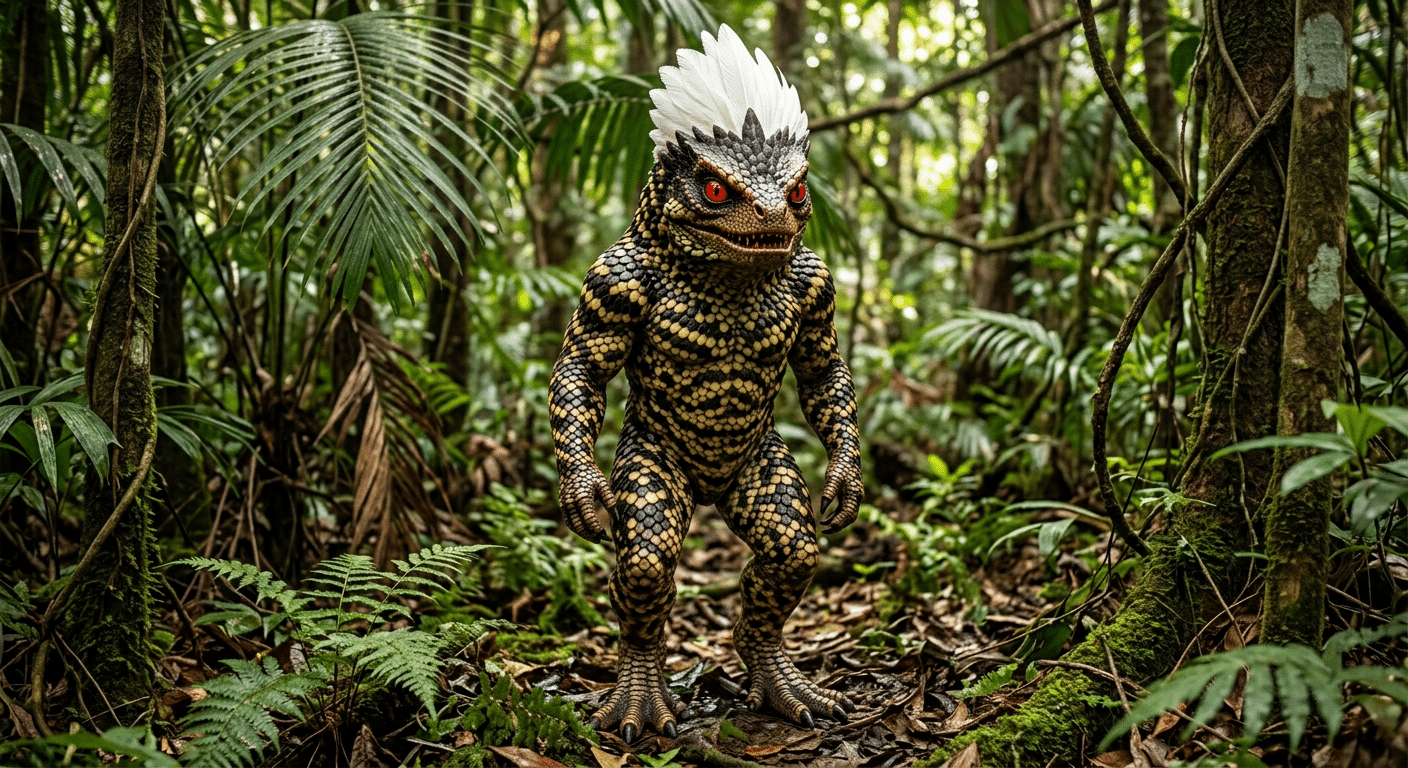
- Witnesses described a roughly four-foot creature standing upright on two legs, covered in black, brown, and light yellow ringed scales, with a white crown atop its head, a large head, and fiery red eyes, and its goose-like tracks gave it the nickname Goosefoot.
- Rather than fleeing, the dragon held its ground in a daring posture, leaped eight feet into the air when struck with a sword, expelled a red blood-like matter from its mouth, and retreated only slowly while turning as if to fight.
- The story closely mirrors Old World dragon traditions brought by British and German settlers, especially the motif of deadly breath, the water-dwelling habits of beasts like the Knucker, and the crowned, lethal form of the cockatrice or basilisk.
- The creature is one of many strange reports from Appalachia, sharing its territory with legends like the Wampus Cat, the Tennessee Cave Creature, the Not Deer, and the giant Allegewi.
- Explanations range from a tall tale or misidentified bird like a heron or crane to a genuine unknown animal, but with no further evidence the case remains unsolved, and the dragon now lives on partly through the trading card game MetaZoo: Cryptid Nation.

Introduction
Among the strangest entries in American cryptid history is a creature that flared into the record just once and then vanished. The Cumberland Dragon, or Goosefoot, as it was sometimes called, is known only from a single newspaper story that appeared in the Caledonian Mercury on December 4, 1794, detailing an encounter in the Cumberland Mountains of what is now East Tennessee. This isn’t a centuries-old beast with a history of sightings or a monster that brings tourists to a lakeside village. It is a one-off, a quirky piece of frontier reporting that has lasted partly because it is so vivid and so weird. But that one account has been sufficient to give the monster a quiet seat in the nation’s roster of unsolved beasts and even a second life on a contemporary playing card. That single narrative implies a lot: it recalls far older traditions of dragons, fits with other weird reports from the same hills, and explains why a monster spotted for three minutes just over two centuries ago still has a spark of intrigue.
The 1794 Newspaper Account
December 4, 1794 The Caledonian Mercury published an article entitled “Curious Animal.” Newspaper text:
In February last, a detachment of mounted infantry, commanded by Captain John Beaird, penetrated fifteen miles into the Cumberland Mountain: On Cove Creek, ensign M’Donald and another man, in advance of the party as spies, they discovered a creature about three steps from them: it had only two legs, and stood almost upright, covered with scales, of a black, brown, and a light yellow colour, in spots like rings, a white tuft or crown on the top of its head, about four feet high, a head as big as a two pound stone, and large eyes of a fiery red. It stood about three minutes in a daring posture (orders being given not to fire a gun except at Indians,) Mr. M’Donald advanced and struck at it with his sword, when it jumped up, at least eight feet, and lit on the same spot of ground, sending forth a red kind of matter out of its mouth resembling blood, and then retreated into a laurel thicket turning round often, as if it intended to fight. The tracks of it resembled that of a goose, but larger. The Indians report, that a creature inhabits that part of the mountain, of the above description, which, by its breath, will kill a man, if he does not instantly immerse himself in water.
The physical description is all taken from that report of ’94 and is extremely precise for such a brief sighting. The monster was nearly four feet high and stood virtually on two legs. The body was covered in black, brown, and light yellow scales, grouped in patches the witness equated to rings. There was a tuft or crown of white on the top of the head and the head was stated to be as big as a stone of two pounds. Most remarkable of all were the eyes, which were described as enormous and a flaming red. The overall impression is of something reptilian and bird-like at the same time, an upright scaled creature capped with a bizarre white plume. Goosefoot was a more lowly detail of the name. The traces it left were like those of a goose but larger.
The conduct depicted in the narrative is as remarkable as the appearance. Scouting ahead of Captain John Beard’s mounted infantry, Ensign McDonald and a colleague found the monster just about three paces away. It did not run away. Instead, it retained a steady position in what the study called a bold posture for about three minutes. When McDonald eventually swung at it with his sword, the animal jumped at least eight feet into the air and landed in the same location. And as it did so, it spewed out of its mouth a red, blood-like stuff. Then it withdrew into a thicket of laurel. Even in retreat, it kept turning back, as if it were meant to fight. This was no timid animal spooked into a run. Something that stood, threatened, and gave ground slowly (Mart & Cabre, 2021).

Frontier Context and Native Testimony
Actually there is only the one sighting, and there is an added element to this worth noting. The soldiers were told to shoot only Indians, so the creature was approached with a knife instead of being shot. That information anchors the story in its frontier moment. The tale also records the secondhand testimony of local Native people, who reportedly say that such a creature inhabited that portion of the mountain and that its breath was capable of killing a man unless he quickly plunged himself into the water. Now whether that was real native tradition or a flourish of the storyteller is impossible to determine. Either way, it puts the Cumberland Dragon within an older regional feeling of the land, a sense that something frightening already lived on those hills.
The dragon as a theme in regional toponyms and folklore can assume multiple shapes in literature and history narratives. A number of references discuss dragon imagery in a wider British and Atlantic setting, and this study helps contextualize the use of “dragon” terminology in Cumberland. For example, a consideration of dragons in medieval and early modern English literature and iconography shows how dragon imagery moves across areas and is embedded in cultural memory (Drake, 1850; Sciacca, 2019; Skene, 1865). Although these sources do not provide evidence for a biological Cumberland dragon, they do show that dragon iconography has traveled in neighboring areas for some time, which can impact local folklore or toponymic linkage.
Echoes of Old World Dragon Lore
What is most telling about the narrative is the way its elements fit so neatly into the dragon legends of the Old World (Lippincott, 1981). Most of the men who brought these legends to Appalachia were of British or German heritage, and they brought their monsters with them. The most obvious connection is the poisonous breath that drives a victim into water. European dragons and serpents are constantly said to poison the air around them, from the venomous wyrms of English folklore to the lindworm of Germanic and Scandinavian tales. The legendary Lambton Worm of County Durham was claimed to poison the earth over which it passed and the Knucker of Sussex lived in a wet hole, very unlike the creek-bound beast of Cumberland (Simpson, 1973). Its erect, scaled, crested shape recalls the cockatrice or basilisk of medieval bestiaries, crowned monsters whose glance or breath was supposed to kill. Like the proud, territorial dragon of European mythology, the creature’s refusal to retreat, turning to face armed men, is also like a beast that guards its ground rather than runs from it. The Cumberland Dragon, seen in this way, appears less an entirely new American animal than a traditional European nightmare repeated against the strange background of the southern mountains.
Appalachian Cryptids and the Creature’s Modern Legacy
The monster does not lie quite alone in its particular territory, for the Cumberland and wider Appalachian highlands have given birth to a lengthy string of unusual accounts. The same environment that produced the 1794 sighting would also become the home of the stories of the Wampus Cat, a terrifying part-feline creature from Cherokee culture and frontier storytelling, reputed to stalk the Tennessee hills (Lancaster, 2024). Cave systems weaving through the limestone of the region spawned reports of the so-called Tennessee Cave Creature, a pale humanoid seen underground (Godfrey, 2020). More recently, the folklore of the area has been populated by the Not-Deer, an animal that appears somewhat like a whitetail but moves and stares in ways that feel profoundly wrong to those who claim to meet it. Even older are the legends of the Allewgewi or Allegewi, a race of giants connected with the deep past of the Appalachian peoples. None of these is the Cumberland Dragon, and there are substantial variations between them, but taken together they demonstrate that this stretch of territory has long been considered to be a region where unexpected and disturbing monsters might arise. The first of them to make the newspaper was the dragon.
Thus, the Cumberland Dragon has a minor but important place in the larger fabric of folklore. It is one of a group of early American monster stories that merge frontier concern with the actual strangeness of the unknown wilderness and that have the unmistakable fingerprints of the European traditions that affected the manner in which the encounter was written down. The creature is at once very local, related to a real watercourse, a real military detachment, and a real portion of the Cumberland range. Its modern afterlife mirrors this dual character. The Cumberland Dragon is a part of the trading card game MetaZoo: Cryptid Nation, bringing the mysterious creature back into the limelight for a new generation that is more familiar with its artwork than its tale.
The mens’ actual sightings range from feasible to impossible, and one anonymous account cannot confirm any of them. Skeptics like to dismiss the whole affair as a tall story, a piece of colorful tabloid fluff of the sort that flourished in the era before fact-checking, perhaps embellished for readers an ocean away in Scotland and decked out in the familiar garb of European dragon lore. Others have speculated that it could be a misidentified animal, perhaps a giant bird like a heron or sandhill crane seen in a scary time, as those creatures are tall and oddly erect and make large tracks. The burning eyes, the scaly body, and the jumping defense don’t match any native species neatly, which is precisely what keeps the cryptozoological reading going for fans. To be honest, the issue is unsolvable without a second sighting, physical evidence, or the ability to question the witnesses. It can only be retold.
Conclusion
Eventually, the Cumberland dragon survives, not due to overwhelming evidence but due to the contrary. It is one weird passage, one phrase frozen in 1794, depicting a four-foot scaled beast with a white crown and blazing eyes who faced armed men and exhaled something lethal. And it is the very thinness of the record that is part of its attractiveness, just enough detail to spark the imagination, not nearly enough to answer the question. Whether a hoax, a mistaken bird, a transplanted European dragon, or something truly inexplicable, the object has outlived those who could confirm or deny it. But such is the curious endurance of folklore. Well over two hundred years later, a creature spotted for three minutes on a Tennessee creek can still be roaming through the woods of the imagination, along with cave dwellers, wrong-eyed deer, and mountain cats.
References
Curious animal. (1794, December 4). Caledonian Mercury.
Drake, W. R. (1850). XVII.—Notes upon the Capture of “The Great Carrack,” in 1592. By William Richard Drake, Esq. F.S.A. Archaeologia, 33(2), 209–240. https://doi.org/10.1017/s0261340900002691
Godfrey, L. S. (2020). I Know what I Saw: Modern-day Encounters with Monsters of New Urban Legend and Ancient Lore. Penguin.
Lancaster, J. (2024). The Little Encyclopedia of Enchanted Woodland Creatures: An A-to-Z Guide to Mythical Beings of the Forest. Running Press Adult.
Lippincott, L. W. (1981). The unnatural history of dragons. Philadelphia Museum of Art Bulletin, 77(334), 3–24.
Mart, T. S., & Cabre, M. (2021). A Guide to Sky Monsters: Thunderbirds, the Jersey Devil, Mothman, and Other Flying Cryptids. Indiana University Press.
MetaZoo Games. (2021). MetaZoo: Cryptid Nation [Trading card game]. MetaZoo Games.
Sciacca, C. D. (2019). Feeding the dragon: The devouring monster in Anglo-Saxon eschatological imagery. Selim Journal of the Spanish Society for Medieval English Language and Literature, 24(1), 53. https://doi.org/10.17811/selim.24.2019.53-104
Simpson, J. (1973). Sussex Local Legends. Folklore, 84(3), 206–223.
Skene, W. F. (1865). Notice of the Site of the Battle of Ardderyd or Arderyth. Proceedings of the Society of Antiquaries of Scotland, 6, 91–98. https://doi.org/10.9750/psas.006.91.98
Leave a Reply