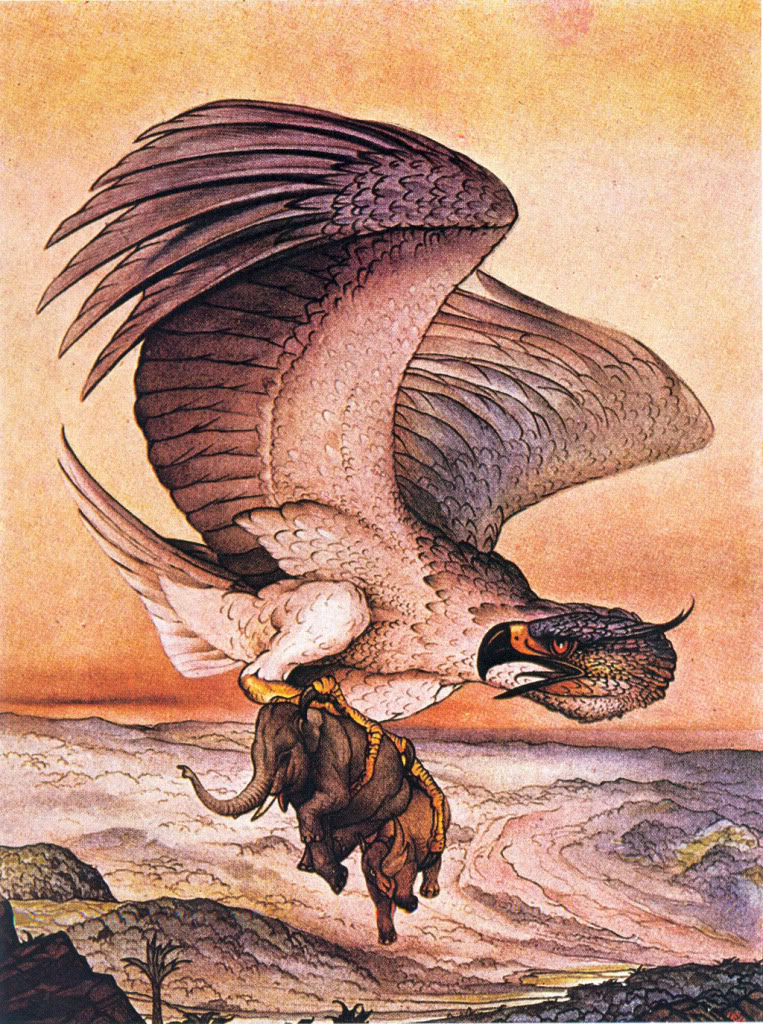
The Roc: Key Points
- The Roc was a bird of enormous size, with a wingspan said to blot out the sun and an eagle-like body featuring powerful talons, a hooked beak, and feathers as large as tree trunks. Its overwhelming defining trait was its impossible scale.
- As a top predator, the Roc was said to snatch up elephants and carry them to its nest, and it fiercely protected its colossal eggs, sometimes dropping boulders on ships that threatened it.
- The Roc is most famous from the tales of Sinbad the Sailor in the One Thousand and One Nights, and it was also reported by the traveler Marco Polo, who placed it near Madagascar.
- The creature symbolized the dangers of the unknown world and the overwhelming power of nature, often serving to test the wit and courage of heroes.
- Explanations for its origin include the real extinct elephant bird of Madagascar, exaggerated sightings of large birds of prey, and the discovery of prehistoric fossils interpreted as giant bird remains.
- The Roc endures as a powerful piece of cultural heritage, reflecting human fears and curiosities and reminding us how legend grows in the space between knowledge and imagination.

Introduction
Few creatures in the annals of folklore loom as enormous in the literal and figurative sense of the word as the Roc. This giant bird of prey has soared through the minds of storytellers for over a thousand years, appearing in stories from the Middle East to the farthest reaches of the Indian Ocean. The Roc is a monster of incredible size and frightening strength, a symbol of our infatuation with the grotesque and the majestic. Knowing the Roc is an exploration of a complex tapestry of mythology, maritime tradition, and the enduring human effort to explain the incomprehensible. This essay will describe the Roc, its physical features, how it behaves, its part in important stories, its place in folklore in general, and the different theories that historians have used to explain the Roc’s beginnings.
Physical Appearance
The roc is always a big bird that may carry away large prey or ships. It is associated with awe, danger and the grandeur of nature. Glossaries of mythic creatures and art-historical materials reiterate the concept of winged, predatory birds with disproportionate sizes, reinforcing a consistent image of the roc across different regions (Elhelw, 2020). Across Mesopotamian iconography, several studies refer to winged deities or monstrous birds, where avian monsters (particularly big birds) indicate meteorological occurrences or divine power, offering a common framework for comprehending roc-like images across the ancient world (Mostafa, 2018).
The Roc was reported to be a bird of enormous size. Ancient and mediaeval legends tell of a beast so immense that its wingspan could eclipse the sun, plunging whole regions into darkness. Some stories say it had wings that spanned dozens of feet; others say the numbers were in the hundreds. It had the body of an eagle, its talons strong enough to hold things far larger than any normal prey. Feathers alone were claimed to be enormous, with quills said to be as long as palm fronds or even tree trunks. Its beak was hooked and terrible, made for shredding flesh. Almost every description emphasises magnitude, to the exclusion of almost everything else. This was no ordinary giant bird. It was a beast of unbelievable size, a flying mountain of feather and muscle.

Behavior and Habits
The Roc acted as one would expect of such a monster. It was a top-order predator, reputed to hunt giant creatures with ease. Legend tells of the Roc snatching up elephants in its talons and carrying them away to feed its offspring. Some accounts say the bird would dump heavy rocks on ships to sink them, then eat the survivors or the cargo. The Roc fiercely guarded her nest and its enormous eggs, often likened to gigantic domes or structures. Those who disturbed a roc’s egg were believed to invite swift and deadly retribution. The bird was fond of remote islands and mountain regions, far from any human population. This added to its mystique as a creature of far-off and perilous places.
The Roc in Literature and Popular Culture
The Roc’s staying power is largely due to appearances in classic literature and mythology. Perhaps the most renowned are the tales of Sinbad the Sailor, which are part of the broader collection called the One Thousand and One Nights. Sinbad encounters the Roc more than once in these voyages. In one particularly famous story, he latches himself to the leg of the sleeping gigantic bird so that he can be transported away from the uninhabited island on which he has been marooned. In another, he and his comrades make the dangerous error of cracking open a Roc’s egg, earning the fury of the returning parents who pelt their ship with pebbles. Venetian traveller Marco Polo also told stories of the Roc on his journeys. He said that Roc lived on the island of Madagascar and was strong enough to pick up an elephant in the air and smash it to bits on the ground. The Roc’s stories helped it establish a position in the cultural imagination of East and West.
The roc’s part in the Arabian Nights and its continuing mystique as a symbol of frightening, exotic power have cemented their place in modern popular culture, including film, literature, and games that adapt or deconstruct cryptozoological and mythological fauna. These modern representations are often seen by modern scholarship not as faithful replications but as reconfigurations of ancient motifs and how the imagery of the roc moves into new media and narratives (e.g., discussions of monster lore, mythic beasts, and cross-cultural transfer) (Mullis, 2024; Escande, 2022; Blaber, 2023). An example of the transmission of imagery is the diffusion of the roc motif through trade routes and literary contact in Chinese, Persian, and Indian legend. For instance, the larger corpus of the “mythic bird” in Eurasia contains animals thematically related to them, such as the Simurgh/Sīmurḡ (Iranian tradition), a giant, venerable bird with a quasi-divine status like the roc. These cross-cultural links serve to explain the appearance of roc-like birds in the many Eurasian epics and mythographies (Elhelw, 2020; Mostafa, 2018; Sugue & Reyes, 2022).
Folklore Significance and Theories of Origin
In folk tradition, the Roc had several vital roles other than amusement. It stood for the perils and mysteries of the unknown world, especially the immense, unexplored oceans that sailors crossed at enormous risk. To those who had never wandered far from home, tales of the Roc gave substance to the dread of far-off countries, packed with strange and deadly marvels. It also stood as a symbol of nature’s overpowering strength, a warning that humanity was insignificant and helpless in a world of forces beyond their control. In several stories, the Rocs showed the heroes’ daring and intelligence, surviving not by strength but by wit. And thus the bird became a standard by which human ingenuity could be measured. Similar enormous birds turn up throughout cultures, suggesting the idea tapped into something fundamental and shared in the human mind.
Studies have acknowledged that roc-type imagery can play distinct roles in different cultural settings. In some versions they are weapons of heavenly or cosmic power; in others they are emblems of great natural forces or devices for testing human daring in epic travel and adventure. Some scholars point to the roc as a “mythic archetype” that runs across many traditions, while others underline its situational localisation and the possibility of mixing up different giant-bird traditions (e.g., Anzu in Mesopotamian myth vs. the Arabian roc) (Elhelw, 2020; Mostafa, 2018). Some works warn of the pitfalls of an excessively simple aetiology. The popularity of the roc in popular storytelling is often more accurate than the testimony of the ancients, and we tend to reinterpret roc-like birds in modern retellings in a way that reflects modern interests in monsters, high fantasy or cryptozoology. This phenomenon is part of a broader analytical emphasis on differentiating primary textual/artefactual attestations from subsequent imagination elaborations (Mullis, 2024; Blaber, 2023).
The origins of the mythology of the Roc have long been a question for scholars and naturalists. One famous notion is the elephant bird of Madagascar. The elephant bird was a real bird, now extinct, that was flightless and taller than a man. It also lays larger eggs than any other animal on record. It may not have been able to fly, but the sheer size of its eggs may have fed travellers’ tales, which grew wilder with each telling. Another explanation is that reports of enormous birds of prey, such as eagles or vultures hauling off tiny animals, were exaggerated over generations until the prey became elephants and the bird became a behemoth. Some scholars refer to fossilised bones from gigantic prehistoric animals that may have been discovered by ancient people and interpreted as the bones of impossibly enormous birds. Others maintain that the Roc was entirely imaginary, a product of the inherent human desire to think the world greater and more dangerous than it is. Each hypothesis answers part of the question and the truth will probably be a mixture of several elements.
Conclusion
The Roc is still one of the most incredible animals to have ever come out of human fiction. Its size, its scary demeanour, and its unforgettable appearances in stories like Sinbad have ensured that it remains part of our shared cultural history. The Roc is not simply a monster but a mirror of the hopes, anxieties, and curiosity of the people who narrated its narrative, giving shape to the unknown and grandeur to the imagination. Real birds, old bones and the limitless imagination of the human mind have all kept the legend of the Roc alive to this day. It is a reminder that the boundary between fact and legend has always been blurry and that some of our best stories are born in the space between what we know and what we can only imagine.
References
Blaber, R. M. (2023). Remythologising Satan: A New Version of The Fall of Lucifer. https://doi.org/10.31235/osf.io/7fvr9
Elhelw, R. (2020). THE HUMAN-HEADED BIRD FIGURE IN PAINTING FROM THE BRONZE AGE TO EARLY TWENTIETH CENTURY. Journal of Art & Architecture Research Studies – Jaars, 1(1), 186–200. https://doi.org/10.47436/jaarsfa.v1i1.47
Escande, J. (2022). Foreign Yet Familiar: J. L. Borges’ Book of Imaginary Beings and Other Cultural Ferrymen in Japanese Fantasy Games. Games and Culture, 18(1), 3–26. https://doi.org/10.1177/15554120211060258
Mostafa, I. (2018). Wings in Mesopotamia, The significance and purpose. التاريخ والمستقبل, 32(1), 758–805. https://doi.org/10.21608/hfj.2018.241835
Mullis, J. (2024). From cryptids to kaijū: Exploring heterodox palaeoscience with Godzilla. Interdisciplinary Science Reviews, 49(3–4), 438–451. https://doi.org/10.1177/03080188241234141
One Thousand and One Nights. (n.d.).
Sugue, A. S., & Reyes, M. M. (2022). Rediscovering the Value of Philippine Mythology for Philippine Schools: Literature Review. International Journal of Language and Literary Studies, 4(3), 329–341. https://doi.org/10.36892/ijlls.v4i3.1057



Leave a Reply