Nessie and the Hollow Earth: Key Points
- The Loch Ness Monster, or Nessie, is a legendary long-necked creature said to live in Scotland’s huge, murky Loch Ness. Its modern fame began with sightings in 1933 and the “surgeon’s photograph” of 1934.
- Edmond Halley proposed the Hollow Earth idea in 1692, and John Cleves Symmes Jr. expanded it in 1818. It imagines a world inside the planet where things could live.
- The combined theory says Nessie is a prehistoric reptile from an underground population. It supposedly reaches Loch Ness now and then through passages linked to the Great Glen Fault.
- Supporters say the theory explains why no carcass has been found, why sightings come and go, and why sonar finds nothing. Large eels are the explanation with the most scientific support.
- Seismology shows that Earth has a solid inner core and a liquid outer core, not a hollow space. An open channel to the interior would also drain the loch.
- DNA surveys found no reptile traces, and the famous photograph was a hoax. Most importantly, the theory treats a lack of evidence as proof, so it can never be tested and explains nothing.

Introduction
The Loch Ness Monster is one of the best-known animals in modern folklore, and the idea that the Earth is hollow is one of the strangest hypotheses about the globe. Some people have married these two concepts. In this version of the narrative, Nessie isn’t a lonely survivor dwelling in a Scottish lake. She’s a visitor from some secret world far down below the surface, who comes up to Loch Ness occasionally and then goes back down again. It’s a fun topic to contemplate because it seems to answer some of the trickiest questions concerning the monster. It also swiftly comes apart when evaluated against geology, physics, and biology. This essay analyzes the Loch Ness Monster and the Hollow Earth idea, points out how the two have been integrated, explores related theories, and then considers the key problems that make the Hollow Earth explanation impractical.
The most likely reasons for Nessie sightings are mundane ones, such as misidentifications of wakes, floating debris, water birds, boats, and native species such as otters and seals. Several surveys and compilations classify sightings as banal vs. remarkable explanations (Smith, 2023; Foxon, 2023; Bauer, 2023; Bauer, 2022). These reports are based on evaluations of eyewitness reports, sonar data, and photographic studies and relate many of the sightings to mundane surface or underwater events rather than a new species (Foxon, 2023; Bauer, 2023). But what if the sightings of Nessie are not commonplace because they are from below?
The Loch Ness Monster and the Hollow Earth Idea
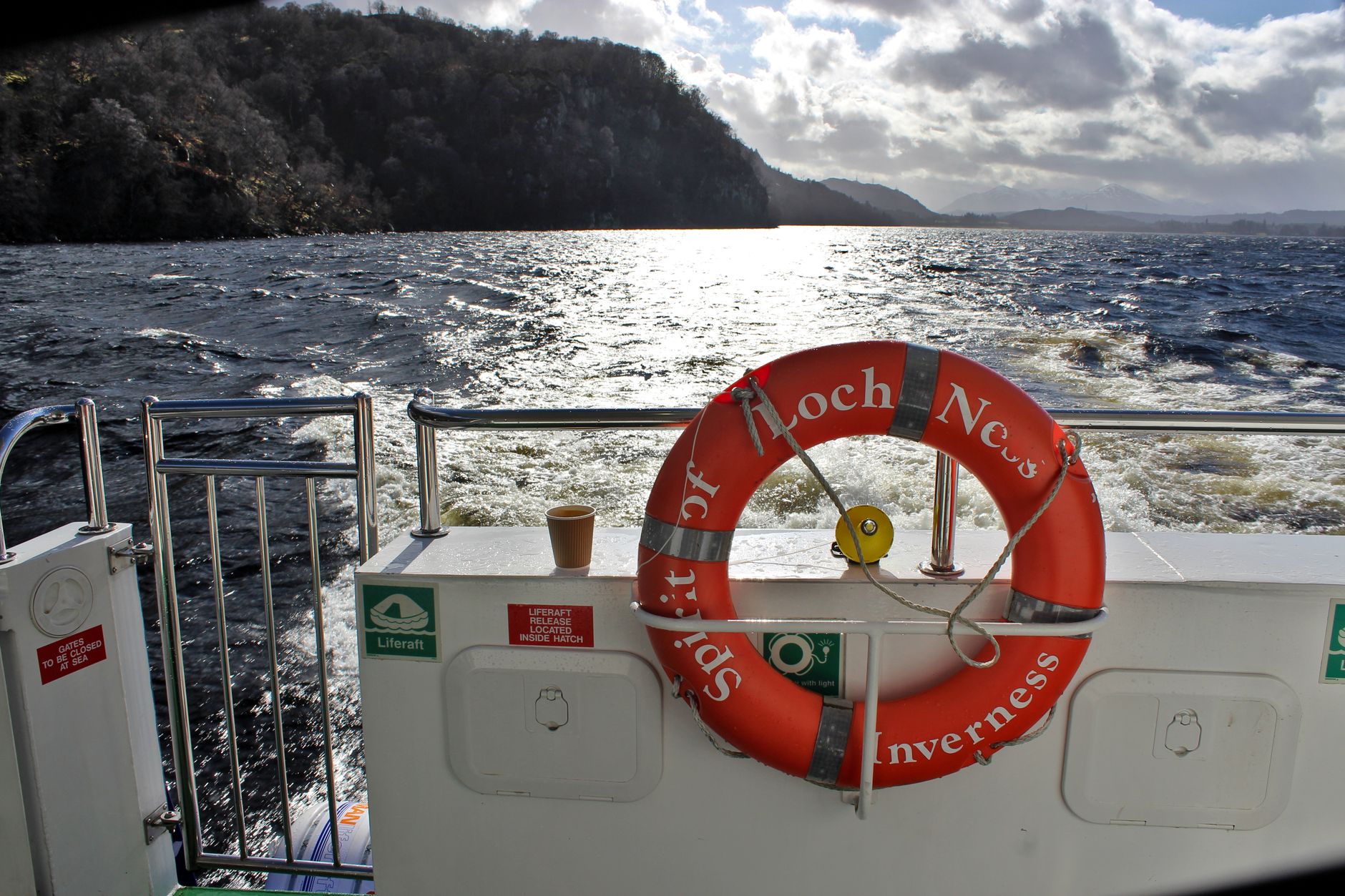
The Loch Ness Monster, sometimes nicknamed Nessie, is a creature supposed to live in Loch Ness in the Scottish Highlands. The stories of a beast in the area are quite ancient. Some of the stories date back to roughly 1,500 years ago, with tales of a creature in the Loch (CBC Radio, 2019). The current mythology began in 1933 when a couple claimed to have seen a large animal, which they equated to a “dragon or prehistoric monster,” cross the road in front of their car and then disappear into the ocean (Britannica Editors, n.d.). A year later, the famous ‘surgeon’s photograph’ was released, which appeared to depict a small head on a long, beautiful neck emerging from the lake. Many individuals suggested that Nessie was a plesiosaur, a sea animal that became extinct about 65.5 million years ago, based on that picture (Britannica Editors, n.d.). A big animal with a long neck, small head, one or more humps and a dark gray or brown body is what most witnesses describe. It’s a location that makes the mythology more realistic. Loch Ness is approximately 37 kilometers in length and around 230 meters deep at its deepest point. It holds more water than all the lakes in England and Wales combined (Loch Ness, n.d.). The water is dark and peaty, making it difficult to see much below the surface.
The idea of a Hollow Earth is far older. The scientist Edmond Halley, most famous for the comet bearing his name, hypothesized in 1692 that the Earth is an outer shell around 800 kilometers thick, encompassing two inner shells and a central core (Hollow Earth, n.d.). Halley created this model to explain the weird compass readings. He even speculated that the inside atmosphere may shine and support life and that gas escaping from the interior generated the northern lights (Encyclopedia.com, 2018). John Cleves Symmes, Jr. took up the idea in 1818. He claimed the planet consisted of concentric spheres with large entrances at the North and South Poles that led into a warm, habitable center lighted by its sun (History.com, n.d.). These polar gaps were known as “Symmes Holes,” and the idea went on to inspire a long line of novels, adventure stories, and later Internet conjecture.
There is little direct discussion in the literature of the Hollow Earth as a scientific claim. The most relevant material is the general study of remarkable claims, pseudoscience, and conspiracy theories (Devine; Keeley; Halstead et al.; Feder) and the social-epistemic dynamics around unconventional hypotheses. These sources do not directly evidence Hollow Earth assertions in the Nessie literature but rather frame, discuss, or refute alternate cosmologies in scholarly and public discourse (Devine, 1975; Keeley, 2007; Feder, 1984).

Linking Nessie to the Hollow Earth
This is the theory that Nessie came from Hollow Earth and links these two tales. Those in favor of the theory, who mostly promote it in online conversations and fringe writing instead of any real research, contend that Loch Ness is not a closed basin. They point to a connection through deep tunnels or fissures to a vast subterranean world. From this point of view, Nessie is one of a population of prehistoric reptiles that lived in the sheltered interior while their cousins on the surface died out. Every now and again one of these animals comes swimming up a channel, makes a brief appearance in the loch, and then returns back home. Frequently, believers will cite the Great Glen Fault, the largest fault line in the British Isles, which runs immediately beneath Loch Ness (Geological Society of London, n.d.). To them the fissure looks like a natural highway connecting the two realms.
One long-standing explanation is that Nessie could be a relict plesiosaur or kindred marine reptile. This theory was a major idea in early Nessie literature and remains a touchstone for disputes regarding cryptozoological claims; however, later scholars and several eyewitness accounts indicate skepticism or retreat from this concept (Smith, 2023; Bauer, 2023; Bauer, 2022). Earlier conjectures have included proposals that Nessie might be an enormous eel. This theory has been renewed by studies of eDNA in eels, which have shown traces of eel DNA in Loch Ness samples, although the evidence does not in itself confirm a giant eel, it continues the discussion of unusual aquatic fauna in the loch (Smith, 2023; Bauer, 2022). Some debates have proposed the idea of unknown species or long-necked pinnipeds as answers, albeit these are speculative and challenged in the literature (Smith, 2023; Bauer, 2023). All of these hypotheses would still function in a Hollow Earth context.
The notion is attractive, for it appears to solve several difficulties in the conventional account. One animal could not live for close to a century, let alone 1500 years. A breeding population big enough to thrive would be difficult to hide in a single lake. A Hollow Earth origin circumvents the issue, as the majority population would be living somewhere else entirely. It also clarifies the sporadic nature of sightings, the absence of washed-up carcasses, and the ongoing failure of sonar searches. If the creature appears only occasionally, a search will normally discover nothing because it is absent at that moment. In fact, the hypothesis even provides an explanation for how a warm-adapted reptile could survive in a chilly Scottish loch, for it would spend most of its life in the purportedly mild interior that Halley and Symmes described.
Related Theories
The idea of a Hollow Earth is just one of many theories explaining Nessie. The most common explanation has long been the plesiosaur notion, which came directly from the surgeon’s photos. Some have suggested gigantic sturgeon, enormous catfish, or even a Greenland shark, a creature that can live for centuries (University of Otago, 2019). Some sightings have been attributed to seals, floating logs, boat wakes, or normal waves observed in poor light. The most scientifically supported theory is that people are seeing really enormous eels. In 2018 a team led by geneticist Neil Gemmell took over 250 water samples from all across the loch and studied the environmental DNA they contained. “We didn’t detect any DNA from sharks, catfish, or sturgeon in the team’s sample. However, it did identify a “very significant amount” of eel DNA in almost every sampling site (University of Otago, 2019). Gemmell was quick to point out that the data didn’t tell how big the eels were. But eels were the one explanation the scientists could not rule out.
Problems With the Hollow Earth Explanation
The theory of a hollow earth is an interesting idea yet it has severe faults. The first and most basic is that the Earth is not hollow. In the 18th century, scientists began measuring the density of the earth. The hollow model was challenged by Pierre Bouguer in 1740, and the Schiehallion experiment performed on a Scottish mountain about 1774 effectively brought it to an end as a serious scientific concept (Hollow Earth, n.d.). Modern seismology has dispelled all residual uncertainty. Earthquake waves flow through the earth and the speed and direction of the waves alter based on what they are traveling through. In examining these waves, scientists learned that Earth has a solid inner core and a liquid outer core around it, a finding established in part by the Danish seismologist Inge Lehmann in 1936 (American Museum of Natural History, n.d.). Since shear waves cannot travel through liquid, the absence of these waves on the opposite side of the globe clearly indicates the location of the molten outer core (Seismology, n.d.). If instead we had a giant-sized empty space filled with oceans and life, the seismic readings would be very different. There has not been a reading like this one before.
The second problem is the loch itself. Loch Ness is a geologically young lake. The Great Glen Fault is hundreds of millions of years old, but the loch was formed when glaciers excavated the valley more than 10,000 years ago (Geological Society of London, n.d.). The loch bottom is rock and sediment, not an open shaft. Surveys have mapped everything thoroughly and when a 2016 study claimed to find a deep crevice, more investigation proved it to be just a sonar anomaly (Loch Ness, n. d.). A fault’s not a tunnel, either. Faults are cracks where large slabs of rock are squeezed together with tremendous force, forcing out any openings. If there was a passage at all, it would have to be thousands of kilometers long. That’s a startling distance when you realize that the deepest hole humanity have ever sunk, the Kola Superdeep Borehole, is just roughly 12.2 kilometers (Chan, 2024). Temperatures and pressures deep inside the earth are so high that no living animal could swim through them (American Museum of Natural History, n.d.).
The third problem is just plumbing. Water runs downhill. But if there were an open passage from Loch Ness to a vast hollow far below, the loch would drain into it. Instead, the loch has a stable surface level around 16 meters above sea level and supplies the River Ness (Loch Ness, n.d.).
The biological evidence is equally incriminating. The environmental DNA survey in 2018 identified signs of thousands of species, including deer, badgers, foxes, sheep, and many birds, but found no reptile DNA at all (University of Otago, 2019). Animals are continually shedding skin, excrement, and mucus. A large species that visited frequently would likely leave behind genetic evidence. Past sonar searches, including in 1987 and 2003, similarly failed to locate anything odd (Britannica Editors, n.d.). The evidence on the other side is minimal. In 1994, experts exposed the most famous image of the creature, taken by the surgeon, as a fraud. The “monster” was a model head on a toy submarine (Britannica Editors, n.d.).
The final defect is a logical one and the most critical. The notion of the Hollow Earth is based on the absence of evidence. If sonar detects nothing, the believer can conclude Nessie was underground at the time. If the DNA tests show no results, it suggests that she must have left before the samples were taken. A claim that explains away every negative outcome is untestable, and an untestable theory provides no true explanation. It doesn’t explain the sightings. It only shields the legend from inquiry.
Conclusion
The idea that Nessie originates from the hollow earth is a fanciful mixing of two well-known stories. It makes use of the spooky depths of Loch Ness, the lengthy history of sightings and the old idea of a hidden world beneath our feet, a notion that once drew a scientist as serious as Edmond Halley. It responds to vexing surface questions about how a creature could exist for generations and still elude capture. However, it fails to withstand examination. Seismology demonstrates that the interior is not empty but solid and molten. Geology suggests a young glacial basin with no tunnel. Basic physics would empty the lake if there was an open channel. DNA surveys reveal eels, not reptiles. Above all, the hypothesis requires the lack of evidence to make its case. Perhaps the main lesson of Nessie is not so much what lives in the loch, but how humans want the mystery to go on. The tale continues to thrive, even as science explains the waters more precisely than ever.
References
American Museum of Natural History. (n.d.). Inge Lehmann: Discoverer of the Earth’s inner core. https://www.amnh.org/learn-teach/curriculum-collections/earth-inside-and-out/inge-lehmann-discoverer-of-the-earth-s-inner-core
Bauer, H. H. (2022). The Water Horses of Loch Ness by Roland Watson. Journal of Scientific Exploration, 36(2), 323–324. https://doi.org/10.31275/20222509
Bauer, H. H. (2023). Occam’s Razor and Bayesian Measures of Likelihood Suggest Loch Ness Monsters Are Real Animals. Journal of Scientific Exploration, 36(4), 740–748. https://doi.org/10.31275/20222647
Britannica Editors. (n.d.). Loch Ness monster. In Encyclopaedia Britannica. https://www.britannica.com/topic/Loch-Ness-monster-legendary-creature
CBC Radio. (2019, September 6). Is the Loch Ness monster a giant eel? Scientists share new DNA evidence from Scottish lake. As It Happens. https://www.cbc.ca/radio/asithappens/as-it-happens-thursday-edition-1.5271622/is-the-loch-ness-monster-a-giant-eel-scientists-share-new-dna-evidence-from-scottish-lake-1.5271626
Chan, Y. B. (2024, May). Unveiling the boundary between the Earth’s crust and mantle with seismic waves. Hong Kong Observatory. https://www.hko.gov.hk/en/education/earth-science/earthquake/00717-Unveiling-the-boundary-between-the-Earth-crust-and-mantle-with-seismic-waves.html
Devine, P. E. (1975a). Does St Anselm Beg the Question? Philosophy, 50(193), 271–281. https://doi.org/10.1017/s0031819100025110
Devine, P. E. (1975b). The Religious Significance of the Ontological Argument. Religious Studies, 11(1), 97–116. https://doi.org/10.1017/s0034412500008209
Encyclopedia.com. (2018). Hollow Earth. https://www.encyclopedia.com/philosophy-and-religion/other-religious-beliefs-and-general-terms/miscellaneous-religion/hollow-earth/
Feder, K. L. (1984). Irrationality and Popular Archaeology. American Antiquity, 49(3), 525–541. https://doi.org/10.2307/280358
Foxon, F. (2023). Can Bayesian Statistics Be Used To Analyze Phenomena In Folk Zoology? Journal of Scientific Exploration, 37(3), 570–571. https://doi.org/10.31275/20233065
Geological Society of London. (n.d.). The Great Glen Fault, Scotland. https://www.geolsoc.org.uk/science-and-policy/plate-tectonic-stories/great-glen-fault/
History.com. (n.d.). The 19th-century push for a “hollow Earth” expedition. https://www.history.com/articles/expedition-to-the-center-of-the-earth
Hollow Earth. (n.d.). In Wikipedia. https://en.wikipedia.org/wiki/Hollow_Earth
Keeley, B. (2007). God as the Ultimate Conspiracy Theory. Episteme, 4(2), 135–149. https://doi.org/10.3366/epi.2007.4.2.135
Loch Ness. (n.d.). In Wikipedia. https://en.wikipedia.org/wiki/Loch_Ness
Seismology. (n.d.). In Wikipedia. https://en.wikipedia.org/wiki/Seismology
Smith, O. (2023). Nessie and Noctilucent Clouds. Coolabah, (34), 25–45. https://doi.org/10.1344/co20233425-45
University of Otago. (2019, September 5). First eDNA study of Loch Ness points to something fishy. https://www.otago.ac.nz/news/newsroom/first-edna-study-of-loch-ness-points-to-something-fishy

Leave a Reply