Woodboogers in Appalachia: Key Points
- The Woodbooger is a legendary creature of the Appalachian Mountains, especially around Norton, Virginia, and High Knob. Its name comes from the old Appalachian word “booger,” meaning a ghost, goblin, or bogeyman.
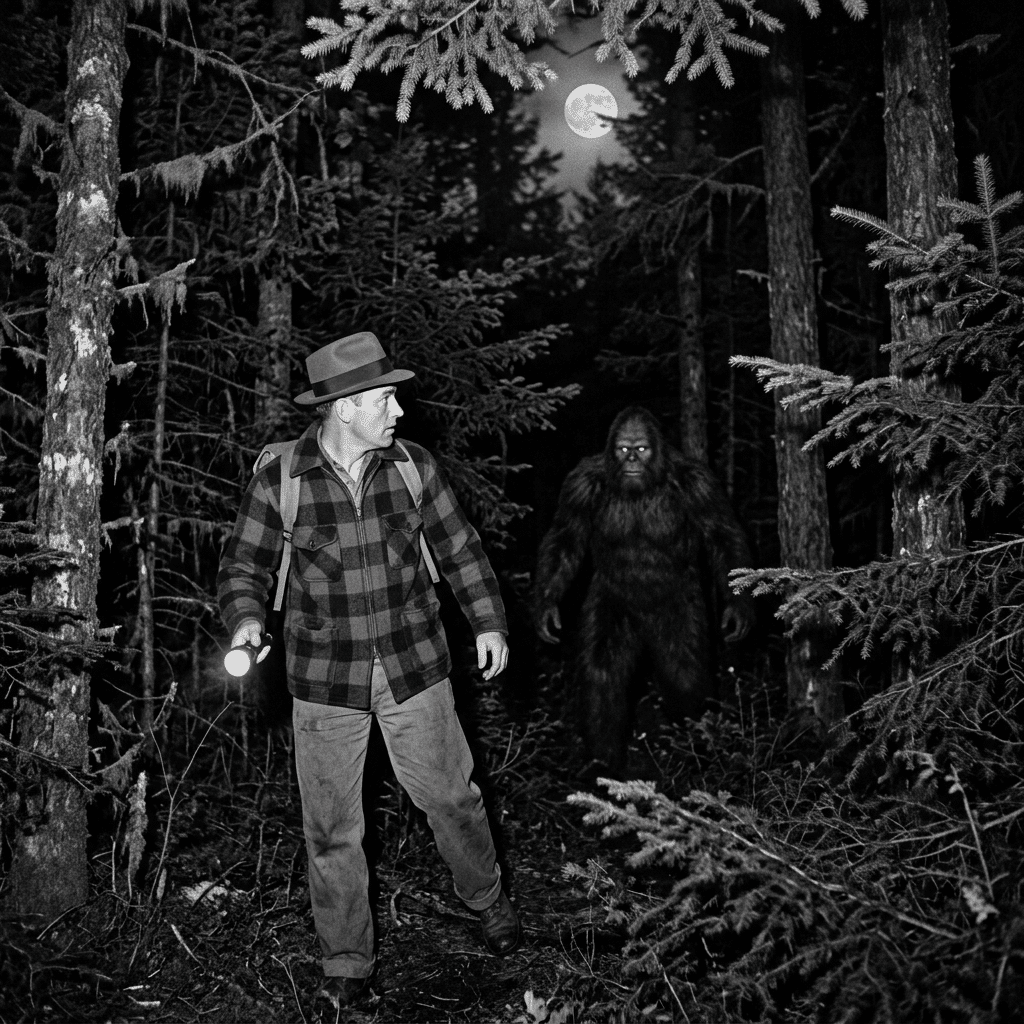
- Witnesses describe a large, upright, hairy figure with dark matted fur, glowing amber or red eyes, and a rank, sulfurous smell. Some say it is shorter and stockier than the classic Bigfoot.
- It is said to be secretive and mostly active at night, though some stories have it following hikers or throwing rocks. Many reports involve sounds, such as humanlike screams that turn into roars, rhythmic wood knocking, and a strange feeling of dread.
- Some people see the Woodbooger as a regional name for Bigfoot. Others say it’s a separate creature, shaped by local bogeyman stories and the warning to children to get home before dark.
- Its fame grew after the show Finding Bigfoot filmed in Southwest Virginia in 2011. Norton then declared itself a Bigfoot sanctuary in 2014, put up a Woodbooger statue at Flag Rock in 2015, and started an annual festival.
- Explanations include an undiscovered relic hominid, mistaken sightings of bears, cougars, or owls, and a folk tale meant to keep children away from dangerous cliffs and mine shafts.

Introduction
Western Virginia has some of the oldest mountains on earth, folded into ridges and hollows. Some 480 million years ago, well before the dinosaurs, the Appalachians started to rise. Once they were as high as the Alps, but time has eroded them into rounded peaks. Under those summits, water has carved tunnels in limestone, while above them the forest grows so thick that noon can feel like dusk. In an area like that, you may encounter bizarre stories everywhere. But one of the craziest belongs to a creature the locals name the Woodbooger. It is part monster, part warning, and part municipal mascot lately (Norton VA Outside, n.d.). In this essay I look at what the Woodbooger is reported to look like and how it is said to behave. It also discusses the folk tales behind its name, whether it’s simply Bigfoot under a different moniker, the sightings that made it famous, and the theories people have to explain it.
In some folklore and paranormal traditions, the name woodbooger is used to refer to a regional cryptid or uncanny creature connected with woodland environments. It is sometimes used in local legend as a cautionary figure. Understanding woodbooger folklore requires considering larger patterns of regional cryptids, modern legends, and monster studies, which scholars have interpreted as manifestations of community identity, anxiety, and social boundary work (Puglia, 2023; Tucker, 2021; Trocio et al., 2023; Bennett, 1993). Folklore monsters, in all sources, often represent anxieties, moral lessons, or societal tensions, and they often move between oral tradition and popular media forms (Puglia, 2023; Tucker, 2021; Trocchio et al., 2023; Bennett, 1993).
The Origins of the Name
The name tells you a significant deal before any witness opens his mouth. In ancient Appalachian terminology, the term booger referred to something apart from a nose-related issue. A ghost, a goblin, a haint, a bogey. The term booger originates from an old Southern and Appalachian language that includes words like boogers, boogermen, and bogeys, which were figures used by parents to scare children away from dark forests and hollows (Hall, 2025). So a wood booger is just a haunt of the woods. Two fan sources link the moniker to an item in a newspaper called The Old Post, dated November 24, 1892, that told of a bogeyman-type figure who was claimed to take children who ventured into the woods at nite (Northwest Bigfoot, n.d.-a; Spooky Appalachia, 2022). Today it is difficult to find the original article. The local version is clearly written on a historical marker in Norton, Virginia: the creature kidnaps children and takes them into the deep woods to turn them into woodboogers themselves (Marsteller & Marsteller, 2023). The message to the kids was rather basic. Home before dusk.
Appearance and Behavior
Descriptions of the creature are quite constant, despite varying in detail. The Woodbooger is commonly described as a huge upright figure, having a bulky humanlike form coated in brown or black fur. Many reports have it as seven or eight feet tall (Northwest Bigfoot, n.d.-a). Others describe it as being considerably taller than a man but much larger and heavier with a massive chest and lengthy limbs. Many witnesses describe its fur as matted and black, resembling the coat of a wild animal rather than that of a groomed pet. Many of the stories mention eyes that appear to glow amber or red when captured in a flashlight or headlights. And then there’s the smell. People describe a vile, sulfurous smell, like rotten eggs or damp rubbish, that lingers in the air before or after a sighting. More than one storyteller has asserted that you can smell a wood booger long before you see it.
Its stated conduct is just as disturbing. Locals around Flag Rock speak of hearing footsteps and seeing shadows on quiet trails and the Woodbooger is reported to roam the ridgelines at night (Spooky Appalachia, 2022). It is said to be reclusive, staying on high hills, rock outcrops, and hollows where people seldom go. Hikers said they saw a giant object gliding silently through the trees, something they said didn’t seem conceivable for anything that big. Some stories depict him as bashful and quick to vanish. Others are assertive, even aggressive: they follow people down a trail, throw rocks or sticks from the brush, or circle a campground after dark. But most of what individuals describe is sound. Hunters, hikers, and people living far up the hollows speak of screams that begin almost human, a woman’s shriek or a child’s cry, and then drop into a deep, chesty roar no person could make. Others speak of wood banging, harsh and repetitive, like a hefty branch pounding on a tree trunk, sometimes returned by one more knock from a ridge away. Then there’s the feeling that witnesses can’t quite put into words: a sudden fear, a pressure or a hum in the chest, a feeling that the woods have gone still, and something’s watching. This phenomenon has sometimes been associated by Bigfoot believers with infrasound, low-frequency sound below the range of human hearing that some animals are known to emit. Whatever it is, those who see it seem to remember it longer than anything else they saw.

Bigfoot, Famous Sightings, and Norton’s Sanctuary
Is the wood booger Bigfoot? There is disagreement even in Norton. Many consider it a regional variety or Southern cousin of the creature reported to walk the Pacific Northwest (Northwest Bigfoot, n.d.-a; Spooky Appalachia, 2022). The city’s own tourism site portrays the Flag Rock statue as “a Bigfoot-like creature” (Explore Norton VA, n.d. “Woodbooger Sanctuary” section). The basic outline clearly fits: a large, hairy, upright monkey living deep in the forest and seldom seen. But some residents want their own identity. For them, the Appalachian creature is a separate species, tougher and even more elusive than its western cousin and born in the dark woods and misty slopes of Virginia’s mountains (Spooky Appalachia, 2022). In one key respect, folklore corroborates that distinction. Sasquatch entered popular culture mainly through footprint casts, film footage, and newspaper headlines. The Woodbooger stems from the boogeyman tradition, and as such, it has the weight of a moral lesson along with a biological enigma (Hall, 2025). You could say he’s Bigfoot with a pedigree.
Norton, a small Wise County, Va., town, and the slopes of High Knob above it, are the Woodbooger’s most celebrated abode. The hollows surrounding the mountain have been the topic of stories told by residents for years, and fans say accounts date back far over a hundred years (Northwest Bigfoot, n.d.-a). The current legend gained momentum in 2009, when an ATV rider in the vicinity of Gum Hill shot a blurry video showing a big black figure striding across a creek. The clip, which has been dubbed online “The Beast of Gum Hill,” has ignited a debate on whether it was a fake, a misidentified animal, or something even crazier (Hall, 2025). In 2011, Animal Planet’s Finding Bigfoot spent a week shooting in Southwest Virginia on High Knob and in the towns of Washington County, Damascus, and Saltville, bringing the creature to a national audience (Explore Norton VA, n.d.). Local sources say the crew expected few reports initially. They then convened a town hall meeting, and the room began to fill as folks lined up to recount occurrences they had never reported before (Spooky Appalachia, 2022). On February 12, 2012, the episode “Virginia Is for Bigfoot Lovers” was aired (Marsteller & Marsteller, 2023). At about the same time, hikers and hunters in the Flag Rock Recreation Area reported a seven- to eight-foot-tall humanoid covered in brown or black fur (Northwest Bigfoot, n.d.-a).
Norton accepted it. In October 2014 the city council issued a resolution proclaiming Norton a “Sasquatch/Bigfoot/Woodbooger Sanctuary.” The resolution cited the High Knob region as potential habitat and, with a straight face, remarked that the creature seemed to be “an endangered species” (Marsteller & Marsteller, 2023, memorial inscription; Norton VA Outside, n.d.). In 2015, the city, with the support of local businesses, placed a big Woodbooger statue at the Flag Rock Overlook, where it is now a popular photo spot for hikers and families (Hall, 2025; Northwest Bigfoot, n.d.-b). The statue was followed by an annual fall festival, a restaurant named the Wood Booger Grill, and a popular line of T-shirts sold at the local Home Hardware (Explore Norton VA, n.d.; Norton VA Outside, n.d.). The city council has appropriately designated Flag Rock as a sanctuary for the green salamander, a rare and true amphibian (City of Norton, n.d.; Explore Norton VA, n.d.). Science has documented one protected beast. The other is chronicled by storytelling.
Theories and Interpretations
But that begs the obvious question—what are people genuinely experiencing? One answer, favored by the faithful, is the relic hominid theory. Supporters say that a population of unknown giant primates could exist in the remote, cave-riddled portions of the Appalachians where steep terrain, abandoned mine land, and deep forest leave enormous areas that are infrequently visited by people. Scientists say no bodies, bones, or proven DNA have ever been found, and a reproducing population of giant beasts would very surely leave physical evidence behind. A second idea, more pragmatic, is misidentification, and even local storytellers concede doubters blame wildlife such as a walking bear erect (Spooky Appalachia, 2022). The area is home to many black bears who can stand up and even walk a few steps on their hind legs. In poor light, a bear with mange, patchy fur, and dark skin can look shockingly human. The shouts also include familiar candidates. A mountain lion’s howl can sound like a woman’s scream. Wild cougars are considered extirpated from the East, yet people still report them. Red foxes, bobcats, and owls all emit noises that can be rather scary to hear all by yourself in the dark. Woodpeckers, falling limbs, or other hunters could be the source of the knocking sound. And fear finishes the work. The shapes in the shadows are a product of a frightened mind.
The third theory might explain the most. It takes the Woodbooger as a folk morality tale, a fable that has completed its purpose. As study on folklore has revealed (Hall, 2025), Appalachian “booger” tales provided pleasure and a moral warning for rural populations. The beauty of Appalachia has always been lethal. There are high cliffs and sinkholes, flooded mine shafts, and woods a lost child may explore for days. A vague warning to be careful might not grab a child’s attention. A monster who snatches children who do not come home after dark would. In this light, the Woodbooger is a form of inherited safety strategy, transmitted by parents and grandparents who understood the mountains could kill. Not all sightings are mere fabrications. That does indicate the stories have reasons to endure, regardless of whether there was anything nasty behind them or not.
Monster studies investigate the ways in which creatures such as cryptids serve as cultural mirrors, reflecting fears, aspirations, and social arrangements. The literature posits that monsters might develop from the interplay of individual experience, collective storytelling, and media representation, changing how groups perceive danger and the unknown (Tucker, 2021; Puglia, 2023). From this perspective, woodbooger mythology may reflect changing social anxieties (e.g., risks in the wilderness, outside threats, or moral violations) portrayed in terms of a locally recognized species.
Folklore studies stress that legends, myths, and folktales encode social meanings and assist groups negotiate identity, values, and limits. This creates woodbooger stories as a way to transmit warnings about dangerous woods, moral injunctions, or transgressive activities, and occasionally as a way to express voice to the disadvantaged and challenged within a community (Bennett, 1993; Tucker, 2021; Puglia, 2023). The data in these sources underscores that the power of regional monsters typically springs from local landscape connections and interpretive frames that listeners share or question (Bennett, 1993; Tucker, 2021; Puglia, 2023).
Some sources describe how modern reimaginings and current folklore refocus monsters to speak to marginalized people or modern issues. Similarly, the Woodbooger narratives may provide a means for communities to process contemporary issues of safety, property, or social change through a native or community-based creature figure (Puglia, 2023; Novianti, 2022). Where present, these linkages suggest that woodbooger lore can have numerous levels of meaning, from traditional protective folklore to modern social satire.
Conclusion
And ultimately, the Woodbooger resides at the intersection between the untamed nature of the Appalachians and their narrative history. It’s the size and shape of Bigfoot, the terror of the old boogeyman, and the pungent fragrance of a positive campfire story. Witnesses speak of dark matted hair, eyes that glow, shouts that become roars, and knocks that resonate from ridge to ridge. Skeptics argue that the sightings can be attributed to bears, large cats, and owls, highlighting how easily the mind can be deceived in the dark. Folklorists have read it as a cautionary tale that kept youngsters away from cliffs and mining shafts for generations. Norton has transformed the creature into a statue, a festival, and a protected resident, which may be the most Appalachian solution of all. However, the uncertainty persists, and that adds to the allure. So if you have ever stood on a dark Appalachian mountain and heard something you couldn’t explain, what was it? What do you believe is in the hollows down below High Knob?
References
Bennett, G. (1993). Folklore studies and the English rural myth. Rural History, 4(1), 77–91. https://doi.org/10.1017/S0956793300003496
City of Norton. (n.d.). Flag Rock Recreation Area [Brochure]. https://www.nortonva.gov/DocumentCenter/View/3824/FRRA-Map
Explore Norton VA. (n.d.). Flag Rock Recreation Area. https://explorenortonva.com/flag-rock-recreation-area/
Hall, A. (2025, December 20). The Woodbooger of Flag Rock: Bigfoot sanctuary, outdoor tourism, and Norton’s High Knob legend. Appalachian Historian. https://appalachianhistorian.org/the-woodbooger-of-flag-rock-bigfoot-sanctuary-outdoor-tourism-and-nortons-high-knob-legend/
Hoffman, K., Kuhlman, B., & Brumels, C. (Executive Producers). (2011–2018). Finding Bigfoot [TV series]. Ping Pong Productions; Animal Planet.
Kuhlman, B., Brumels, C., & Hoffman, K. (Executive Producers). (2012, February 12). Virginia is for Bigfoot lovers (Season 2, Episode 6) [TV series episode]. In Finding Bigfoot. Ping Pong Productions; Animal Planet.
Marsteller, D., & Marsteller, T. (2023). Resolution declaring a Sasquatch/Bigfoot sanctuary [Historical marker entry]. The Historical Marker Database. https://www.hmdb.org/m.asp?m=228680
Northwest Bigfoot. (n.d.-a). Appalachian mystery: The Woodbooger of Norton Virginia. https://www.northwestbigfoot.com/appalachian-mystery-the-woodbooger-of-norton-virginia/
Northwest Bigfoot. (n.d.-b). The Woodbooger: Norton, Virginia Bigfoot. https://www.northwestbigfoot.com/the-woodbooger-norton-virginia-bigfoot/
Norton VA Outside. (n.d.). Woodbooger. https://www.nortonvaoutside.com/woodbooger
Novianti, N. (2022). Indonesian folk narratives: On the interstices of national identity, national values, and character education. Journal of Ethnology and Folkloristics, 16(1), 99–116. https://doi.org/10.2478/jef-2022-0006
Puglia, D. J. (2023). The (mostly) unseen world of cryptids: Legendary monsters in North America. Humanities, 13(1), Article 1. https://doi.org/10.3390/h13010001
Spooky Appalachia. (2022, July 12). The story of Wood Booger. https://www.spookyappalachia.com/the-story-of-wood-booger/
Trocio, J. V., Campos, E., & Yu, A. L. (2023). Cultural motifs in Blaan flalok: Revitalization of oral lore for preservation, development, and sustainability. Southeastern Philippines Journal of Research and Development, 28(2), 13–25. https://doi.org/10.53899/spjrd.v28i2.253
Tucker, E. (2021). The Lake Lieberman monster. In D. J. Puglia (Ed.), North American monsters: A contemporary legend casebook (pp. 154–170). Utah State University Press. https://doi.org/10.7330/9781646421602.c017


Leave a Reply