Who Is the Hat Man? Key Points
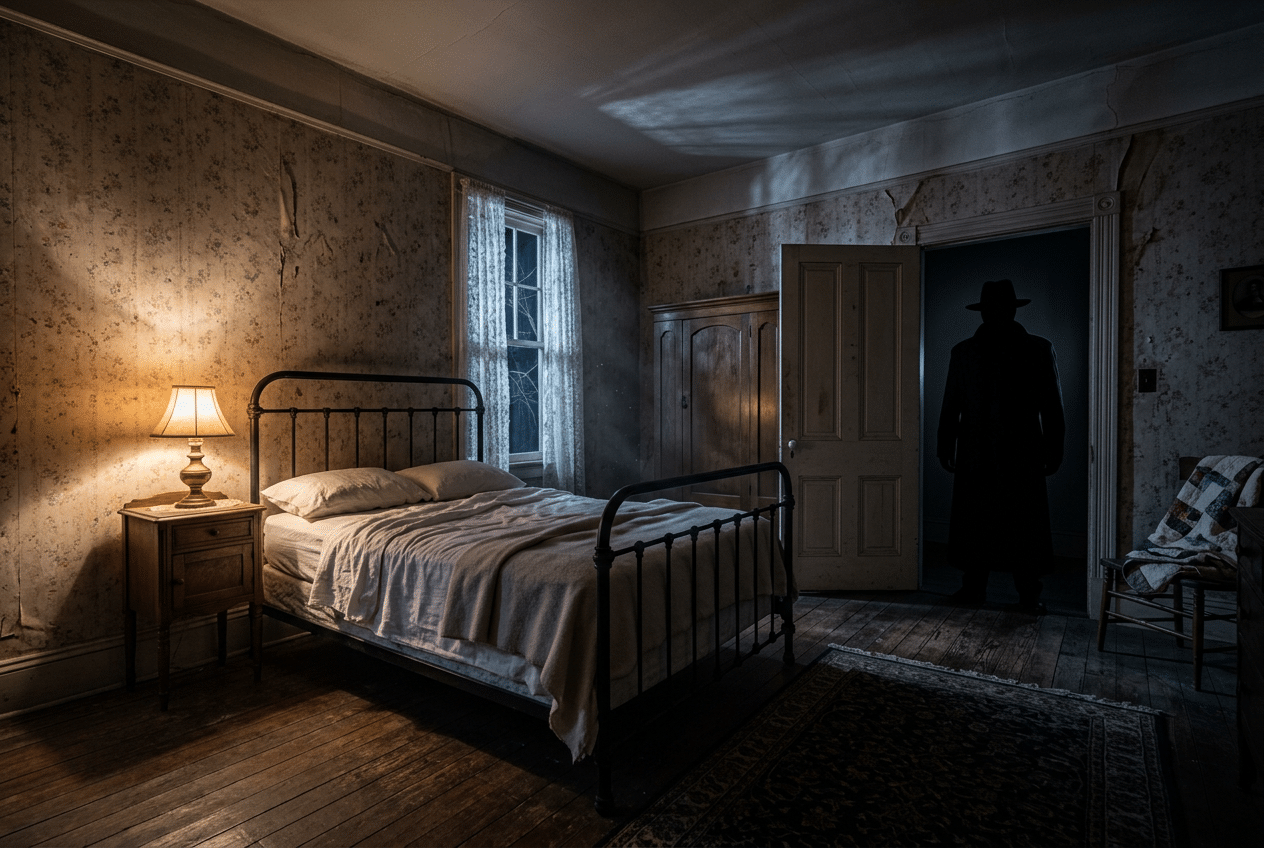
- The Hat Man is a tall shadow figure in a wide-brimmed hat and long coat, often seen standing still in a doorway or at the foot of a bed. Unrelated people around the world describe him the same way.
- Reports took off in the early 2000s after radio shows and books about shadow people, then spread through internet forums. Witnesses often mention a hidden face, red eyes, and intense dread.
- Science links many sightings to sleep paralysis, when the mind wakes during REM sleep but the body can’t move yet. The brain’s fear centers stay active, so it looks for a threat in the dark.
- The brain may project its own body map outward as a dark human shape, and pareidolia can turn shadows into a figure. Cultural beliefs also affect how scary the experience feels.
- The Hat Man fits a long line of bedroom intruders, such as the Old Hag, the mara, and Spring-heeled Jack. His look may come from twentieth-century fashion, film noir, and Odin’s broad-brimmed hat.
- Whether he’s a brain glitch or a paranormal entity, the Hat Man looks the same across cultures. That suggests the fear of a silent watcher at night is one of humanity’s oldest fears.

Introduction
The Hat Man is one of the most disturbing figures in contemporary paranormal culture. Partly it’s because he looks so normal. He has no wings. No claws. No horrific face. He is only a tall black shape in a wide-brimmed hat and a long coat, usually motionless in a doorway or at the foot of a bed. It’s not how scary he looks that makes him special. That’s how steady he is. People who have never met, who live on different continents, who say they knew nothing about the legend previously, describe the same person almost perfectly. This article explores that core mystery. It follows the Hat Man’s rise to online fame, explores what sleep science can tell us about the experiences behind the accounts, and ties the character to centuries of mythology about bedroom intruders. Taken together, all these strands show that the Hat Man, whether a product of the brain or something beyond it, adheres to a pattern that people have recognized for a very long time.
The Hat Man in Contemporary Paranormal Culture
The Hat Man became a distinctive character at the turn of the 2000s, despite being a shadowy figure featured in ghost stories for years. The late-night radio program, Coast to Coast AM, was crucial. Host Art Bell talked extensively about “shadow people” on April 12, 2001, and listeners began phoning and writing in with their experiences (“Shadow person,” 2026). The same year author Heidi Hollis published her first book on shadow people. She later published a whole volume on the Hat Man, compiling hundreds of experiences sent in by readers (Hollis, 2014). As internet forums and social media grew, the number of reports also increased. The features recur with remarkable frequency. Witnesses describe the figure as taller than a man. His face is blank or obscured by the brim of a fedora or similar hat. Occasionally he has faintly glowing red eyes. Most people report a feeling of dread that is almost overwhelming. Many believe the figure did not move or talk. It just watched. Some witnesses say they saw him once and never again; others describe frequent visits over decades and even across various homes and countries (Hollis, 2014). Hollis interprets these experiences via a religious lens, seeing the Hat Man as an evil spiritual entity. But her collection remains a vital record of how regular people recount the event in their words.
Sleep Paralysis and the Science of Shadow Figures
Science has a very convincing explanation for many of these encounters, and it begins with sleep paralysis. During rapid eye movement (REM) sleep the brain is active enough to create vivid dreams, but the body is kept almost entirely still. This protective paralysis prevents sleepers from acting out their dreams. The paralysis may still be wearing off when a person wakes up. The paralysis occasionally starts before the mind has entirely slipped into slumber. In this state, the person becomes aware of their actual bedroom but finds themselves unable to move. Hypnagogic hallucinations develop when you are falling asleep. Those that occur during waking are called hypnopompic. Sleep paralysis is remarkably prevalent. A thorough review indicated that roughly 7.6% of the general population suffer at least one episode in their lives, while students and mental patients have substantially higher rates (Sharpless & Barber, 2011). Cheyne et al. (1999) surveyed thousands of individuals with sleep paralysis and found a cluster of episodes that they termed the “intruder” category. It involves a sensed presence, a sense of threat, and visual hallucinations of a figure in the room. The researchers concluded that this cluster is produced by a threat-detection mechanism that is triggered when a person suddenly finds themselves weak and defenseless. Brain scans support these findings. Studies of REM sleep have found the amygdala, the brain area most directly associated with detecting fear and threat, to be very active (Maquet et al., 1996). The brain is set up to detect danger, but the body can’t react. So the mind seeks a cause for the fear, and it finds one in the shadows.
But why does the shadowy figure take on a human shape, and why is it so similar across different individuals? Jalal and Ramachandran (2014) suggested that the dark bedroom invader could be the result of a disruption to the right parietal cortex, an area involved in constructing the brain’s internal map of the body. In sleep paralysis, the regular signals of communication between brain and body become muddled. The researchers argued that the brain may project its own built-in template of a human body outwards, such that it appears like a separate figure in the room. That would explain why the intruder often has a humanoid shape and appears black and featureless. The brain can be drawing a basic sketch instead of a full-bodied person. Pareidolia is the tendency to imagine faces and figures in random patterns, which can turn a coat on a door or a shadow from a streetlight into a standing silhouette. Culture matters as well. Jalal and Hinton (2013) compared sleep paralysis in Denmark and Egypt. They observed that Egyptian individuals, many of whom attributed the experience to supernatural agents such as the jinn, had more frequent episodes and greater terror than the Danish participants. The way people interpret sleep paralysis seems to influence the way they experience it.

Historical Folklore and Supernatural Intruders
Viewed this way, the Hat Man seems less like an entirely new phenomenon and more like the latest disguise for an ancient guest. In his famous book of Newfoundland folklore, Hufford (1982) recorded the “Old Hag,” a creature purported to sit on sleepers’ chests and hold them immobile in the night. Hufford learned something important: people described the event in strikingly identical terms even if they had never heard of the custom. The encounter came first, then the folklore sprang up around it, he said. Europe, too, has a lengthy tradition of these figures. In Germanic and Scandinavian belief, the mara, or the Nachtalb (night elf), was a spirit who crept into bedrooms and pressed down on sleepers. The English word “nightmare” itself originates from the earlier word “mare,” which refers to this crushing nite spirit (Davies, 2003). Davies (2003) has also shown that terrible events at night that resemble sleep paralysis often contributed to charges of witchcraft in early modern England. The victim, paralyzed, was certain a neighbor had appeared to them as a spirit. In nineteenth-century Britain, there were also tall phantom figures unique to that era. The most famous is Spring-heeled Jack, who is described in popular legends as a shrouded creature with blazing eyes. Details passed from one age to the next. The basic image of a dark intruder appearing when people are most vulnerable persisted.
Clinical Evidence and Cultural Interpretations
Sleep paralysis occurs when an individual is waking up or falling asleep and is completely aware but cannot move or talk. They typically envision a shadow-like or vague shape moving toward them. The feeling commonly includes chest tightness, heaviness in the body, or dyspnea (Hinton et al., 2005). Shadow figures are common during these episodes. In a Turkish sample of 59 patients who experienced sleep paralysis, more than half (53%) reported seeing a shadow or something approaching them (Jalal et al., 2021). A clinical case report describes a patient who during episodes saw shadows and felt an alien presence in the room (McCarty & Chesson, 2009).
The highest rates are reported by traumatized groups. Cambodian immigrants had very high rates, and the authors attribute trauma to increased odds of sleep paralysis (Hinton et al., 2005). Shadow people are also a folk belief. Sharpless and Doghramji explain that people in the past interpreted the experience in terms of supernatural creatures such as demons and ghosts and that ideas about shadow people are still present now (Mayer & Fuhrmann, 2022). Cultural framing shapes the experience. The most frequent moniker for sleep paralysis in Turkey is the “Karabasan” ghost. However, many who thought it to be supernatural still took religious precautions (Jalal et al., 2021). In 2025 a review found sleep paralysis to be widespread in primary care and associated with PTSD, hypertension, and sleep apnea (Honnekeri, 2025).
Culture could also impact the precise costume the Hat Man wears. The fedora and trench coat were standard men’s clothing for much of the twentieth century. They also became famous in film noir, frequently worn by people half-hidden in shadow. A large brim hides the face, and a long coat softens the body’s form. Together they make a silhouette that is unmistakably human but unidentifiable. That is just the kind of picture a frightened and half-awake brain might make. The archetype dates back even further. In Norse mythology Odin is typically depicted as a tall traveler wearing a cloak and a broad-brimmed hat. His various names include Síðhöttr, meaning the “broad hat” (Lindow, 2001). Odin appears without warning, watches silently, and knows more than he lets on. No one has to tell us that witnesses today are seeing a Norse god. But the analogy implies that the towering stranger with a hat has long been a symbol of mystery and uneasiness in the Western mind.
Conclusion
The Hat Man exists at the intersection of neurobiology, mythology, and human experience. The science is really solid. Sleep paralysis is prevalent, reliably causes a sense of threat and a sensed presence, and the brain appears primed to fill that presence with a human form. Folklore suggests people have described similar visitations for generations, from the Old Hag and the mara to Victorian phantoms. The similar clothing worn by so many current figures may be explained by cultural iconography ranging from noir flicks to Odin’s broad cap. But for many who have seen him, these explanations do not quite convey the reality of the encounter or the intimacy of meeting him. They still wonder why strangers who have never shared notes have such similar details. Maybe the Hat Man is a common fault of the human nervous system, an ancient threat detector firing in the dark. Perhaps he is something more, as the Christians say. In any event, his pattern is astonishingly consistent from culture to culture, and it implies that the terror of a silent watcher at the door is one of the oldest and most generally shared of human experiences.
References
Cheyne, J. A., Rueffer, S. D., & Newby-Clark, I. R. (1999). Hypnagogic and hypnopompic hallucinations during sleep paralysis: Neurological and cultural construction of the night-mare. Consciousness and Cognition, 8(3), 319–337. https://doi.org/10.1006/ccog.1999.0404
Coast to Coast AM [Radio program]. (n.d.). https://www.coasttocoastam.com/
Davies, O. (2003). The nightmare experience, sleep paralysis, and witchcraft accusations. Folklore, 114(2), 181–203. https://doi.org/10.1080/0015587032000104211
Hinton, D. E., Hufford, D. J., & Kirmayer, L. J. (2005). Culture and sleep paralysis [Editorial]. Transcultural Psychiatry, 42(1), 5–10. https://doi.org/10.1177/1363461505050708
Hollis, H. (2014). The Hat Man: The true story of evil encounters. Level Head Publishing.
Honnekeri, A. (2025). Nightmares or a crippling reality? A review on sleep paralysis. Journal of Family Medicine and Primary Care, 14(7), 2639–2642. https://doi.org/10.4103/jfmpc.jfmpc_212_25
Hufford, D. J. (1982). The terror that comes in the night: An experience-centered study of supernatural assault traditions. University of Pennsylvania Press.
Jalal, B., & Hinton, D. E. (2013). Rates and characteristics of sleep paralysis in the general population of Denmark and Egypt. Culture, Medicine, and Psychiatry, 37(3), 534–548. https://doi.org/10.1007/s11013-013-9327-x
Jalal, B., & Ramachandran, V. S. (2014). Sleep paralysis and “the bedroom intruder”: The role of the right superior parietal, phantom pain and body image projection. Medical Hypotheses, 83(6), 755–757. https://doi.org/10.1016/j.mehy.2014.10.002
Jalal, B., Eskici, H. S., Acarturk, C., & Hinton, D. E. (2021). Beliefs about sleep paralysis in Turkey: Karabasan attack. Transcultural Psychiatry, 58(3), 414–426. https://doi.org/10.1177/1363461520909616
Lindow, J. (2001). Norse mythology: A guide to the gods, heroes, rituals, and beliefs. Oxford University Press.
Maquet, P., Péters, J.-M., Aerts, J., Delfiore, G., Degueldre, C., Luxen, A., & Franck, G. (1996). Functional neuroanatomy of human rapid-eye-movement sleep and dreaming. Nature, 383(6596), 163–166. https://doi.org/10.1038/383163a0
Mayer, G., & Fuhrmann, M. (2022). Sleep paralysis and extraordinary experiences. Journal of Anomalous Experience and Cognition, 2(1), 111–143. https://doi.org/10.31156/jaex.23534
McCarty, D. E., & Chesson, A. L., Jr. (2009). A case of sleep paralysis with hypnopompic hallucinations. Journal of Clinical Sleep Medicine, 5(1), 83–84. https://doi.org/10.5664/jcsm.27398
Shadow person. (2026, November 25). In Wikipedia. https://en.wikipedia.org/wiki/Shadow_person
Sharpless, B. A., & Barber, J. P. (2011). Lifetime prevalence rates of sleep paralysis: A systematic review. Sleep Medicine Reviews, 15(5), 311–315. https://doi.org/10.1016/j.smrv.2011.01.007


Leave a Reply