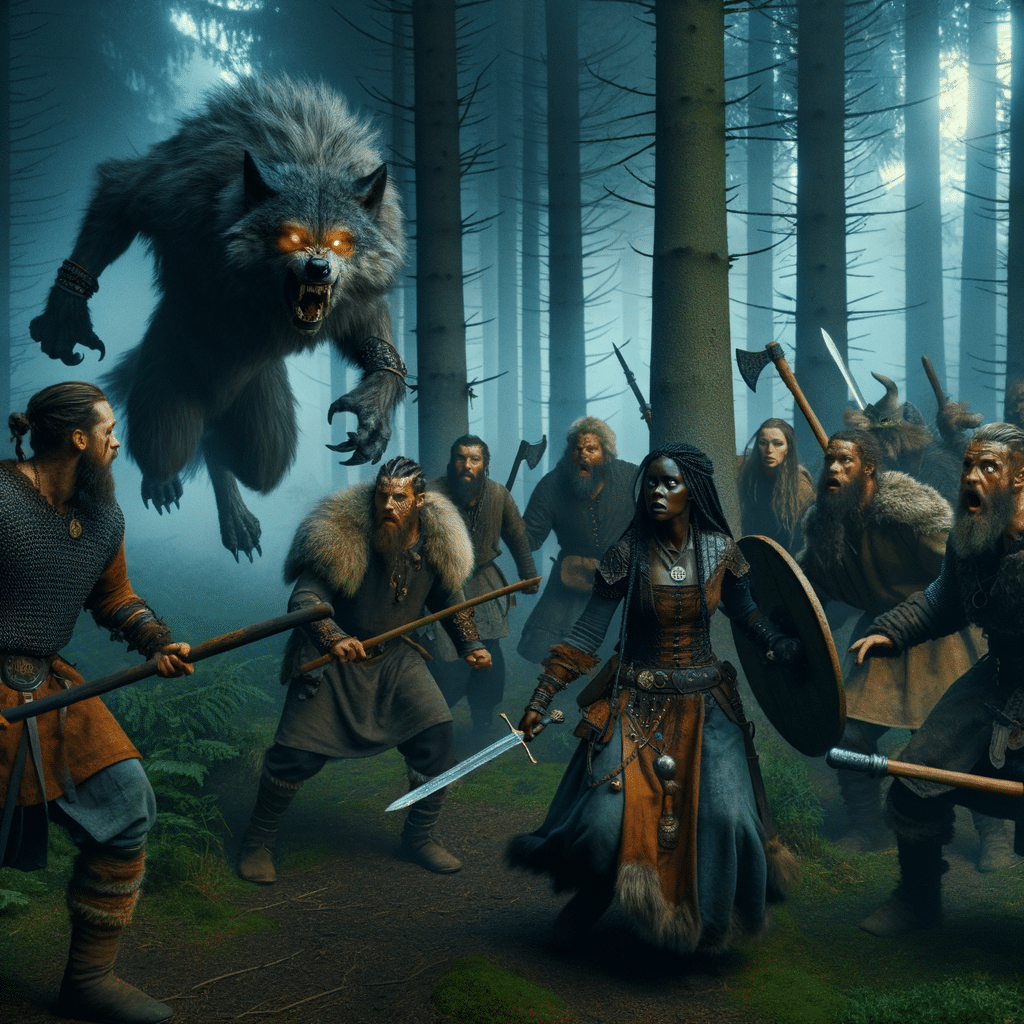
Norse mythology has a lot to say about wolves, werewolves, and lycanthropy. Geri and Freki, two wolves, are with Odin, the main god of the Vikings. The 13th-century epic Norse poetry book Poetic Edda has numerous references to these wolves, even though little is known about them or their purpose beyond being Odin’s friends and guardians.
Additional references to wolves and werewolves in Viking mythology provide witness to the monsters’ dual natures and, consequently, the harmony between chaos and order in the Viking world. Sköll and Hati, two wolves that follow the sun and moon across the skies and are thus in charge of the emergence of night and day and, consequently, the cycles of the seasons, are examples of the significance of wolves in Norse cosmology.
It must be acknowledged that their names—which translate as “one who mocks” and “one who hates”—are intriguing titles for two creatures whose job it is to keep time passing. Maybe, though, these names make sense when one realizes that the wolf’s father is Fenrir, the enormous child of the trickster deity Loki and the female giant Angerboda.
The Place of Fenrir at the End and Start of the World
Fenrir is associated with the destiny of the gods, whereas Sköll and Hati are linked to the Norse cosmology. As a wolf cub, the gods in Asgard first raised him. However, everyone was aware of the prophecy that he was created to kill Odin, so the gods chose to lock this enormous and fierce creature in enchanted chains that would not let him free out of fear (see above).
But according to tradition, Sköll and Hati finally caught their meal and ate the sun on the eve of Ragnarok. The enormous Tree of Life, also referred to as the Yggdrasil in Norse mythology, started to tremble as darkness fell. This made the ground tremble, uprooting the enchanted bonds that held Fenrir and paving the way for the wolf to finally escape. Regaining his ability to run, he sprinted over the landscape, consuming all in his path as he prepared to meet his fate.
It is crucial to comprehend how chaos and order coexisted in Norse mythology that such a horrific creature would play a major part in the fight to end all days and, thus, make it possible for a new world to arise.
Furthermore, the fact that this animal was a wolf emphasizes the respect the ancient people held for these animals while also emphasizing the idea that even things that are respected may still be frightening.

Ölfhéðnar’s Literary Relationship with Werewolves
Odin, the most significant god to the Vikings, is reported to have traveled with two more wolves, Geri and Freki. They are mentioned in the 13th-century epic poem collection Poetic Edda, and are frequently associated with the myths surrounding the aforementioned úlfhéðnar.
Numerous academics assert that the abundance of wolf and werewolf stories seen in early medieval Scandinavian literature all allude to the Álfhéðnar. As proof, they point out that not only are a number of werewolf tales associated with conflict or heroic deeds, but there are also 14 werewolf tales out of 46 in the Sagas of Iceland, a nation founded by Vikings that was entirely bereft of real wolves!
In Sigmundr and Sinfjötli’s tale, father and son venture into the forest, where the young Sinfjötli has to rediscover his wild side in order to develop into the greatest fighter he can be. Later on in the story, the two guys come across two more people who are dozing off after spending nine days transformed into wolves by a sorcery. They can take off their wolf skins on the ninth day, which they do, allowing Sigmundr and Sinfjötli to take them. The two robbers instantly transform into wolves, and after splitting up, each “shapeshifter” goes on a murderous rampage. Even later, once they have transformed back into men and are back home, Sinfjötli adopts the moniker ylfingr, which translates to “wolfling,” and he claims that this indicates that he is “a noble beast.”
Ocean Wolves
It’s unclear if all Vikings saw themselves as wolves or wolflings, but in the nations they invaded and pillaged, they undoubtedly had a reputation for resembling these vicious creatures. The English chronicler Simeon of Durham likened the Vikings to “fearful wolves” when narrating the legendary raid that took place in 793 CE off the coast of what is now Northumberland. He claimed that the Vikings not only stole, tore, and killed sheep, oxen, and beasts of burden, but also priests, deacons, and groups of monks and nuns.
William of Jumieges, a Norman monk who lived in the eleventh century, likened these terrifying fighters to “agile wolves set out to rip apart the Lord’s sheep.”
The fact that they “prowled” the ocean in search of a territory to raid further enhanced their reputation as true “sea wolves.” It’s interesting to note that Adolf Hitler used this designation for his German Navy during World War II. He coined the phrase to compare his U-boat fleet, which operated in wolf packs throughout the war, to the legendary Viking raids that terrorized coastal towns all over the western European coast.
References
Downey, P. M. (2023). The Werewolf Motif in Medieval Irish and Norse Literature: A Study on the Social Effects of Werewolf Characters (Master’s thesis).
Guðmundsdóttir, A. (2007). The werewolf in medieval Icelandic literature. The Journal of English and Germanic Philology, 106(3), 277-303.
Su, M. (2020). Werewolves in old Norse-Icelandic literature (Doctoral dissertation, University of Oxford).
Leave a Reply