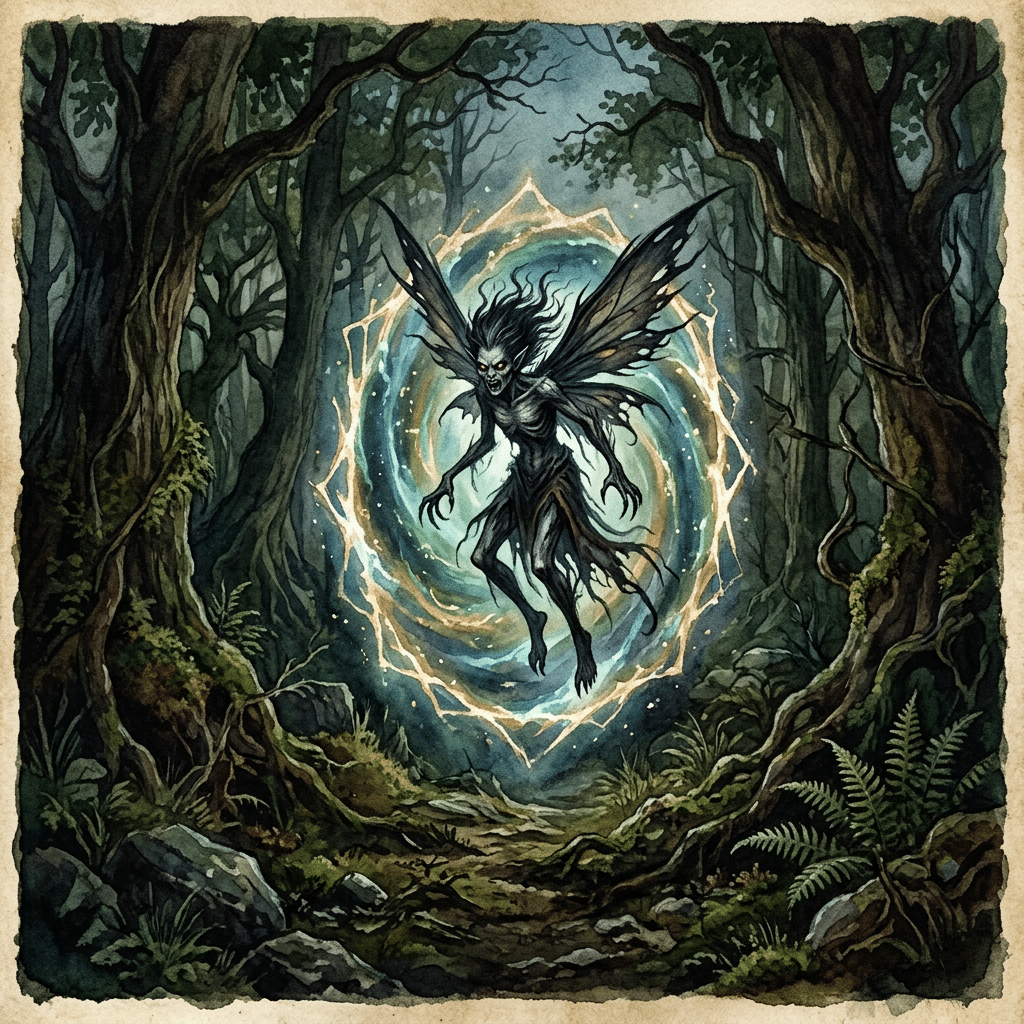
The notion of fairies has captivated human imagination for a considerable amount of time. These mystical creatures are sometimes portrayed as having a lifespan that surpasses human comprehension, thereby making them appear eternal to humans. The way time bends in the fairy realm in comparison to our temporal measurements—a place where minutes could become years and a single night could last centuries—is evidence of this immortality. In Ralph of Coggeshall’s medieval tale of Malekin, there are instances of these temporal distortions. Speaking in a childlike tone, this ghost stated that he had been living in Fairyland for seven years and that another seven years were yet to pass before he was reintegrated into the human race.
Fairies are elusive, as demonstrated by Malekin’s ghostly presence, which could be sensed and sometimes seen—most notably as a small person dressed in white. His story provides an insight into the mysterious passage of time in the fairy realm since it makes use of the number seven, a mystical figure that frequently appears in fairy lore, as well as the idea of a year-long delay. The story also discusses the fairies’ love of disappearing, which is made possible by magical hats, and their relationships with people, which are marked by a mixture of pleas and prohibitions.

A common theme in folklore is the temporal distortion that people who enter or are transported into fairyland experience. For example, people who vanish for years reappearance young, only to pass away suddenly a short while later. On the other hand, abducted children may mature into adults in the world of fairies while just a few days pass in the human world. This phenomenon is embodied in the Irish mythology narrative of Oisín. After breaking a taboo and marrying Niamh, the Queen of Tir na n’Og, Oisín discovers that decades have passed since his brief visit to Ireland, which culminates in his transformation into an elderly man when he gets off his horse.
On the other hand, the story from Pembrokeshire describes a shepherd who, after living among the fair folk for years, breaks the spell by touching a forbidden fountain, only to find himself back in his pastoral life in a matter of minutes. These stories highlight how powerful and erratic fairy tales about time may be.
In addition to being adept at manipulating time, fairies are also renowned for their cunning. Their antics vary from harmless hair tangles, which are jokingly called “elf locks,” to more annoying deeds like causing objects to become excessively heavy or ruining milk. Such acts show a lighthearted but possibly vindictive nature, depending on how the fairies interpret human deference or insult.
Fairies are playful creatures with a variety of magical abilities. They control the weather and the seasons; they can bring about disease or calamity, but they can also bring about fertility and healing. Under the fairies’ watchful supervision, a farmer who heeds their wisdom may prosper; one who incurs their wrath faces certain ruin. The fairies are more powerful than humans in terms of illumination, clairvoyance, and increased senses. One of their distinguishing characteristics is their invisibility, yet fairies occasionally decide to show themselves, which frequently leaves onlookers perplexed.

Even if their healing abilities vary, fairies’ ability to administer healing ointments and delicacies or heal quickly on their own illustrates their connection to life and regeneration. They further solidify their status as creatures of great mystery and awe with their connectivity with animals, their capacity to call creatures, and their gift of flight—whether via magical levitation or perched upon natural objects.
All things considered, the world of Fairyland and its people represent an intriguing fabric of enchantment, mystique, and timelessness. We are given a glimpse into a world where the incredible meets the everyday through the stories of Malekin, Oisín, and countless others. The bounds of reality are as mutable and flexible as the whims of the fairies themselves.
Further Reading
Briggs, K. (1967). The Fairies in English Tradition and Literature. Chicago: University of Chicago Press.
Katharine Briggs’ comprehensive work is a seminal text in the study of English fairy folklore. The author delves into the rich tapestry of fairy traditions, exploring their origins and the myriad forms they take in literature and popular belief. This book was selected for its scholarly approach to the subject and its broad coverage of fairy lore, making it an essential read for anyone interested in the historical and cultural aspects of fairies.
Latham, M. (2004). Discovering English Folklore. Buckinghamshire: Shire Publications.
Monica Latham’s book offers an accessible introduction to the broader field of English folklore, including chapters dedicated to the role of fairies within this tradition. Chosen for its reader-friendly format and clear writing style, this book serves as an excellent primer for those new to the subject and who wish to understand the context in which fairy folklore has developed and persisted in England.
Silver, C. S., & Fries, N. J. (1999). Celtic Folklore and Christianity: Studies in Memory of William W. Heist. Santa Barbara: ABC-CLIO.
This collection of essays provides an in-depth analysis of the intersection between Celtic folklore, of which fairies are a significant part, and Christian thought. The book was selected for its focus on the syncretism between these two belief systems and the way in which Christianity has influenced and been influenced by Celtic fairy traditions. It is an invaluable resource for those interested in understanding the complex layers of religious and cultural influences on the fairy tales of the British Isles.


Leave a Reply