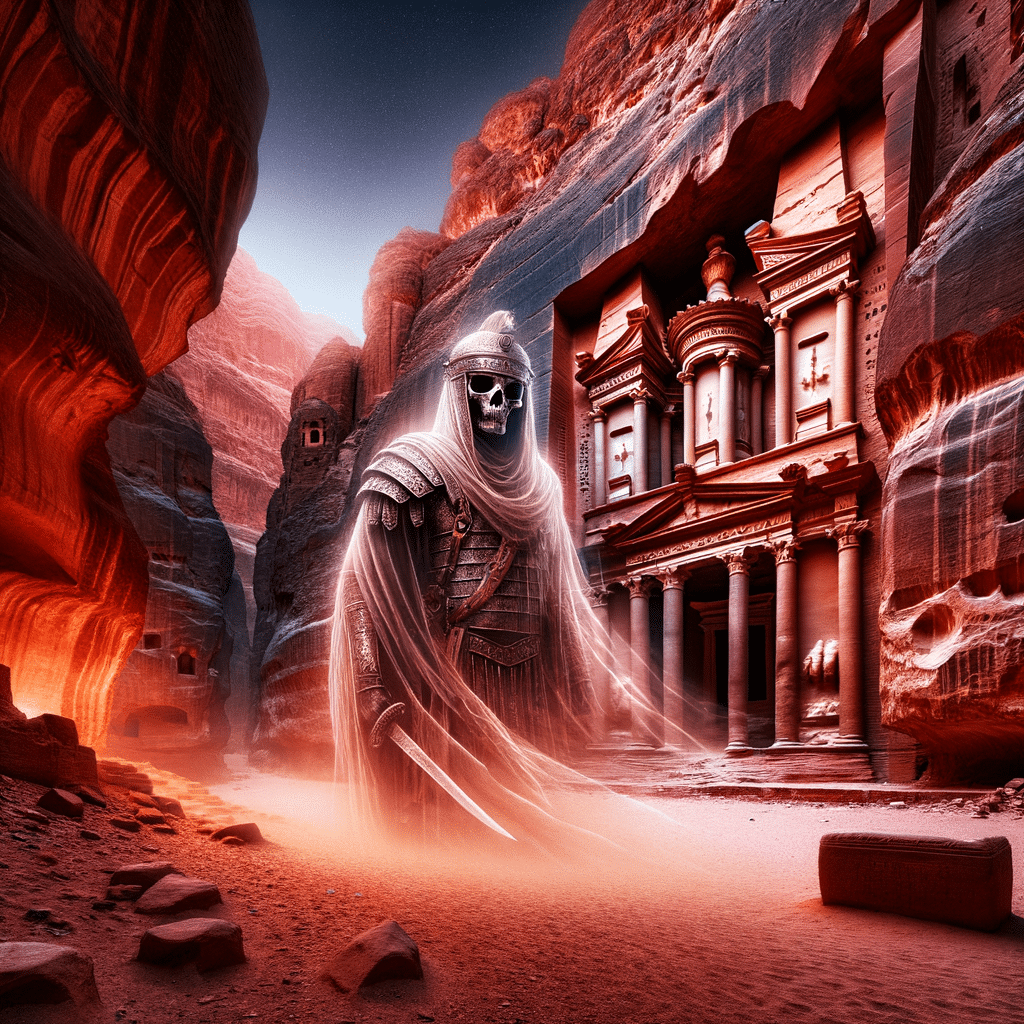
Travelers, archaeologists, and mystery seekers have been enthralled with Petra, the ancient city etched into rose-red cliffs in southern Jordan, for ages. Once lost to history, this UNESCO World Heritage site is not only a mystery but also a wonder of ancient engineering. Petra never ceases to amaze and astound, from its historical significance to reported paranormal activities and influence on contemporary culture.

Petra History
Petra, which the Nabataean Arabs founded in 312 BCE, developed as a significant conduit for trade between ancient civilizations. The Nabataeans skillfully chiseled intricate buildings into the sandstone cliffs, establishing a metropolis whose design complemented the surrounding scenery. The Treasury (Al-Khazneh), Petra’s most well-known building, represents the height of Nabataean artistry. Due to its advantageous location along major commercial routes, the city flourished and eventually became an essential conduit between Egypt, the Levant, and Arabia.
In 106 AD, the Roman Empire seized Petra, bringing it into the Arabian Petraea province. The city grew and prospered during the Roman era. The Romans contributed their own architectural features, such as a colonnade roadway and a huge theater that could hold thousands of people. During this period, the city thrived amidst the dry desert, thanks to the implementation of a complex water management system and the construction of numerous public buildings (Fiema, 2003).
But in the fourth and sixth centuries CE, a succession of strong earthquakes along with shifting trade routes caused Petra to gradually deteriorate. The outside world eventually forgot and abandoned the city, except for the Bedouin tribes living nearby. Not until 1812, when Swiss explorer Johann Ludwig Burckhardt made a second discovery of Petra, did Western scholars and travelers become aware of it (Kennedy & Philby, 1925).

Paranormal Mysteries
Beyond its historical significance, Petra exudes a strange air. There are rumors that the historic grounds are the source of some paranormal activities. Some tourists claim to have sensed an enigmatic presence in the Siq, the city’s slender gorge. Some say they heard weird whispers reverberating through the empty halls or have seen ghostly figures close to the Royal Tombs. Even if these reports are unconfirmed, they heighten Petra’s allure and encourage conjecture about the alleged spiritual force kept within its old walls.
The Treasury building’s purpose remains one of Petra’s most persistent mysteries. Despite its name, a lot of archaeologists think it was more of a temple or royal mausoleum than a place to hide riches. There is still discussion and conjecture surrounding the actual purpose of this amazing building (Kanellopoulos, 2004).
Petra’s complex architecture and engineering are often the subject of alien speculation. Proponents contend that ancient human civilizations could not have achieved the accuracy and intricacy of Petra’s rock-cut monuments, especially the Treasury. They speculate that the Nabataeans may have received advanced technology from aliens or assisted in building. These hypotheses sometimes cite the difficulty of using archaic tools to carve such complex designs into solid rock as proof of extraterrestrial intervention.
Another theory about aliens suggests that Petra served as an alien visitor’s base or landing spot. This theory’s proponents have occasionally proposed that alien technology storage facilities or extraterrestrial life could reside in Petra’s numerous empty rooms and corridors.
Regional folklore frequently connects Petra to djinn, mystical beings from Islamic and Arabic mythology. Some people think that the old city is home to djinn, strong spirits with the ability to affect human affairs. There are theories that the djinn helped build Petra, or that they are still watching over treasures buried beneath the site.
Some residents and tourists have reported seeing weird occurrences that they link to djinn activities, like eerie lights, unusual noises, or ghostly sensations. These narratives frequently concentrate on locations such as the Siq, the slender canyon that leads to Petra, or the more secluded caves and ruins.
Keep in mind that these claims lack scientific and archaeological evidence. Rather than alien or supernatural intervention, mainstream historians and archaeologists credit Petra’s extraordinary features to the creativity and expertise of the Nabataeans and subsequent Roman occupants. Petra was constructed by actual people.
Modern Impact
Petra has had a significant impact on modern popular culture and tourism. The location has garnered significant popular notoriety and attention because of its inclusion in multiple films, most notably Indiana Jones and the Last Crusade. Because of the city’s unique charm and mystique, it has become a top travel destination for people all over the world, greatly boosting Jordan’s travel and tourism sector (Eliasoph, 2014).
Petra’s famous facades and enigmatic atmosphere have influenced innumerable creative works in literature, art, and even video games. Archaeologists are still researching the site using cutting-edge technologies to find additional structures and learn more about the prehistoric occupants’ lives.
Mythology and folklore significantly influence the understanding of historical sites such as Petra, influencing not only public opinion but also, to some extent, scholarly research. These components offer important insights into the worldviews, cultural beliefs, and values of the people who lived at or visited these locations, giving us a glimpse into how ancient societies perceived the world and their place in it. Official records often fail to document historical details that folklore frequently preserves. These legends, though frequently inflated or changed over time, occasionally inspire fresh insights or theories among scholars. Mythical links can also aid in the preservation of a site, as local communities are more likely to defend a location that holds special meaning or is considered sacred.
Stories and folklore about a site like Petra can draw in more visitors and money for study and preservation by making it seem more fascinating to tourists. Mythological readings of historical events can occasionally cast doubt on well-accepted theories, pushing academics to reevaluate their presumptions and pursue novel lines of inquiry. Myths and legends about historical sites frequently play a significant role in the cultural identity and heritage of local communities by giving them a deeper symbolic meaning and converting them from just physical locations to sites of spiritual or cultural significance (Tuttle, 2013).
Understanding historical settings through the lens of folklore and mythology can facilitate interdisciplinary research across disciplines including anthropology, literature, religion studies, and archaeology, leading to a more comprehensive understanding of the site. Despite its value, folklore has the potential to distort historical facts. Researchers must carefully balance folklore stories with historical and archaeological information. Modern folklore and urban tales, such as those speculating about aliens at Petra, reflect contemporary cultural preoccupations. We can investigate these to gain insight into contemporary perspectives on history and the unexplained.
Conclusion
Indigenous Bedouin folklore, in the case of Petra, has contributed to our understanding of the site’s recent history and helped preserve information about the region over decades lost to the outside world. Stories about djinn and hidden wealth, which also reflect elements of Arab and Islamic culture, enhance Petra’s mystique. But while interpreting history, it is imperative to approach mythology and folklore with a critical eye. Even though they can occasionally preserve historical knowledge and offer important cultural context, we should also consider scientific analysis, historical texts, and archaeological evidence to provide a complete picture of places like Petra.
People from all over the world are still enthralled and motivated by Petra’s wonders. It is a place where the past and present seem to merge because of its amazing history, which includes the Roman occupation’s grandeur and the Nabataeans’ inventiveness, as well as its purported paranormal elements. Petra is a monument to human inventiveness and tenacity, beckoning us to contemplate the mysteries it still conceals and the civilizations that previously called it home as fresh study illuminates this ancient marvel.
References
Eliasoph, P. (2014). Bucket List Bonanza: Petra’s Ancient Pagan Sites Inspired Indiana Jones and Lawrence of Arabia. Venu, 24.
Fiema, Z. T. (2003). Roman Petra (AD 106–363): a neglected subject. Zeitschrift des Deutschen Palästina-Vereins (1953-), (H. 1), 38-58.
Kanellopoulos, C. (2004). The temples of Petra: An architectural analysis. Archäologische Anziger, 1, 221-239.
Kennedy, A. B. W., & Philby, H. S. J. B. (1925). Petra: its history and monuments. Country life.
Tuttle, C. A. (2013). Preserving Petra sustainably (one step at a time): The Temple of the winged lions cultural resource management initiative as a step forward. Journal of Eastern Mediterranean Archaeology and Heritage Studies, 1(1), 1-23.




Leave a Reply