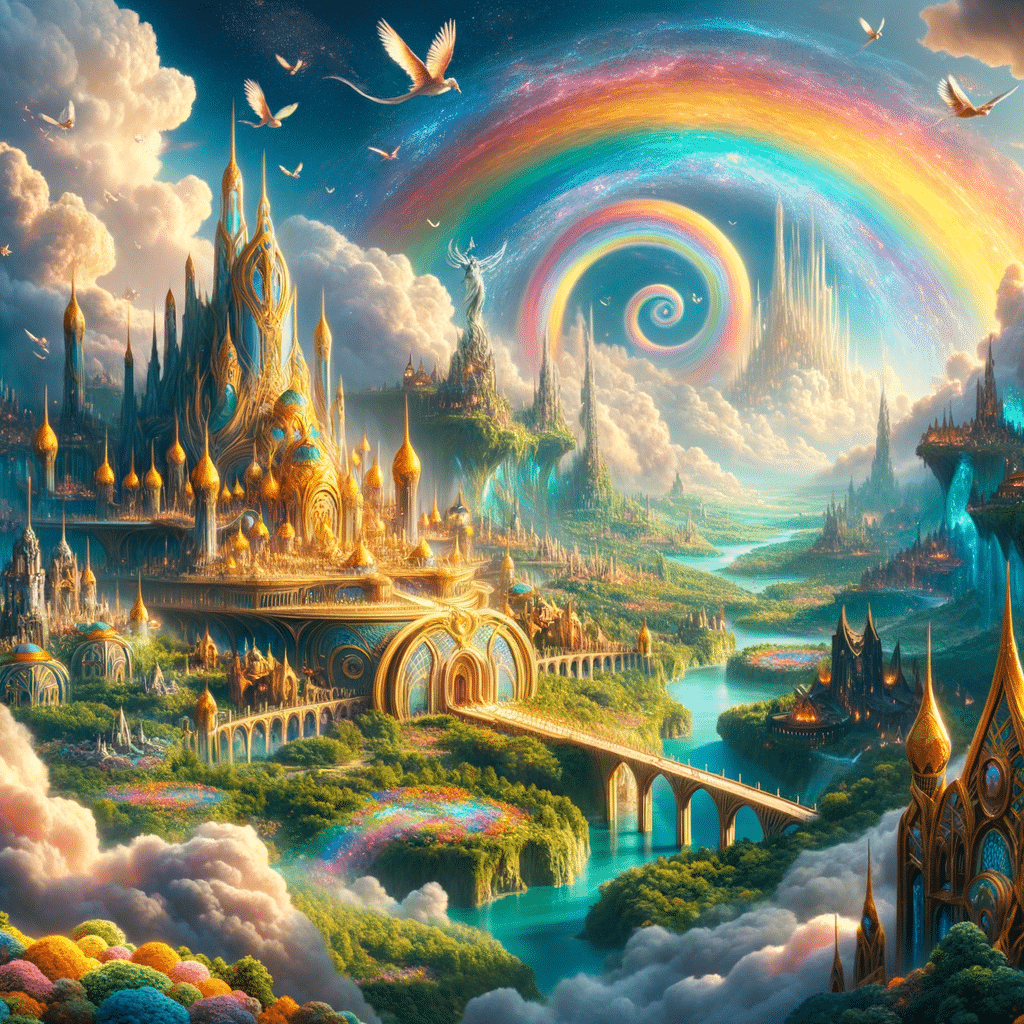
Since the dawn of human civilization, we have sought to understand the forces that shape our world and our existence. The ancient Norse people were no exception, crafting a vivid mythos to make sense of the cosmos, one populated by legendary deities both mighty and flawed. Join us on an epic journey into the captivating realm of Norse mythology as we unravel the dramatic tales of gods and giants that laid the foundations for modern traditions and captured the human imagination for countless generations.
In the beginning, before the beginning of time itself, there was only a great void called Ginnungagap—an abyss of pure nothingness where the forces of scorching heat and bitter cold collided. From this primordial clash of elemental fire and ice emerged the first being, the towering primeval giant known as Ymir. It was from Ymir’s own bodily remains that the gods Odin, Vili, and Ve would go on to painstakingly craft the nine realms, turning his flesh into the fertile lands, his blood into the encircling oceans, and his mighty bones into the soaring mountain ranges.
At the head of the divine pantheon reigns Odin, the wise and venerable All-Father who leads the gods from his divine palace in Asgard. So unquenchable was Odin’s profound thirst for knowledge that he offered one of his eyes as sacrifice, hanging himself upon the branches of the great cosmic tree Yggdrasil for nine agonizing nights to gain mastery over the mysteries of the runic alphabet. His beloved wife Frigg, the radiant queen of the gods, possessed the gift of prophecy but was often tormented by the visions she foresaw, including the tragic and unavoidable death of her favored son Balder, the gentle god of light, hope, and purity, whose senseless murder at the hands of a delusion cast by Loki would set the apocalyptic events of Ragnarok in motion.

Among the gods stands the mighty Thor, the fearless thunderer who wields his enchanted hammer Mjolnir as an unbreakable bulwark of protection for the realms. Feared and revered by both gods and mortals, Thor’s presence booms like thunder as he fights to uphold order in the cosmos. His counterpart is the red-headed fertility god Freyr—a lord of peace and prosperity worshipped by the Norse for his life-giving powers that ensure bountiful harvests. Freyr’s twin sister Freyja reigns as the radiant goddess of love and beauty, ushering half of the warriors slain in battle to the verdant paradise realm of Fólkvangr.
No tale of the Norse gods would be complete without Loki, the cunning trickster whose penchant for mischief and deception ultimately leads him to betray the gods and join the ranks of the giants and other monstrous forces gathered at the great battle of Ragnarok. On that fateful day, the shining chrome watchman Heimdall, the immortal guardian tasked with guarding the rainbow bridge Bifrost, will sound the Gjallarhorn to rouse the gods to their final struggle. There the courageous Odin, alongside Thor and their divine kin, will wage an apocalyptic war against the giants, the undead armies of Hel’s realm, and the great cosmic serpent Jormungand itself.
The dramatic tales of the Norse gods explore profound themes that have echoed across human civilization—of fate and sacrifice, of the fragile balance between order and chaos, and of humble humanity’s role as mere pieces upon the game board of divinity. While Ragnarok may bring an end to the old world of gods and beasts, it also represents the possibility of rebirth and renewal, a new world to emerge from the ashes of the old. The gripping narratives of figures like Odin, Thor, Balder, Loki, and so many others serve as engaging mythological explanations for the natural forces that governed the ancient Norse world while simultaneously reflecting poignant truths about the triumphs and struggles of the human condition. Let the grand sagas of the Vikings transport you to the awesome and unforgiving realms where gods, giants, and heroic mortals waged battles that still resonate across the ages.

Further Reading
Faulkes, A. (Trans.). (1995). Edda: Snorri Sturluson. Everyman.
Flowers, S. (1989). The Galdrabók: An Icelandic Grimoire. S. Weiser.
Lindow, J. (2001). Norse Mythology: A Guide to the Gods, Heroes, Rituals, and Beliefs. Oxford University Press.
MacLeod, M., & Mees, B. (2006). Runic Amulets and Magic Objects. Boydell Press.
Mallory, J. P. (2005). In Search of the Indo-Europeans: Language, Archaeology and Myth. Thames & Hudson.
Orchard, A. (1997). Dictionary of Norse Myth and Legend. Cassell.
Puhvel, J. (1989). Comparative Mythology. Johns Hopkins University Press.
Simek, R. (2007). Dictionary of Northern Mythology (A. Hall, Trans.). D.S. Brewer.
Turville-Petre, E. O. G. (1964). Myth and Religion of the North: The Religion of Ancient Scandinavia. Holt, Rinehart and Winston.

Leave a Reply