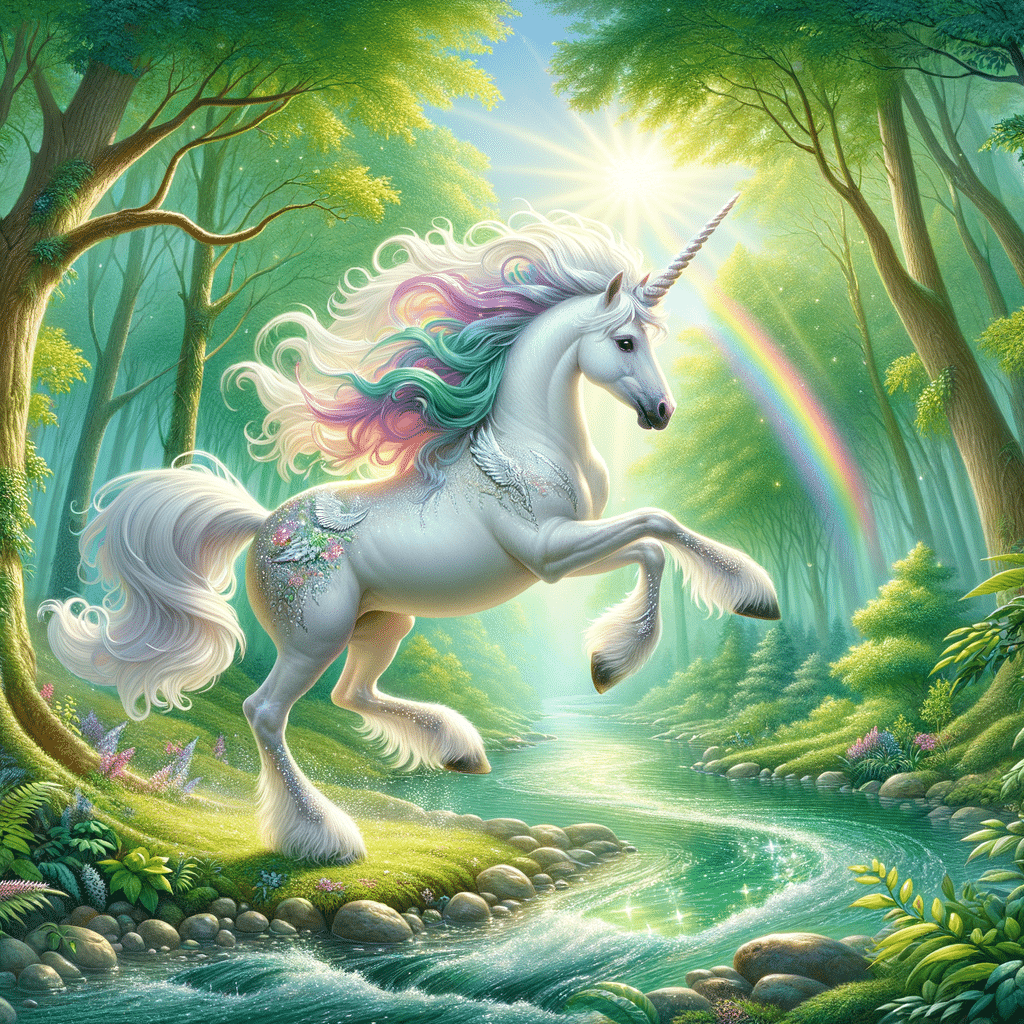
Few mythological animals in human history have captivated people’s attention as much as the unicorn. Usually portrayed as a horse-like monster with a single spiral horn sticking out of its forehead, this magnificent beast has evolved from mythology to become a potent psychological symbol ingrained in our collective psyche. In both ancient mythology and contemporary popular culture, the unicorn has consistently symbolized humanity’s loftiest aspirations and most cherished values.

Unicorn Purity
Ancient Greek natural history writings provide the earliest known accounts of unicorns, characterizing them as ferocious, untamed animals indigenous to India. According to these stories, particularly those written by Ctesias in the fifth century BC, the unicorn was a strong animal with a multicolored horn that had therapeutic qualities. During the Middle Ages, European bestiaries transformed this perception by portraying unicorns as pristine white animals that only virginal maidens could subdue. The unicorn myth’s development followed the shifting morals and psychological requirements of society (Orfanidis, 2021).
Unicorns became potent emblems of grace, purity, and spiritual enlightenment in medieval art and classical mythology. Their single horn reflected the oneness of earthly and divine nature, and their white tint stood for innocence and spiritual purity. Sometimes portrayed as a spiral, the horn itself symbolized spiritual development and metamorphosis. The unicorn became a representation of Christ in medieval Christianity, and its purported capacity to cleanse poisoned water symbolized spiritual purification (Alexander, 2015).
According to Carl Jung’s theory, unicorns hold a special place in the collective unconscious from a psychological standpoint. They stand for the fusion of conflicting energies: the tame and the wild, the spiritual and the physical, the masculine (the horn) and the feminine (the horse’s caring nature). Unicorns frequently show up in imagination and dreams as guides to the unconscious world, symbolizing the dreamer’s pursuit of spiritual development and self-discovery (Thiery,1993).
Beyond conventional symbology, the unicorn has a deeper psychological significance. They symbolize humanity’s capacity for awe and our ability to derive meaning from the fantastical while being purely imaginary creatures. Their perceived inaccessibility and rarity reflect our own need for individuality and meaning in a society that is becoming more and more homogenized. The fact that unicorns frequently appear exclusively to those with pure hearts suggests our innate need for affirmation of our inner value.
Eastern vs. Western Unicorns
As a reflection of their own philosophical traditions and cultural ideals, Eastern and Western civilizations have created different, though sometimes overlapping, interpretations of unicorn symbolism. The unicorn, which represents grace, purity, and a divine connection, usually takes the form of a horse-like creature with a single horn in Western culture. European unicorns of the Middle Ages often portrayed themselves as white, peaceful yet fierce, and only tamed by a virgin. The unicorn came to symbolize Christ, divine incarnation, and spiritual purity as a result of this symbolism’s strong effect on Christian iconography (Fazlellahi & Ghiasian, 2024).
Eastern cultures, especially Chinese and Japanese, view unicorns very differently. Frequently mistranslated as unicorn, the Chinese qilin (or kirin in Japanese) is not physically similar to its Western equivalent. Usually like a dragon, the qilin possesses scales and occasionally several horns. It appears during the reign of beneficial kings or the birth of famous sages and represents wisdom, compassion, and beneficial fortune; it was supposedly present before the birth of Confucius.
While Eastern unicorns symbolize justice, knowledge, and prosperity, Western unicorns are often associated with feminine energy and purity. The qilin, in contrast to the Western unicorn’s more submissive metaphorical position, is believed to reward the good and punish the wicked. In addition, Eastern unicorns are more strongly associated with leadership and political power, whereas Western unicorns are more strongly associated with spiritual and individual values.

Modern Interpretations
Though their fundamental psychological value has not changed, modern interpretations of unicorns have. They have become emblems of individualism, inventiveness, and self-expression in today’s popular culture. The recent explosion of unicorn-themed merchandise, ranging from apparel to corporate branding, reflects a widespread need for fantasy and wonder in a frequently pessimistic world. Social media and digital art, especially among younger people, have further strengthened the unicorn’s relationship with individuality and a positive self-image (Imorde, 2024).
In unicorn-themed children’s books, innocence plays a number of important roles in both narrative and the development of young readers. Children’s books commonly portray unicorns as kind protectors of young readers’ innocence, providing secure environments for them to examine difficult feelings and valuable life lessons. Because of its innate innocence, the unicorn is a perfect figure to guide kids through morally difficult situations while preserving their sense of wonder.
Although it is not specifically children’s literature, the unicorn in classic works like Peter S. Beagle’s The Last Unicorn symbolizes both innocence and the price of preserving it in a flawed world. More overtly kid-friendly series, such as Bruce Coville’s Unicorn Chronicles, use unicorns to protect youthful wonder from forces that could otherwise destroy enchantment and creativity. Unicorns frequently serve as a bridge between pure imagination and practical difficulties in contemporary children’s literature. For instance, while preserving the unicorn’s historical connotation of purity, many modern unicorn tales tackle themes like courage, friendship, and self-acceptance. This gives young readers a comfortable, non-threatening lens through which to explore difficult feelings (Łaszkiewicz, 2014).
Unicorn-themed picture books usually highlight their magical abilities while imparting straightforward moral teachings. While unicorns’ rarity supports messages about individuality and self-worth, their historic capacity to purify water becomes a metaphor for fixing faults or assisting others. Children respond well to unicorns.
Unicorn symbolism has a significant and complex influence on contemporary society. Because unicorns are traditionally associated with rarity and value, the term unicorn has come to refer to rare, extremely successful businesses in the business world. Personal development and wellness circles frequently use unicorn imagery to encourage self-acceptance and celebrate individuality. This contemporary modification shows how resilient the symbol is psychologically and how it may change to meet shifting societal demands.
Conclusion
The unicorn’s enduring attraction in the human mind reveals profound psychological truths about our nature and goals. The unicorn has undergone constant change while retaining its fundamental symbolic significance, evolving from an old mythological beast to a contemporary representation of uniqueness and optimism. Its enduring appeal in human civilization illustrates our never-ending need for wonder, self-discovery, and purity in a world growing more complicated by the day. The unicorn continues to serve as a potent reminder of our potential for wonder and our need for a connection with something transcendent and pure as we continue to negotiate the difficulties of contemporary life.
References
Alexander, S. (2015). Unicorns: The Myths, Legends, & Lore. Simon and Schuster.
Fazlellahi, S., & Ghiasian, M. R. (2024). The Evolution of the Unicorn Motif of the in the Shahnama Illustrations (14th-16th Centuries). Negareh Journal.
Imorde, J. (2024). Unicorns in Contemporary Popular Culture. The Middle Ages and Popular Culture Volume 4, 205.
Łaszkiewicz, W. (2014). Peter S. Beagle’s Transformations of the Mythic Unicorn. Mythlore, 33(1 (125), 53-65.
Orfanidis, G. (2021). Chased by a Unicorn. Medievalista. Online, (29), 183-209.
Thiery, P. (1993). The process of individuation: A Jungian approach to” Vendredi ou les limbes du Pacifique”, Michel Tournier,” The Unicorn”, Iris Murdoch,” Death in Venice”, Thomas Mann. University of South Carolina.



Leave a Reply