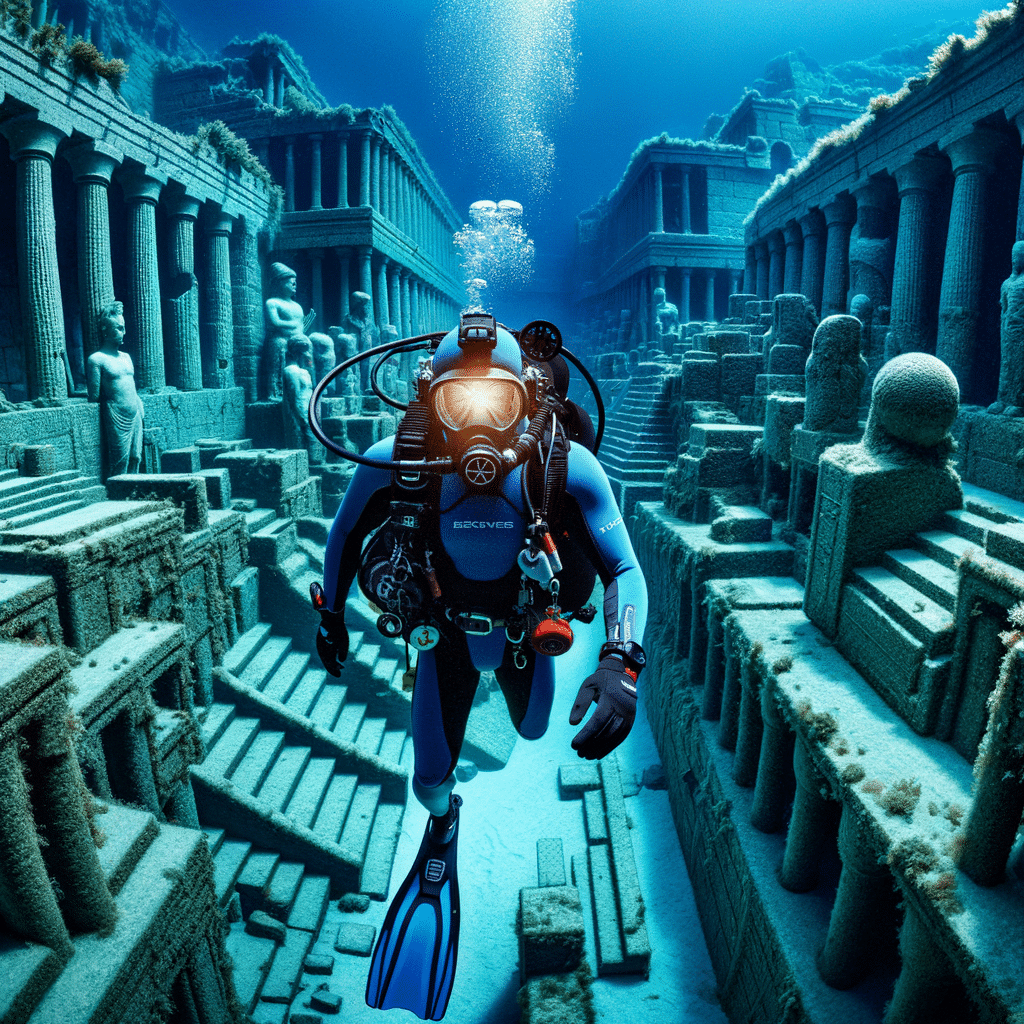
For millennia, Thonis-Heracleion, an ancient Egyptian city, was a gateway between Egypt and Greece and one of the most significant port cities in the Mediterranean region. Discovered in 2000 beneath the waters of Abu Qir Bay near Alexandria, the enigmatic collapse and eventual submersion of this once-magnificent metropolis have fascinated archaeologists and historians. The city’s dual name—Thonis to the Egyptians and Heracleion to the Greeks—reflects its importance to both Egyptian and Greek cultures.

Description
Thonis-Heracleion’s location near the mouth of the Nile Delta was ideal for regulating the maritime trade entering Egypt. The city erected buildings on top of sand and compacted soil on a system of islands connected by waterways and bridges. The city flourished as a significant economic center thanks to its distinctive physical location, which included multiple harbors and anchorages that could hold hundreds of ships (Fabre & Goddio, 2013).
Ancient mythology attributes the city’s Greek name to Heracles, who is believed to have visited the region during his twelve labors. Important events, such as the coronation of multiple pharaohs, were held at the city’s magnificent temple dedicated to Amun-Gereb. Ancient texts claim that the mythology of Helen of Troy, who took sanctuary there with her lover Paris prior to the Trojan War, further enhances the city’s magical charm (Robinson & Goddio, 2019).
City Destruction
Scientists and academics have proposed numerous explanations for the destruction of Thonis-Heracleion. According to the most widely accepted theory, the city began to gradually sink into the Mediterranean about the eighth century CE as a result of a confluence of natural calamities, including earthquakes, soil liquefaction, and rising sea levels. Some analysts attribute the collapse of the city to the weight of enormous stone statues and temples, as well as unstable sedimentary soil. Land colonization and rising sea levels may have exacerbated these problems, leading to the submersion of the city (Brocard, Goiran & Robinson, 2024).
Geological evidence from the Abu Qir Bay location points to a number of causes for the submergence of Thonis-Heracleion. Seabed core samples reveal discrete sedimentary layers that show progressive sinking interspersed with more spectacular geological occurrences. The evidence points to a series of natural processes spanning several centuries rather than a single catastrophic event.
Seismic research in the area has identified fault lines that run through the Nile Delta, providing evidence of significant earthquake activity in the late Roman and early Arab eras. These earthquakes would have undermined the city’s already shaky foundation, primarily composed of wet silt and sand layers. Toppled sculptures and broken building foundations are examples of archeological evidence of structural damage compatible with seismic activity.
Soil liquefaction, a process where water-saturated soils lose strength and behave like a liquid under stress, is evident in geological core samples. Large stone temples and statues, some weighing up to 50 tons, subjected these unstable soils to tremendous pressure. Sediment layer analysis reveals several liquefaction occurrences, most likely brought on by earthquakes or severe flooding.
Sea levels gradually increased over the city’s later years, according to environmental statistics, and the Nile Delta region significantly subsided. Differential tidal markers and sediment deposits demonstrating progressive maritime transgression serve as proof of this. The delicate balance of sediment deposition that had previously preserved the city’s foundation might have been different if scientists had discovered evidence of alterations in the Nile’s flow patterns.
By analyzing organic components discovered at different depths, scientists have been able to use carbon dating to produce a timeline of the city’s submersion. These results imply that the process, which resulted in the city’s ultimate abandonment, started as early as the second century CE and picked up speed around the eighth century CE. The preservation of objects in discrete sedimentary strata partially supports this chronology.

Thonis-Heracleion and Atlantis
Historians, scholars, and the general public are very interested in the similarities between Thonis-Heracleion and Atlantis. Many people have drawn intriguing comparisons between the historical truth of Thonis-Heracleion and Plato’s mythical Atlantis. Both cities share a compelling story of thriving maritime civilizations that vanished under the waters (Dawson & Hayward, 2016).
Thonis-Heracleion was a prosperous port city with remarkable architecture, featuring enormous temples and statues that showed its might and cultural sophistication, much like the legendary Atlantis. More than 700 anchors and 60 shipwrecks found in its waters echo Plato’s depictions of Atlantis as a significant naval power. Plato’s depiction of the concentric waterways and harbors of Atlantis is also somewhat similar to the architectural design of Thonis-Heracleion, with its system of canals and islands (Robinson, 2018).
The destruction of Thonis-Heracleion in particular has stoked Atlantis analogies. Several interpretations of Plato’s description of the collapse of Atlantis are consistent with the natural phenomena that caused its submersion, such as earthquakes, soil liquefaction, and flooding. Some researchers speculate that ancient descriptions of cities like Thonis-Heracleion may have influenced Plato’s story, despite the majority of historians agreeing that Atlantis was completely symbolic.
Some alternative historians have suggested that Thonis-Heracleion may have been one of several actual sites that served as the inspiration for the Atlantis story. Even though mainstream archaeologists deny direct connections between the two cities, the parallel of an advanced civilization abruptly losing to the sea has captured the public’s attention and prompted a number of documentaries and books examining possible connections between the mythical Atlantis and the historical Thonis-Heracleion.
Conclusion
Thonis-Heracleion’s discovery and continued excavation have had a big impact on contemporary storytelling and popular culture. The city’s mysterious disappearance has served as a setting for adventure and historical fiction, and both video game and fiction writers have used it to tell their stories. The breathtaking underwater photos of enormous statues and well-preserved antiquities sustain the public’s fascination with ancient Egyptian civilization.
Thonis-Heracleion’s legacy is a potent reminder of the power of nature and the transience of even the greatest human accomplishments. Its discovery has yielded priceless information about the religious customs, marine trade, and cultures of ancient Egypt and Greece. This amazing metropolis is still a reminder of the advanced civilizations that once ruled the Mediterranean region, and both academics and fans are still fascinated by its strange death as underwater digs continue.
References
Brocard, G., Goiran, J. P., & Robinson, D. (2024). Fate of two cities built on sinking ground: slow and fast submergence at Thonis-Heracleion and Canopus, Nile River Delta, Egypt. Urban Geoarcheology, 381-400.
Dawson, H., & Hayward, P. (2016). SUBMERGENCE: A special issue on Atlantis and related mythologies. Shima, 10(2).
Fabre, D., & Goddio, F. (2013). Thonis-Heracleion, emporion of Egypt, recent discoveries and research perspectives: The shipwrecks. Journal of Ancient Egyptian Interconnections, 5(1), 1-8.
Robinson, D. (2018). The Depositional Contexts of the Ships from Thonis‐Heracleion, Egypt. International Journal of Nautical Archaeology, 47(2), 325-336.
Robinson, D., & Goddio, F. (2019). A port at the edge of the Sea of the Greeks: Hellenism in Thonis‑Heracleion, Egypt. Revue archeologique, (2), 435-450.



Leave a Reply