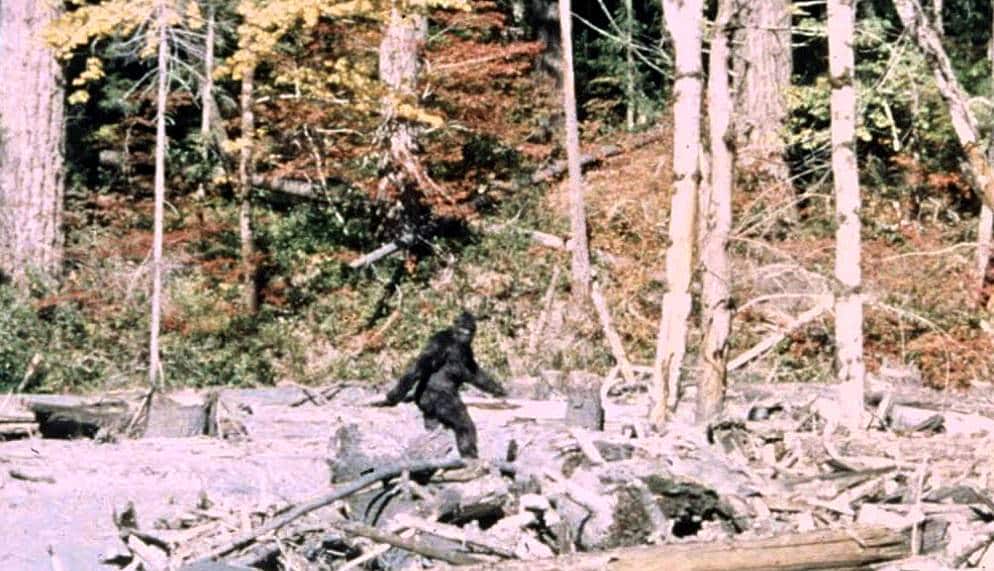
This video is a segment of an online presentation for an anthropology course at Western Illinois University by Dr. Michael Lorenzen. This segment discusses how to think about credible sources when researching cryptozoology and archaeology topics.

[Dr. Michael Lorenzen]
Why this happens is one of the main things in popular culture. If you’re getting into a topic, a lot of this stuff is in the popular imagination. Bigfoot’s more than just, you know, a monster someone sees or a large ape that someone has seen throughout the United States.
It’s entertainment. It’s monstertainment. You can find many reality TV shows about Bigfoot currently airing.
People publish books on this all the time. There are, you know, books that are prepared, you know, non-fiction trying to find Bigfoot. There’s stuff out there that’s fiction that people write.
There’s a whole line of Bigfoot erotica now that people can find on Amazon Kindle. There’s a lot that’ll come up if you’re doing a search, like on Bigfoot. Same thing if you’re looking for some archaeology topics.
You know, the Ancient Apocalypse show, which is now big on Netflix, their number one show, is a lot of pseudo-archaeology. But if you’re looking for stuff on that type of topic, that’s the sort of reference you’re going to find in many cases—the popular culture stuff relating to that. Another reason why a lot of this is difficult is there’s a great deal of what we call woo in pseudo-archaeology and then also encrypted research.
And this is when people get outside the normal scientific method. You know, we have a scientific research method where you make a hypothesis, you go out and study the evidence, and then you draw conclusions of whether or not your hypothesis was correct. And there’s a whole process for finding out whether or not if something is actually valid.
You know, finding out, you know, getting more and better facts to get closer and closer to the truth as best as we can, particularly when we’re dealing with an animal that might be hidden, or if we’re dealing with things that may have happened in the past thousands of years ago. You may never know everything for certain, but you can acquire some knowledge that is more reliable than other information. When you get into woo, that’s when people kind of throw that out.
Some people come up with alternative explanations for why certain things cannot be found. Consider the scenario involving cryptids such as the Loch Ness Monster. The reason you can’t find anything about the Loch Ness Monster is that it travels using portals in the water.
You know, it’s really a time-traveling dinosaur from the past. Or you’re talking about people who are talking about Bigfoot and they claim, well, UFOs deliver Bigfoot and take Bigfoot away. While this may sound humorous to us, if you begin researching the Loch Ness Monster or Bigfoot, you will discover that many people make these claims, and they appear prominently in web searches.
So, they can’t explain scientifically why the species can’t be found, or they can’t explain why, you know, giant bones can’t be found out in the wild, even though they claim that there used to be a civilization of giants in North America. They’ll come up with things like God hid them, the bones, and that they’re not there. They will propose ideas that are untestable, often referred to as woo.
And those, unfortunately, although they might be entertaining, are not really good for finding credible resources or valid sources if you’re doing an assignment for this class. Another important point to consider is that many conspiracy theories exist regarding cryptids, as well as various pseudo-archaeological claims. For example, the reason you can’t find any evidence of Bigfoot may be that the government is covering up his existence.
Or someone might say, “Well, there is a lot of evidence suggesting that Atlantis had colonies in North America, but major archaeological institutions do not want you to know that they are concealing this information.” And, you know, that should immediately raise alarm bells when people start claiming conspiracies. Conspiracies are very difficult to pull off when you have many people.
Many archaeologists and historians around the world are working at various sites, conducting research and excavations. And it’s really difficult to keep every single one of them quiet if they found things that went against, you know, what was a normal narrative. If someone found proof, they would probably say something.
Same thing, you know, with, you know, a government conspiracy to cover up, you know, the Loch Ness Monster or to cover up the existence of Bigfoot. There are so many people that’d be involved in that, it’d be virtually impossible that someone wouldn’t leak this out because it’d be big news and you could get rich really fast if you, like, had this information. It’d make your career.
It is simply not feasible or realistic for a small group of people to maintain a conspiracy, while it would be nearly impossible for hundreds of thousands, or even millions, of scientists in certain fields to keep such information secret, even if they desired to do so. So it’s highly unlikely there’s some sort of conspiracy. Some people use conspiracy to explain why we can’t find evidence.
This is another indication that this method of conducting research is not credible, and the resources being used may not be the most reliable. And again, I mention that because you’re going to find it very common. Some TV shows discuss how the government or scientists are allegedly covering up evidence regarding the death of an ancient culture 8,000 years ago.
But there’s no real evidence that they’re covering up other than the fact that people don’t think like they think. You know, it’s really hard to find proof that there’s a conspiracy, and oftentimes the fact that you can’t find anything is proof that there’s a conspiracy, is what they claim. So just be very careful of that kind of stuff.
There are also challenges associated with locating information in the scholarly literature. I’ll show you some databases because there’s often little evidence for something. There’s not a lot of evidence that there’s a chupacabra running around Latin America, or Puerto Rico, or in Texas.
If you’re looking for information on chupacabras, you’ll find many articles from popular culture; however, few scientists have actively searched for chupacabras because no evidence has been presented to them that supports the existence of chupacabras. So it’s not something that they’re likely to go out and do a lot of study on. Therefore, scientists, historians, or archaeologists are unlikely to devote a significant amount of time to pursuing unproven theories without substantial hard evidence or indicators beyond popular culture.
Additionally, there is some stigma associated with conducting this type of research. If you’re a grad student, you’re not going to go to your professor and say, I want to do my dissertation on Bigfoot or Loch Ness Monster or on Atlantean colonies in North America. Most likely, your proposal won’t receive approval.
It’s really not something that you’re going to want to do research on or try to get research grant funding on. And the reason for that is because there’s not much out there indicating this stuff is real. It’s not a conspiracy that you’re not going to be encouraged to do that.
It’s just that it’s not really a productive way to use your time as a scholar unless some other evidence comes out. And you probably don’t want to make a name for yourself as the Loch Ness Monster professor. I mean, it’s not really going to help your career.
However, if there were compelling evidence regarding the discovery of the Loch Ness Monster—something that could significantly change our understanding of North America’s origins—most scientists and archaeologists would pursue it. If there is actual evidence, scientists and archaeologists will not try to hide it; they will pursue it. Without strong evidence and encouragement, along with some stigma against it, people are not going to pursue it.
That’s going to mean there’s not a lot of scholarship published on some of these topics. There’s simply not going to be some stuff that you might consider the best when you do the research. You’re going to really need to think carefully about your research terms and be a little loose in what you consider some of the valid sources to be.
You don’t want to just, you know, take wild, crazy games from the web. But when you do the cryptid assignment, maybe folklore about a creature’s existence could be considered evidence. Perhaps it could be viewed as a folklore creature, a legendary creature, and not necessarily a physical entity.
Clearly, if you can locate arguments from others, those may also be valuable sources. However, it is advisable to focus on books published by mainstream publishers and consider journal articles that are not available in scholarly peer-reviewed literature. There might still be information available in the New York Times or in some popular news magazines, which are generally more credible than the wild claims you might find on the web.
Again, I’m happy to help you with any one of these topics; locate some credible sources. And I’m sure that your professor would be happy to help you too if you’re not sure if he’s going to accept a particular citation as a valid source as we go through here and see what things might be good and useful for this course. But it might not be as easy to find some stuff on these topics as you might normally find in some other courses dealing with some more mainstream topics.
Again, that’s part of the fun. Just give yourself a lot of time to go in and do some of this research.


Leave a Reply