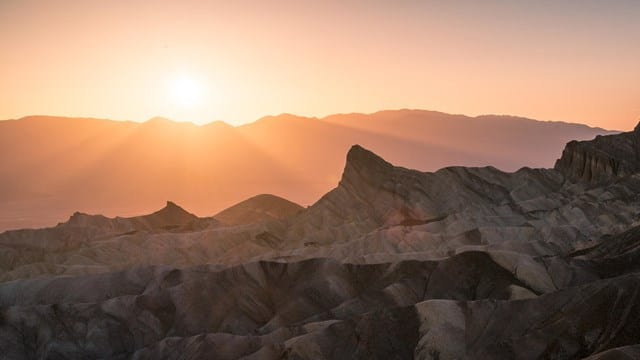
One of the most amazing and tough sites in America, Death Valley National Park is where the natural world appears to lean toward the otherworldly. Running along the California-Nevada border, this tough desert terrain is the lowest, driest, and hottest national park in the United States. Beyond its severe environmental circumstances, Death Valley has built a rich tapestry of ghostly stories and unexplained events that have fascinated tourists and academics alike for years. Set against the backdrop of an already otherworldly terrain, these enigmatic events have confirmed Death Valley’s status as a magnet for individuals looking for experiences outside the realm of conventional explanation.

Overview
With its environment ranging from salt flats lying 282 feet below sea level to mountains rising over 11,000 feet into the sky, Death Valley’s landscape is a study in extremes and paradoxes. Roughly 3.4 million acres of desert wilderness make up the park, marked by great stretches of sand dunes, multicolored rock formations, and uniquely carved badlands. Summer temperatures often approach 120 degrees Fahrenheit, which causes heat mirages to swirl over the valley bottom and helps to create the confusing environment many say enhances paranormal events. This beautiful but tough environment naturally stages the strange—where the line between fact and illusion often blurs in the glistening heat (Roof & Callagan, 2003).
Beginning with the Indigenous Timbisha Shoshone, who lived in the area for centuries before European contact, the human history of Death Valley is as harsh as its geography. With legends depicting different supernatural beings and sacred sites all around the valley, they came to feel a profound spiritual connection to the region. The California Gold Rush of 1849 gave the region its foreboding name when a group of pioneers wandered in the valley looking for a shortcut to the goldfields. Though just one person died before the group found escape, they said back, “Goodbye, Death Valley,” giving the area its lasting moniker. This event set the stage for a difficult interaction between people and this harsh terrain, laying the groundwork for the paranormal reputation that would follow (Hunt, 1975).

Paranormal Death Valley
With many stories focusing on abandoned mining towns like Rhyolite and Skidoo, ghost sightings are maybe the most often reported paranormal events in Death Valley. Visitors have reported seeing ghostly miners going about their everyday activities, transparent people walking through dilapidated buildings, and hearing the ghostly noises of pickaxes hitting stone while no living person toils. Said to roam the corridors of the Furnace Creek Inn, the ghost of a nurse helps visitors and disappears when acknowledged. Particularly close to Scotty’s Castle, where the eccentric prospector Walter Scott is reputed to still walk the land he once claimed as his own, park rangers have gathered hundreds of tourist accounts detailing run-ins with apparitions clothed in period attire from the late 1800s. Certain park spots have become frequent destinations for paranormal researchers and ghost-hunting trips because of these ongoing encounters (Lankford, 2006).
Death Valley is home to numerous strange paranormal events that challenge simple classification beyond conventional ghost sightings. One of the most well-known puzzles in Racetrack Playa is the strange moving rocks, which are heavy stones that mysteriously travel across the flat lakebed, leaving long trails behind them with no obvious power propelling them. Many tourists find these explanations lacking even if scientists have suggested possibilities such as ice and wind (Messina, 1998). Many stories tell of unusual lights floating over the valley floor at night, dancing in patterns too intentional to be dismissed as natural events or planes. Reports of “time slips,” in which hikers say they have briefly entered other time periods, meeting mining facilities long abandoned or indigenous encampments from centuries past before apparently finding themselves back in the present instant, are maybe most unsettling.
Significantly, many paranormal occurrences in Death Valley are linked to the location known as Badwater Basin, which denotes the lowest elevation in North America. Those who visit this enormous salt flat have claimed sensations of being observed by invisible presences, unexplainable emotional reactions from joy to horror, and severe disorientation. Certain park sections see regular electronic equipment failure; cameras catch mysterious orbs and mists; recording devices catch sounds and voices with no apparent origin. Some guests have claimed to see their doppelgängers—exact replicas of themselves—roaming the salt flats or far-off dunes, encounters that deeply unsettle them and challenge reality itself. Some of these stories have inspired certain paranormal investigators to suggest “thin spots” in Death Valley where the boundary between realms sometimes breaks (Dwyer, 2008).
The indigenous viewpoints on Death Valley’s paranormal reputation provide some of the oldest and most reliable justifications for the odd occurrences. Certain valley regions, according to the Timbisha Shoshone people, are portals or doorways linking the physical world with the spirit world. Their oral histories tell of guardian spirits that watch holy places and may seem to the uninitiated as terrifying apparitions or alter the environment to produce unsettling consequences. Some anthropologists argue that these indigenous beliefs might be based on observable events science has not yet completely explained, thereby indicating an alternate knowledge system rather than simple superstition. The longevity of these beliefs throughout centuries implies that whatever odd events in Death Valley had been continuously experienced by human populations long before the arrival of European invaders.
Analysis
Skeptical theories regarding Death Valley’s paranormal reputation emphasize mostly the severe environmental conditions and their impact on human perception. While the great emptiness of the terrain could set sensations of disquiet that the mind reads as supernatural presence, the extreme heat produces strong mirages and might cause hallucinations in thirsty tourists. Certain wind patterns across canyons naturally produce infrasound—low-frequency sound waves below human hearing—which has been experimentally connected to sensations of terror and impressions of supernatural events. The park’s peculiar geology also comprises magnetite and other mineral formations that could cause local magnetic anomalies, perhaps influencing the electrochemical processes of the human brain as well as technological devices. While they provide logical substitutes for supernatural readings, these natural explanations can not fully explain the consistency and particularity of several reported experiences.
Paranormal researchers who have done thorough Death Valley investigations have developed more exotic ideas. Some argue that the severe conditions act as a natural amplifier for mental events, hence increasing latent human capabilities within the park limits. Some believe the valley’s unusual geology, especially its high concentration of quartz crystals in particular rock formations, may collect and periodically release energy in forms that show as apparitions or other paranormal experiences. A tiny but committed group of academics has suggested that Death Valley might be a focus point for interdimensional activity, hence perhaps accounting for the recorded time slips as well as the moving rocks. Although there is no scientific proof, these ideas aim to provide frameworks for understanding events that challenge traditional explanations.
The scholarly investigation of Death Valley’s paranormal reputation uncovers intriguing trends that cross beyond personal experiences. Sociologists say the park’s name alone predisposes visitors to see confusing encounters via a supernatural prism, hence perpetuating a loop of anticipation and interpretation. Sometimes including aspects from popular culture or prior stories, folklorists follow how tales of paranormal experiences change and spread to produce more interesting stories. Psychologists investigate how the solitude felt in the huge desert environment influences memory creation and perception, thereby perhaps clarifying why apparently mundane occurrences could be recalled as exceptional. Though they offer background for knowing how human psychology interacts with uncommon settings to produce significant experiences, these scholarly points of view do not directly refute paranormal assertions.
Conclusion
Standing as a monument to the ongoing human interest with the unknown, Death Valley National Park nevertheless inspires both awe and dread. The sheer number and constancy of paranormal tales from this harsh desert setting call for attention beyond easy dismissal, whether one approaches its secrets from a viewpoint of belief or skepticism. Maybe the real importance of Death Valley’s paranormal reputation is not in deciding if ghosts or interdimensional portals exist objectively, but rather in understanding how these stories mirror our multifaceted relationship with harsh and dangerous terrain. Death Valley’s great emptiness and harsh conditions challenge visitors not just in the outside environment but also in the limits of their own awareness and knowledge, therefore creating a uniquely strong backdrop for events that go beyond the ordinary. The paranormal legacy of Death Valley will surely keep growing as long as people keep exploring this stunning but harsh wilderness, pushing us to broaden our idea of what is conceivable in the areas where the known world gives way to the unknown.
References
Dwyer, J. (2008). Ghost Hunter’s Guide to California’s Wine Country. Pelican Publishing.
Hunt, C. B. (1975). Death valley. Univ of California Press.
Lankford, A. (2006). Haunted Hikes: Spine-Tingling Tales and Trails from North America’s National Parks. Santa Monica Press.
Messina, P. (1998). The sliding rocks of Racetrack Playa, Death Valley National Park, California: Physical and spatial influences on surface processes. City University of New York.
Roof, S., & Callagan, C. (2003). The climate of Death Valley, California. Bulletin of the American Meteorological Society, 84(12), 1725-1740.
Leave a Reply