Six Key Points About Ghosts and Deserts
-
Deserts create perfect conditions for ghost stories due to their extreme isolation, visual mirages, and harsh conditions that have claimed countless lives throughout history.
-
Ghost folklore varies across desert cultures, from Native American skinwalkers to Middle Eastern djinn to Australian Min Min lights yet shares common elements despite developing independently.
-
Desert environments may amplify paranormal experiences through unique physical properties like extreme electromagnetic fields, while the preservation of footprints and artifacts in sand creates a sense of timelessness.
-
Skeptics attribute desert ghost encounters to natural phenomena such as temperature-induced sound distortions, light refraction, dust devils, and the psychological impact of disorienting vastness.
-
Desert ghost stories serve practical purposes beyond entertainment, functioning as survival tools for indigenous peoples and supporting cultural identity and tourism in modern contexts.
-
The enduring appeal of desert ghost stories reflects humanity’s need to reconcile empirical evidence with the mysterious unknown, particularly in landscapes that serve as metaphors for the boundary between life and death.

Introduction
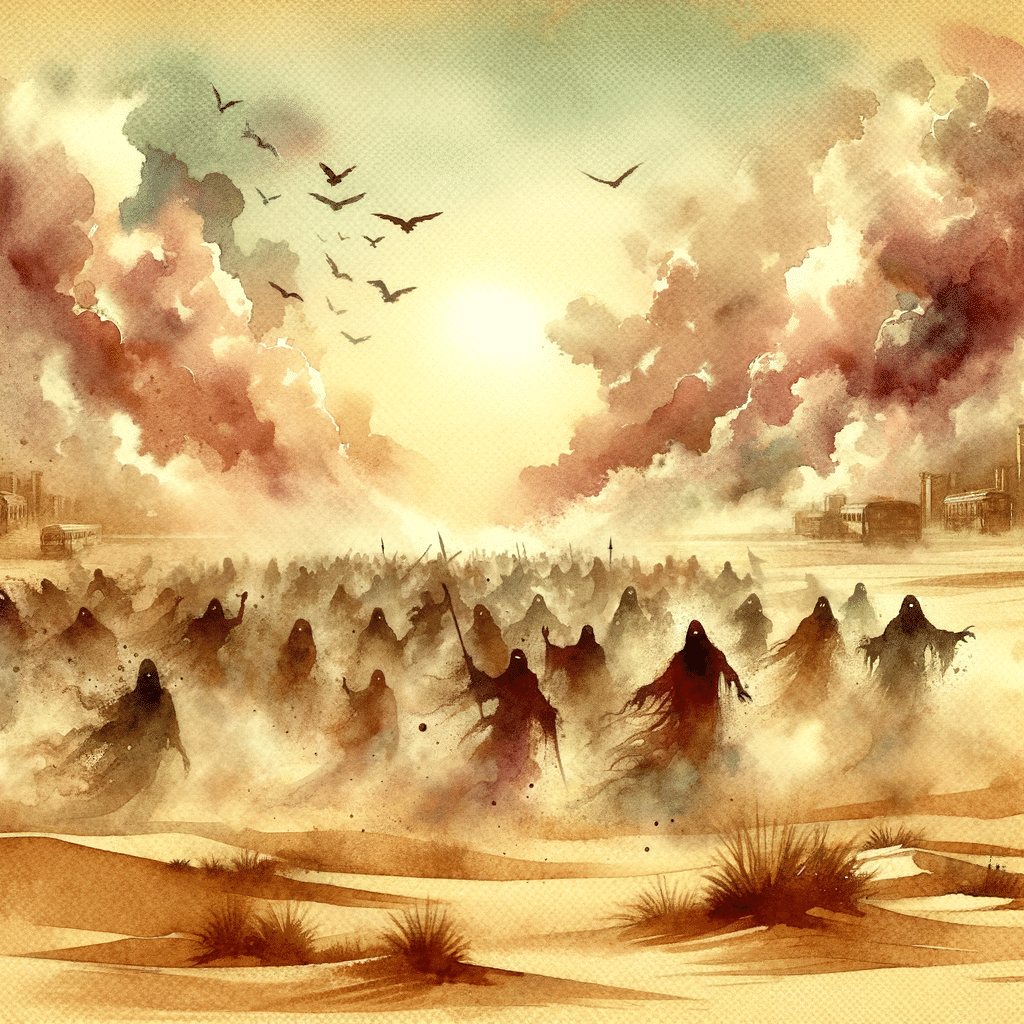
Stories of the supernatural have been around for thousands of years in the vast, shimmering deserts of the planet, where the unending sun bakes old landscapes into strange terrains. These desolate areas, which appear to be lifeless but are full of secrets, have become a rich source of stories about restless spirits, ghostly travelers, and strange events that make us question what we think we know about reality. The severe isolation and harsh battle for survival have produced the right conditions for ghostly encounters. This is because desert landscapes have a mirage-like aspect that makes the line between truth and illusion waver like heat rising from sun-baked sand.
Overview
The idea of ghosts is widespread in cultures all around the world and throughout history. It shows how we all strive to understand death and what might be on the other side of it. These ghostly beings are often thought to be the souls or spirits of people who have died but are still connected to the physical world instead of going on to the afterlife that their culture says they should. Some appear as misty ghosts resembling people, while others manifest as balls of light, disembodied voices, or an inexplicable cold presence in a desert that is otherwise quite hot. Different cultures have different ideas about why they stay on Earth. Some claim that they remain on Earth due to unresolved matters, violent deaths, or strong emotional bonds. Others say it’s because they got lost between worlds, like travelers who got lost in the vastness of the desert (Righi, 2011).
Desert environments provide specific conditions that appear to enhance paranormal experiences, establishing a special connection between these arid landscapes and ghostly phenomena (King, 1892). The utter solitude, the shifting of sound in the dry air, and the play of heat waves and moonlight on the sand create natural settings that are enigmatic and prone to misinterpretation. Many people who walk across the desert say that time seems to stretch or compress in strange ways, which is similar to how spiritual experiences are sometimes said to be timeless. The harsh conditions that have killed many people over the years, from ancient trade caravans to modern hikers, are what make ghost stories captivating. These conditions preserve both bodies and memories for much longer than more temperate ones. For instance, hardened sand still displays footprints from hundreds of years ago, and dunes still hold ancient artifacts.
Different civilizations’ folklore about the desert teems with ghosts perfectly suited to these harsh places. According to Native American legends, skinwalkers and coyote spirits live in the deserts of the American Southwest. They may change between animal and human forms to confound travelers. According to Middle Eastern folklore, djinn are magical beings made of smokeless fire that live in the vacant parts of immense deserts (Yasmin, 2024). They sometimes interact with people who go into their territory. In the Australian outback, Aboriginal stories include the Min Min lights, strange flying orbs that have been seen for generations and can sometimes lead travelers off course or warn them of danger. Although these cultural interpretations developed independently, they share certain commonalities. This conclusion could mean that people have the same psychological reactions to desert situations, or it could mean that people really do see things that go across cultural bounds.

Analysis
There are several theories that paranormal researchers have come up with to explain desert ghost sightings. Some of these beliefs are scientific, while others are more spiritual. Some people think that the extreme electromagnetic qualities of some desert areas, especially those with a lot of quartz deposits or that are on geological fault lines, can change how people see things and maybe even let people from different planes of existence talk to each other. Some people point to the well-known effects of high heat, dehydration, and being alone on the mind, which can cause hallucinations that are almost impossible to tell apart from reality. The idea of “place memory,” or residual hauntings, is especially strong in deserts, where the dry conditions might keep energetic imprints of traumatic events better than in wetter, more active areas where such energy could fade away.
Skeptics provide more plausible explanations for desert ghost encounters, emphasizing the distinct physical characteristics of arid settings. The temperature differences between day and night make it feasible for strange acoustic phenomena to happen, where sounds might travel very far or seem to come from impossible places. Mirages and light refraction can explain many strange things we see, and dust devils—swirling vortices of sand and air—can look like people when seen from particular angles or distances (Amery, 2020). The inherent danger and disorienting vastness of the desert have a big effect on people’s minds. When people feel vulnerable, they naturally search for patterns and meaning, and they may interpret natural events through the lens of cultural ghost stories they’ve heard throughout their lives. This creates a self-reinforcing cycle of expectation and interpretation that turns normal desert events into supernatural encounters.
Desert ghost stories have effects that go well beyond just being amusing; they are important for both indigenous people and modern societies in terms of culture and psychology. For people who have lived in the desert for a long time, these stories often serve as survival tools that look like supernatural warnings. They keep people from going to dangerous places or encourage them to travel in groups and avoid going out at night when the chance of getting lost goes up a lot. The ghosts themselves often represent cultural ideals and cautionary tales. For example, the spirits of those who broke tribal taboos, strayed from the community, or didn’t appreciate the desert’s power can be beneficial guides for how to behave without needing clear regulations. In today’s world, desert ghost stories are an important part of regional identity and tourism. Ghost tours of abandoned mining towns and other historic sites help communities economically while keeping local history alive through intriguing stories that might otherwise be lost.
The enduring nature of desert ghost stories in our technological era reflects a basic aspect of the human condition—our necessity to harmonize the tangible realm of empirical facts with the enigmatic, the unknowable, and the potential for existence beyond mortality. These empty landscapes are outstanding examples of the line between life and death: places where life exists on the edge, where survival needs respect and adaptation, and where the line between worlds may be thinner than in more welcoming areas. Whether told around campfires in the Sahara, written about in research journals in the Atacama, or shared on social media from the Mojave, stories of desert ghosts continue to fascinate us because they exist at the crossroads of the known and the unknown. They make us question what we think we know about consciousness, perception, and the very nature of reality.
Conclusion
The connection between ghosts and deserts is an intriguing mix of environmental factors, human psychology, cultural traditions, and maybe even something more that science can’t explain yet. These stories live on not just as fun folktales, but also as important stories that help us confront both physical landscapes and profound issues about death and what might come beyond it. As we keep exploring and living in desert areas, bringing modern technology into ancient landscapes, the ghosts of the desert change and grow with us. They remind us that even though we have made progress in science, some mysteries are still hidden in the shifting sands, waiting, watching, and sometimes showing themselves to those who dare to enter these beautiful but harsh places where the lines between worlds, like the horizon line itself, always seem to be just out of reach.
References
Amery, F. (2020). ‘An attempt to trace illusions to their physical causes’: atmospheric mirages and the performance of their demystification in the 1820s and 1830s. The British Journal for the History of Science, 53(4), 443-467.
Gilbey, G. (1995). Paranormal Phenomena and the Christian.
King, J. H. (1892). The Supernatural: Its Origin, Nature and Evolution (Vol. 1). London: Williams.
Righi, B. (2011). Ghosts, Apparitions and Poltergeists: An Exploration of the Supernatural Through History. Llewellyn Worldwide.
Yasmin, S. (2024). Djinnology: An Illuminated Compendium of Spirits and Stories from the Muslim World. Chronicle Books.
Leave a Reply