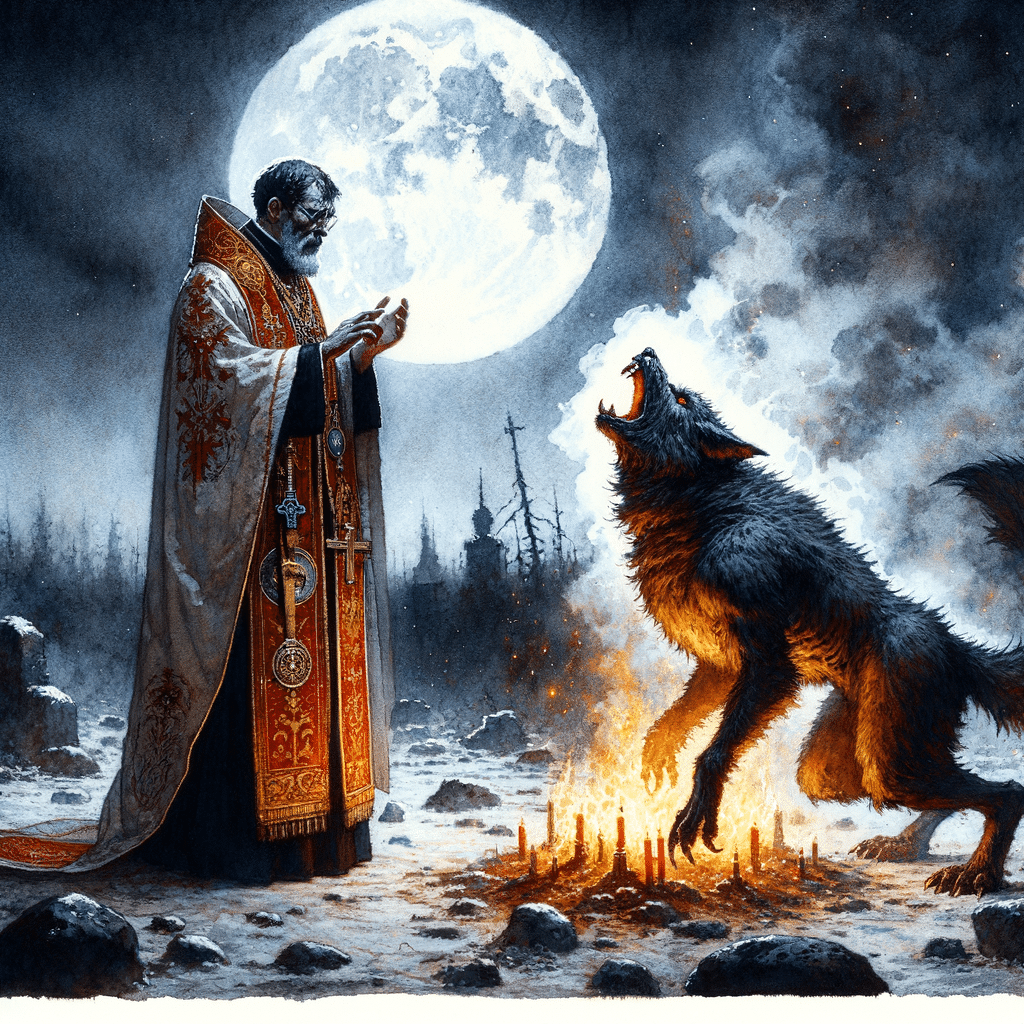
Six Key Points on Clergy-Werewolf Connections
-
Medieval Europe associated clergy with lycanthropy, symbolizing the ultimate descent from grace.
-
Werewolves are depicted as moon-triggered wolf-human hybrids vulnerable to silver.
-
Medieval texts featured priests transformed as divine punishment for corruption.
-
Stephen King’s Silver Bullet continues this tradition with Reverend Lowe as the monster.
-
This connection persists because the clergy’s moral status creates dramatic irony in transformation.
-
The werewolf-priest metaphor explores human duality and our complex relationship with authority.

Introduction
People have made creatures throughout history that show our deepest fears and worst urges. The werewolf is a strong emblem of the beast inside humans, the fight between civilization and savagery. Interestingly, throughout diverse cultures and historical epochs, a remarkable correlation arises between these animalistic mutations and those who ought to vehemently oppose them—clergy members. This link between religious personalities and lycanthropy shows how complicated cultural fears about power, morality, and the basic duality of human nature are, which still interest us now.
Overview
The werewolf is one of the most terrifying creatures in history. It is a person who turns into a wolf-human hybrid, usually when the full moon is out. People often draw these animals with large snouts, sharp fangs, and bodies covered in coarse hair. Despite moving on two legs like humans, they possess the strength and fierceness of wolves. It is generally said that their transition is very painful, with bones breaking and reconstructing, skin expanding, and the human mind being taken over by wild hunger. Once they transform, bloodlust drives them to relentlessly pursue humans. Their extraordinary strength and speed make them almost impossible to stop, except by certain means like silver weaponry, wolfsbane, or the interference of other supernatural powers.
The link between clergy and werewolves goes back hundreds of years and is obvious in medieval European sources. Witch trials accused several religious figures of lycanthropy, viewing their metamorphosis as evidence of a devilish bargain. The contrast is jarring by nature; individuals in charge of spiritual direction becoming the personification of animalistic brutality is the ultimate fall from grace. This relationship played on people’s fears of corrupt clergy who might look holy on the front but have horrible thoughts on the inside. Such an arrangement was a common theme in civilizations where the church had a lot of authority but occasionally didn’t live up to its moral ideals. The werewolf-priest is the most extreme example of this hypocrisy because he literally wears two skins.

Folklore and Popular Culture
In medieval werewolf stories, priests would change into werewolves as punishment for their sins or because of demons. The 12th-century Narratio de Arthuro narrates the story of a priest who turns into a wolf every week as punishment from God for his misdeeds. In the same way, Gervase of Tilbury’s Otia Imperialia tells stories of priests who were cursed with lycanthropy after breaking sacred vows. These stories were meant to warn people about corrupt clergy and show how worried people were about the secret lives of spiritual leaders. The idea became so popular that Pope Innocent VIII’s famous 1484 bull Summis desiderantes affectibus specifically named werewolves as threats to Christianity, which is ironic because it set an official church position on creatures that would later be strongly associated with its clergy.
There are several stories about werewolf priests and monks in European folklore. People in France used to believe that the loup-garou was a demon-possessed priest. Sometimes, Norse sagas told stories of Christian missionaries who turned into wolves as punishment for trying to convert pagans in dishonest ways. In Eastern European traditions, priests turned into werewolves after doing black masses or desecrating holy things. In the Polish story, Father Konstanty, a priest, turns into a wolf every full moon after being cursed by a witch whose daughter he had mistreated. He uses his lycanthropic form to protect his parish from evil while simultaneously grappling with his own hideous nature.
Current books and movies breathe new life into this thematic link. Stephen King’s Silver Bullet, which is based on his short story Cycle of the Werewolf, has one of the most remarkable ties between a clergy member and a werewolf. In the story, Reverend Lowe is revealed to be the deadly beast that terrorizes the small community of Tarker’s Mills. The revelation is very symbolic: the community’s spiritual leader has a real monster inside of him. King’s story looks at how Lowe’s respectability keeps people from being suspicious of him and how his inner beast shows how hypocritical it is to act like you’re pious while having violent thoughts. The silver bullet that finally kills him represents the purity needed to fight corrupted religion. It is given to him by a crippled youngster, whose innocence is in stark contrast to the pastor’s moral deterioration.
Other pieces of art have kept this trend going. In the 1981 movie The Howling, a psychiatrist who seems to help people control their impulses is actually the leader of a group of werewolves. In the 2000 movie Ginger Snaps, a guidance counselor has ties to werewolves, which aligns with the concept of authority figures whose animalistic nature contradicts their roles as counselors. The TV show Hemlock Grove recently had a religious group that had to hunt werewolves while keeping their own magical mysteries. These modern readings preserve the fundamental conflict between spiritual authority and primal instincts while recontextualizing it to address contemporary concerns with institutional power and hypocrisy.
Analysis
Several hypotheses attempt to explain the close connection between clergy and lycanthropy. The psychological interpretation posits that werewolf traditions symbolize worries regarding concealed tendencies, with clergy embodying ideal conduits for this concern due to their heightened moral authority. The higher the pedestal, the more stunning the fall. Anthropologists observe that in civilizations where the church wielded significant influence, werewolf narratives served as a vehicle for indirect critique of that authority, articulating anxieties over religious leaders who may exploit their roles. The transforming essence of both spiritual calling and lycanthropic curse illustrates a connection; both entail a fundamental alteration in identity and character, albeit in contrasting directions.
Historical circumstances offer more understanding of this link. During times of theological turmoil, such as the Protestant Reformation, allegations of lycanthropy were occasionally used as religious propaganda, with rival Christian groups portraying each other’s clergy as genuinely horrible. The werewolf trials in Franche-Comté, France, in the 1600s happened at a time when religious tensions were high and several local priests were accused of wrongdoing. Some researchers think that conditions like porphyria, which can make people sensitive to sunlight and cause gums to recede, making teeth look bigger, may have affected clergy who lived in remote monasteries. Such conditions may have led to rumors of transformation when these people showed up in public with symptoms that matched werewolf descriptions.
The continuous interest in linkages between clergy and werewolves in modern media shows that people are still worried about institutional power and concealed corruption. People today are still fascinated by the dramatic irony of spiritual leaders having bestial natures because it taps into larger fears about authority figures who don’t do what they say. The werewolf-priest represents worries that big organizations are hiding terrible secrets beneath respectable fronts. In a time when trust in conventional authority is fading and scandals are happening at institutions, these stories present us a way to confront complicated feelings of betrayal by people who are supposed to be moral leaders.
The connection between clerics and werewolves ultimately reflects basic human worries about dualism and authenticity. These stories question whether anyone, including those who have committed themselves to spiritual principles, can genuinely transcend their animalistic nature. They ask if it is really possible to be morally pure in a world where everyone has negative thoughts. The werewolf-priest is a strong symbol of how people are always torn between their desire to be close to God and their connection to the natural world, which is full of violence and primal desires. This tension has persisted through generations and civilizations due to its connection to a universal aspect of the human experience.
Conclusion
When we look at the peculiar connection between clerics and werewolves in mythology and popular culture, we see something deep about ourselves. These stories show how complicated our relationship with authority is, how scared we are of being betrayed by people we trust, and how conscious we are of the thin line between civilization and savagery. The werewolf-priest is still captivating, whether you see it in medieval manuscripts or modern horror movies, because it represents the paradoxes that lie in all of our hearts—the ability to rise above the spiritual level and fall back to the animal level. As long as we continue to navigate between our higher and lower natures, these stories will continue to evoke fear and shed light on the darkness within us.
References
Gervase of Tilbury. (1992). Otia Imperialia: Recreation for an emperor (S. E. Banks & J. W. Binns, Trans.). Oxford University Press. (Original work published c. 1211)
Innocent VIII. (1484). Summis desiderantes affectibus [Bull].
King, S. (1983). Cycle of the werewolf. Land of Enchantment.
King, S. (Writer), & Attias, D. (Director). (1985). Silver bullet [Film]. Paramount Pictures.
McGinley, K. (2005). The narratio de Arthuro: Arthur and Gorlagon (J. D. Bruce, Trans.). Medieval Academy of America.
Dante, J. (Director). (1981). The howling [Film]. AVCO Embassy Pictures.
Fawcett, J. (Director). (2000). Ginger snaps [Film]. Motion International.
McGreevy, B., & Shipman, L. (Creators). (2013-2015). Hemlock grove [Television series]. Gaumont International Television.

Leave a Reply