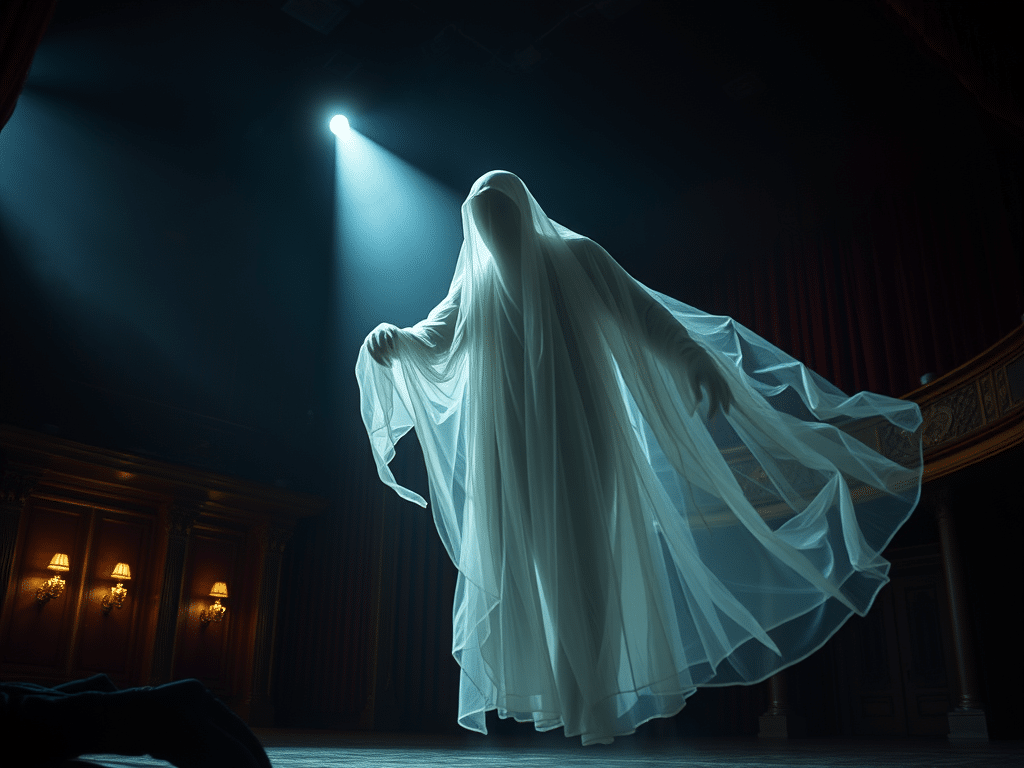
Ghosts and Theaters: Key Points
-
Ghosts in theater serve as metaphors for unresolved historical traumas and societal anxieties, allowing audiences to confront uncomfortable truths through the mediating distance of performance.
-
The psychological relationship between performers and audiences parallels how ghosts function in theater, with virtual reality innovations expanding possibilities for interactive spectral narratives that blur observer and participant boundaries.
-
Theatrical ghosts represent suppressed histories of colonial violence and indigenous dispossession, demanding acknowledgment of historical injustices and challenging dominant narratives of national identity.
-
Different cultures demonstrate varying relationships with theatrical ghosts, yet these spectral narratives address universal concerns about mortality and memory across diverse theatrical traditions.
-
Theaters function as liminal spaces where boundaries between past and present become unstable, enabling ghosts to serve as temporal bridges connecting audiences with historical events.
-
Contemporary innovations in virtual and augmented reality are transforming theatrical ghost encounters, while interdisciplinary scholarship deepens understanding of ghostly narratives across different contexts.

Introduction
The intersection of ghosts and theatrical performance presents a compelling confluence of the supernatural, cultural memory, and the performing arts, a phenomenon that has captivated audiences globally and throughout history. Within the theatrical context, ghosts transcend their role as mere supernatural entities; they function as potent symbols representing unresolved traumas, societal anxieties, and collective memories that persistently affect individuals and communities. Given the theater’s inherent liminality, existing between the realms of reality and fiction, it serves as an ideal medium for spectral narratives that compel audiences to confront unsettling truths concerning both their historical and contemporary circumstances. This essay examines the complex connection between theater and ghosts, looking at their symbolic meanings, academic approaches, cultural settings, and how ghostly performances are changing in modern media.
The Symbolic Nature of Ghosts in Performance
The symbolic use of ghosts in performance involves complex symbols, representing more than just frightening supernatural things. They can also mean deeper social and cultural problems that are relevant to modern audiences. When studying movies, especially horror movies, the way ghosts are portrayed often shows the underlying political tensions, emotional landscapes, and shared fears that are built into the structure of the stories. Nair’s study of Hindi film shows how ghostly figures are used in a planned way to explore cultural ideas, emotional undercurrents, and psychological pressures that might not be talked about in everyday life (Nair, 2017). Through the distance of supernatural stories, these spectral representations provide people a way to talk about tough issues like identity, morals, and social justice.
The gothic film tradition further complicates this connection by fusing supernatural elements with themes of land, identity, and national awareness. West’s study of Australian New Wave gothic film shows how haunting images improve the viewing experience by adding many layers of meaning that move between personal, national, and global stories (West, 2014). In these movies, haunted landscapes become places where violence and pain from colonialism in the past come back to life, refusing to remain buried in official histories. In theater, ghosts also serve as memory vessels for the audience, creating a useful tension between historical facts and mythological interpretations that leads to a stronger connection with place and a sense of shared identity (Leontis, 2019).
Theoretical Frameworks and Performance Dynamics
Frameworks for theory and performance dynamics include several theories that shed light on the connection between theatergoers, actors, and ghost stories, helping us understand the psychological and physical aspects of ghostly presence in theaters. Leitner and Richlan’s study on performance-related interpretation shows how the presence of an audience affects the behavior and emotion of performers, which is similar to how theatrical ghosts work within story structures (Leitner & Richlan, 2021). Their study of “ghost games” in football, which were games played without fans during the COVID-19 pandemic, shows how the lack of an audience changes the dynamics of performance and the emotional involvement of fans (Leitner & Richlan, 2021). The findings imply that the incorporation of spectral elements within theatrical productions, irrespective of their function as representations of absent spectators, historical personages, or unaddressed psychological wounds, can potentially reshape the physical environment of the performance and the subjective experiences of both performers and spectators.
The advent of virtual reality theater provides novel avenues for the narration of ghost narratives, unconstrained by the limitations inherent in conventional theatrical settings. Ren et al. (2025) investigate the capacity of immersive VR theater to facilitate audience interaction with narratives from diverse perspectives. Consequently, ghosts can be portrayed as active, participatory entities rather than mere ethereal manifestations. This innovative technology fundamentally alters narrative construction by integrating audience agency with narrative immersion, thereby enabling individuals to engage with haunted environments in ways that surpass the capabilities of traditional theater. These immersive experiences, like ghostly encounters, can have a similar unsettling effect on people, blurring the lines between observer and participant, what is real and what is imagined, and the present and the past.
Cultural Contexts and Colonial Hauntings
Cultural contexts and colonial ghosts must be understood within specific historical and political contexts. Examining the connection between spectral narratives and the colonial past, along with its enduring consequences, is crucial. Lambert and Simpson’s (2008) analysis of Australian gothic cinema demonstrates how spectral imagery mirrors suppressed historical traumas, including colonial violence, the displacement of Indigenous populations, and the persistent societal tensions that continue to shape contemporary Australia. These spectral manifestations serve not only as supernatural elements but also as reminders of a troubled colonial history that persists, despite official narratives of national advancement and reconciliation that seek to obscure it. The spectral landscapes of Australian cinema resurrect the violent legacy of colonization, compelling contemporary viewers to confront its realities.
García’s examination of the arts as instruments of resistance and empowerment enriches our comprehension of how ghost narratives subvert dominant power dynamics and amplify marginalized voices (García, 2015). Theatrical apparitions frequently symbolize individuals silenced by historical violence, social subjugation, or societal inequity. Through their ethereal manifestations, they disrupt established narratives and assert their right to be acknowledged. Oriental cinema employs a synthesis of traditional ghost stories and contemporary cinematic techniques to intricately investigate identity, cultural preservation, and the interplay between past and present (Fischer, 2023). These spectral entities function as cultural signifiers, simultaneously grappling with historical traumas and probing existential inquiries concerning identity, recollection, and contemporary cultural veracity.
Ghosts, Theaters, and the Negotiation of Space
Ghosts, play, and the manipulation of space occur when the staging of ghost narratives within a theatrical setting transforms the performance space into a site of haunting, thereby rendering commonplace locations into arenas where temporal and cultural complexities are interwoven. Theaters deliberately obscure the boundaries separating past and present, the living and the deceased, and veracity from its representation. This deliberate instability facilitates a multi-temporal experience for the audience, enabling them to engage with historical occurrences and their enduring impact within a singular moment of performance. In theatrical contexts, the spectral figure functions as a temporal bridge, facilitating access to distant or seemingly inaccessible memories, thereby fostering emotional resonance with events that predate the audience’s existence.
Furthermore, the motif of the haunted theater reflects broader societal anxieties concerning the processes of remembrance, the act of forgetting, and the imperative to confront traumatic histories. Theatrical narratives featuring ghosts frequently emerge from attempts to suppress or erase painful historical episodes. Consequently, these apparitions transform into lasting emblems of memories that defy obliteration or must not be overlooked. This theatrical employment of ghosts aligns with wider cultural movements advocating for historical reckoning, the dissemination of truth, and the acknowledgment of past injustices. The recurrent presence of spectral figures in theatrical traditions across diverse cultures suggests a fundamental human inclination to confront unresolved historical narratives, notwithstanding the potential for emotional distress or psychological disquiet.

Skepticism, Belief, and Theatrical Convention
Belief, skepticism, and the theatrical framework demonstrate that the relationship between the supernatural and the theatrical, particularly concerning the presence of ghosts, mirrors the multiple layers of credulity and skepticism inherent in human attitudes toward the inexplicable. Theatrical representations of ghosts frequently involve deliberate deception. Audiences, aware of the performative nature of the presentation, willingly suspend their disbelief to engage emotionally with the narratives involving the spectral. The interplay between skeptical inquiry and open-minded acceptance creates a unique psychological environment, allowing individuals to contemplate mortality, recollection, and the persistence of the past without necessitating a literal belief in the supernatural. Consequently, the theatrical ghost functions as a mediator, enabling audiences to engage with existential concerns while preserving an aesthetic detachment.
Furthermore, diverse cultural perspectives on the representation of ghosts in theatrical performances reflect varying attitudes toward the supernatural and its integration into daily existence. In societies where the belief in ghosts or spirits is still strong, theatrical portrayals of these entities can have different meanings and emotional effects than in societies where religious beliefs are less common. These cultural differences show how the representation of ghosts in drama is shaped by the specific cultural context. These narratives further illuminate the universal human preoccupation with mortality, recollection, and the interplay between historical and contemporary existence. The enduring presence of ghost stories across diverse theatrical traditions implies that these spectral entities fulfill significant psychological and cultural functions, irrespective of individual beliefs in the supernatural.
Contemporary Innovations and Future Directions
Innovations and future trajectories show that theater and performance art continue to evolve, generating novel approaches to the ghost story genre. These advancements utilize cutting-edge technologies and cross-disciplinary approaches to create spectral experiences that are progressively immersive and psychologically complex. Virtual reality, augmented reality, and other digital technologies are increasingly being integrated into theatrical productions, thereby expanding the methods by which audiences can engage with and perceive ghostly presences. This integration facilitates the creation of more distinctive and interactive encounters with narratives centered on spectral entities. Consequently, these technological advancements prompt novel inquiries concerning the nature of presence and absence, the definition of humanity, and the essence of ghosthood. These inquiries echo philosophical debates that have persisted throughout the history of traditional ghost stories. The virtual ghost, therefore, represents a potential evolution of a longstanding narrative form, one that continues to adapt in response to technological and cultural transformations.
Contemporary ghost research utilizes a wide range of fields, such as performance studies, film studies, cultural anthropology, psychology, and postcolonial theory. This interdisciplinary approach facilitates a more comprehensive examination of spectral narratives across diverse media and cultural contexts. This multifaceted methodology recognizes the limitations of a singular analytical perspective in fully grasping the phenomenon of ghosts. Consequently, a multifaceted examination is essential to fully appreciate their cultural significance and inherent complexity. Future investigations into the intersection of ghosts and theatrical practices are likely to continue transcending conventional disciplinary boundaries. Employing novel methodologies and theoretical perspectives, this study will investigate novel inquiries concerning memory, trauma, representation, and the interplay between historical and contemporary contexts.
Conclusion
The relationship between ghosts and theatrical performance constitutes a profound and intricate facet of cultural expression, engaging fundamental human concerns such as memory, mortality, and the persistence of the past. Within the theatrical realm, ghosts serve as both supernatural entities and symbolic manifestations of historical suffering. Furthermore, they are utilized to examine contemporary anxieties and unresolved cultural tensions. Theoretical frameworks elucidating this relationship are derived from diverse fields, including performance studies, film theory, psychology, and postcolonial studies. This highlights the interdisciplinary relevance and cultural importance of spectral narratives. The production and interpretation of ghost stories are subject to cultural variation, particularly concerning colonial violence, suppressed histories, and marginalized perspectives within contemporary societies.
The persistent existence of ghosts in theatrical traditions across various cultures indicates their role in fulfilling important psychological and cultural functions that transcend mere entertainment. Theatrical representations of ghosts provide a means for audiences to engage with challenging historical events and memories, facilitated by the artistic medium’s inherent detachment. This approach enables audiences to establish emotional and intellectual bonds with past traumas, regardless of their belief in the supernatural. Consequently, the ghost figure is likely to remain a pivotal element in performative narratives, even amidst the evolving landscape of theatrical practices influenced by technological advancements and interdisciplinary collaborations. The ghost’s capacity to adjust to novel circumstances will persist, even as it fulfills its fundamental role: bridging the temporal divide between past and present, absence and presence, and the interplay of memory and oblivion. The enduring fascination with theatrical ghosts stems from a collective human need to comprehend and engage with the spectral dimensions of history that continue to shape our lives and our societal identities.
References
Fischer, M. M. J. (2023). At the pivot of East and West. Duke University Press. https://doi.org/10.2307/jj.5864802
García, J. (2015). Leonidas K Cheliotis (ed.), The Arts of Imprisonment: Control, Resistance and Empowerment. Punishment & Society, 17(5), 636-638. https://doi.org/10.1177/1462474514532045
Lambert, A., & Simpson, C. (2008). Jindabyne’s Haunted Alpine Country: Producing (an) Australian Badland. M/C Journal, 11(5). https://doi.org/10.5204/mcj.81
Leitner, M., & Richlan, F. (2021). Analysis System for Emotional Behavior in Football (ASEB-F): matches of FC Red Bull Salzburg without supporters during the COVID-19 pandemic. Humanities and Social Sciences Communications, 8(1). https://doi.org/10.1057/s41599-020-00699-1
Leontis, A. (2019). Introduction: Mapping the territory. In Topographies of Hellenism: Mapping the homeland (pp. 1–14). Cornell University Press. https://doi.org/10.7591/9781501737015-004
Nair, K. (2017). Book Review: Meraj Ahmed Mubarki, Filming Horror: Hindi Cinema, Ghosts and Ideologies and Meheli Sen, Haunting Bollywood: Gender, Genre, and the Supernatural in Hindi Commercial Cinema. Bioscope South Asian Screen Studies, 8(2), 280-285. https://doi.org/10.1177/0974927617728143
Ren, X., Zhu, Y., Xu, J., & Yim, J. (2025). Virtual Reality and Immersive Theatre Experiences: An Internal Motivation Study. https://doi.org/10.21203/rs.3.rs-7550535/v1
West, P. (2014). Towards a Politics and Art of the Land: Gothic Cinema of the Australian New Wave and Its Reception by American Film Critics. M/C Journal, 17(4). https://doi.org/10.5204/mcj.847


Leave a Reply