Necromancy in Ancient Greece: Key Points
- Necromancy, from the Greek words for corpse (nekros) and divination (manteia), was the practice of communicating with the dead to gain knowledge or foresee the future, reflecting the Greek belief that the dead endured as shades who could be summoned back to speak.
- The practice grew out of a broader Near Eastern and Mediterranean tradition, seen in Mesopotamian rites, the biblical Witch of Endor, and Egyptian afterlife religion, which the Greeks adapted into their own distinctive underworld geography and rituals.
- Greeks associated necromancy with specific sites called nekyomanteia, or oracles of the dead, located at caves, chasms, and dark waters such as the Nekromanteion in Epirus and Cape Tainaron, where visitors performed blood sacrifices and libations to summon the shades.
- Literature preserves the richest examples, beginning with Odysseus summoning the dead in Homer’s Odyssey to consult the prophet Tiresias, and continuing through Aeschylus’s raising of King Darius and Lucan’s grotesque witch Erictho.
- Ordinary Greeks engaged in necromantic practices through curse tablets (defixiones) buried with the restless dead, ancestral tomb offerings, and the detailed ritual instructions found in later magical papyri.
- Scholars explain necromancy through theories of ritual psychology and altered states, its social function in seeking authority and closure, debates over ambiguous archaeological remains, and its cultural role in exploring anxieties about death and fate.

Introduction
Necromancy, the art of talking to the dead to acquire knowledge, predict the future, or influence events, occupies a curious and obscure position in the history of ancient religion. The word itself originates from the Greek roots ‘nekros’, meaning ‘corpse’ or ‘dead body’, and ‘manteia’, meaning ‘divination’ or ‘prophecy’. To the ancient Greeks, the deceased were not just gone. They were shades in the underworld, and under the right conditions, they could be called back to the living to talk. This notion flowed via myth, literature, ritual and public fear for more than a thousand years. In Greece, necromancy was never a single institution or a single doctrine. Rather, it was a complex of rituals and stories—some sanctioned, others feared—that illustrate the Greek sense of death, of fate, and of the porous line between the two worlds.
Origins in the Ancient Near East and Mediterranean
The idea of the dead as having wisdom and being consulted was popular all over the ancient Near East and Mediterranean long before it took on recognisable Greek forms. Ritual professionals in Mesopotamia performed procedures to conjure up and question the souls of the dead. The well-known tale of the Witch of Endor exemplifies both the practice and the profound distrust that accompanied it, as she raises the spirit of the prophet Samuel at the behest of King Saul and survives in the Hebrew Bible. Egyptian funeral religion, with its complex concern for the afterlife, offered a different but comparable idea of ongoing existence after death. The Greeks took over and reformed this larger cultural assumption that death did not totally break communication. They provided their underworld geography, vocabulary of shades and libations, and literary talent for dramatising the living-dead interaction.

Sacred Sites and Ritual Practices
In the classical Greek and Hellenistic cultures, necromancy is usually represented as contacting the dead for purposes of divination, usually at tombs, necromantic shrines or oracular places. “Necromancy”, Faraone adds, “is the act of asking the dead for information through skull- or corpse-divination and associated psychagogic activities that are performed at tombs, necromanteia, or other places of a specified kind.” This practice is found in classical Greek sources such as Homer, the tragedians and the later magical papyri. It is described as a genre that incorporates both public and private forms (Faraone, 2005).
In Greek civilization, necromancy was associated with specific places and certain practices. Some places the Greeks imagined as where the underworld was unpleasantly close to the earth’s surface. Sometimes termed nekyomanteia, or oracles of the dead, these sites were associated with caves, chasms, dark lakes and rivers that were considered to lead down into Hades. The most known was the Nekromanteion of Epirus, on the banks of the river Acheron, whose very name conjured up the mythological waters of the underworld. Other tales placed such oracles at Cape Tainaron in the far south of the Peloponnese, at Heraclea Pontica on the Black Sea, and at Avernus in Italy. A visitor might sacrifice at these spots, pour libations and wait, often for days, in the hope of a word from the dead. The atmosphere of such rites was intentionally dismal. Blood offerings, nocturnal scheduling, and gloomy or underground settings all served to attract and please the shades being called.
Necromancy in Greek Literature
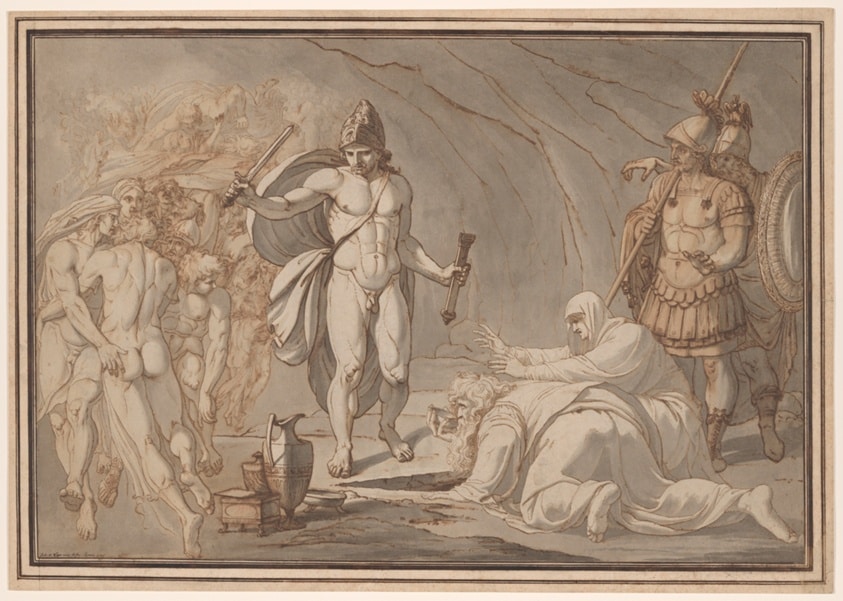
Greek literature provides the fullest and most vivid accounts of these interactions, with the fundamental example appearing at the very beginning of the tradition. In the eleventh book of Homer’s Odyssey, known as the Nekyia, Odysseus travels to the edge of the world to perform a rite in an attempt to summon the dead. He digs a trench, pours libations of milk, honey, wine and water, sprinkles barley and sacrifices sheep, whose blood pools in the trench. The shades are drawn, attracted by the blood. Only after swallowing the blood can the shades speak clearly. Odysseus consults the blind prophet Tiresias, who informs him of the ordeals to come, and he beholds the spirit of his mother and the spirits of dead allies and heroes. The scene sets up motifs that repeat in later stories. Blood feeds the dead, ritual precision counts, and the knowledge the dead possess is often knowledge of the future or of hidden truths. Aeschylus presented a similar scenario in his tragedy. In “The Persians,” the ghost of the dead king Darius is summoned at his grave to opine on the calamity that has befallen his people. Later writers, like the Roman poet Lucan, took the theme towards the bizarre in his description of the witch Erictho, where a sorceress reanimates a body so that she can extract a prophecy from it. These works range in tone from serious ceremonial to horror, but the underlying concept is the same.
The literary record (Odyssey, Persians, and other ancient literature) locates necromantic episodes in salient mythic contexts (Circe’s consultation of Teiresias, Amphiaraus/Lebedeia/Trophonius oracles, and end-death travels), thereby anchoring necromancy in hero tales and ritual imagery. The Paris magical papyri (PGM) demonstrate the incorporation of skull- and corpse-divination within the wider Greek magical toolkit, particularly within ritual apparatus and a ritualised connection with the dead (Faraone, 2005). Academic frames tend to detach mythic-religious narratives from actual cultic practice. Various authors see necromancy in ancient Greece as a literary survivor of ritualised beliefs about the dead and the underworld, typically with a tension between heroic, epic and cultic contexts. The literature indicates the ubiquitous presence of necromancy in myth and the relative scarcity of uncontroversial, non-literary evidence for extensive necromantic ritual practice in daily Greek religion (Vítek, 2021; Faraone, 2005; Mylonopoulos, 2008; “VII. Transformations”, 2016).
Material Evidence and Scholarly Interpretations
There is substantial evidence, outside the pages of myth and drama, of ordinary Greeks interacting with the dead in ways that border on necromancy. The most obvious evidence is the form of the curse tablets, defixiones, thin sheets of lead with written binding spells, often buried in graves. People placed these tablets with the deceased, especially with those who died young or violently and were considered to linger restlessly, in the belief that the spirits would become agents to bring their curses to their chosen targets. The restless dead, aoroi and biaiothanatoi, were thought to be particularly potent and particularly liable to such uses. Households frequently kept in touch with their ancestors by making sacrifices at tombs. The difference between honouring the deceased and asking for their help was not always clear. The magical papyri of later antiquity, albeit mainly of Egyptian origin and Hellenistic in date, contain elaborate prescriptions for necromantic rituals, testifying to a continuous history of practitioners who claimed to control the dead. These sources reveal that necromancy was not a literary fancy but a collection of behaviours embedded in the texture of ordinary hopes and concerns.
There are different views by scholars that describe the nature of necromancy and the real practice of it in Greek life. Others see the oracles of the dead as the outcome of ritual psychology, in which darkness, sensory deprivation, fasting and suggestibility of the site created an altered state of consciousness in which the visitors felt they had really encountered the dead. Others stress the social purpose of necromancy, claiming that it offered a way for individuals to find authority and closure by invoking voices beyond the reach of the living. There is also a long-standing disagreement concerning the physical remains at sites like the Nekromanteion in Epirus, whose excavations once believed it to be a complex of intricate rituals but have been reinterpreted by some archaeologists as a defended farmhouse, a reminder that our evidence is often unclear. A second line of enquiry has to do with the cultural work performed by stories of necromancy. In a regulated imaginative arena, the Greeks could examine fears about death, fate, and the limits of human understanding. These theories are not mutually exclusive. Together they encapsulate how necromancy functioned as belief, as ritual, as a social tool and as fiction all at once.
One of the oldest and most influential Greek necromantic episodes is that of the Circe story in The Odyssey. The necromancer reveals the seer Teiresias’s prophecies. This analysis is a literary framing, not a simple ethnographic report, but it locates the long association of the dead with oracular knowledge in Greek storytelling (Faraone, 2005). Herodotus’ description of the necromantic rites at tombs and oracular shrines in the Greek world (e.g., Amphiaraus’ oracles and Trophonius) is another example of how necromancy is represented in antiquity, frequently as a spectacle of visiting oracles of the dead at specialised sites (Faraone, 2005). Concrete evidence for necromantic materials (oil lamps, skulls, and ritual artefacts) associated with dead-spirit communication in the Levant and Near East, with cross-cultural parallels to Greek necromantic imagery and practice, comes from the study of the Te’omim Cave and related discussions of necromancy-like practices in the wider ancient world. This location is not Greek, but it is within a wider Mediterranean environment where skulls, lamps and other ritual items played a part in necromantic rites. Greek papyrological and inscriptional resources (lamellae, obols, and ritual texts) are cited as part of the larger necromantic toolkit in the ancient world, demonstrating that similar techniques and invocations were employed in Greek and nearby cultures (Grypeou, 2019; Klein & Zissu, 2023).
Several modern academics contend that a great deal of what is called “necromancy” in Greek contexts may be legendary, ritual or literary creations, rather than acts of religion regularly performed in quotidian life. Vítek argues that many of the necromantic scenes from the Classical period are literary or dramatic extrapolations and may not represent actual practices or beliefs regarding souls, the underworld, and chthonic deities. It may have continued to exist chiefly as a literary surmise derived from Homeric conventions rather than as a universal or regularly performed rite (Vítek, 2021). However, some scholars emphasise the existence of necromantic traditions based on classical texts that describe grave oracular rites and later mediaeval and Greco-Roman magical traditions that refer to necromantic practices (e.g., necromantic rituals around tombs and the dead in Greek magical papyri) (Faraone, 2005; “VII. Transformations”, 2016).
Conclusion
So necromancy in ancient Greece was a great deal more than a dark addendum to classical religion. It arose out of a widespread Mediterranean belief that the dead endured and could be contacted, and it took on a specifically Greek form in the oracles of the dead, the blood rites of Homeric epic, and the curse tablets buried in ordinary homes. It was in the highest literature and in the most private actions of hope and revenge. What unified these disparate utterances was a strong idea: that the barrier between the living and the dead was real, but not insurmountable, and that with the correct words and gifts a man might overcome it, if only for a while, to hear what only the dead could tell him. When examining these activities, we learn less about ghosts than we do about the Greeks themselves, about how they confronted the certainty of death and the uncertainty of the future, and about their persistent effort to extract meaning from the quiet beyond the tomb.
References
Aeschylus. (n.d.). The Persians.
Faraone, C. A. (2005). Necromancy goes underground: The disguise of skull- and corpse-divination in the Paris magical papyri (PGM IV 1928-2144). 255–282. https://doi.org/10.1163/9789047407966_010
Grypeou, E. (2019). Talking heads: Necromancy in Jewish and Christian accounts from Mesopotamia and beyond. Collectanea Christiana Orientalia, 16, 1–30. https://doi.org/10.21071/cco.v16i.14595
Homer. (n.d.). The Odyssey.
Klein, E., & Zissu, B. (2023). Oil lamps, spearheads and skulls: Possible evidence of necromancy during late antiquity in the Te’omim Cave, Judean Hills. Harvard Theological Review, 116(3), 399–421. https://doi.org/10.1017/s0017816023000214
Mylonopoulos, J. (2008). Daniel Ogden (ed.), A Companion to Greek Religion. Kernos, 21, 319–325. https://doi.org/10.4000/kernos.1683
VII. Transformations. (2016). New Surveys in the Classics, 46, 97–113. https://doi.org/10.1017/s0533245120000097
Vítek, T. (2021). Greek necromancy: Reality or myth? Acta Antiqua Academiae Scientiarum Hungaricae, 60(1–2), 27–51. https://doi.org/10.1556/068.2020.00004

Leave a Reply