Haunted Island of the Dolls: Key Points
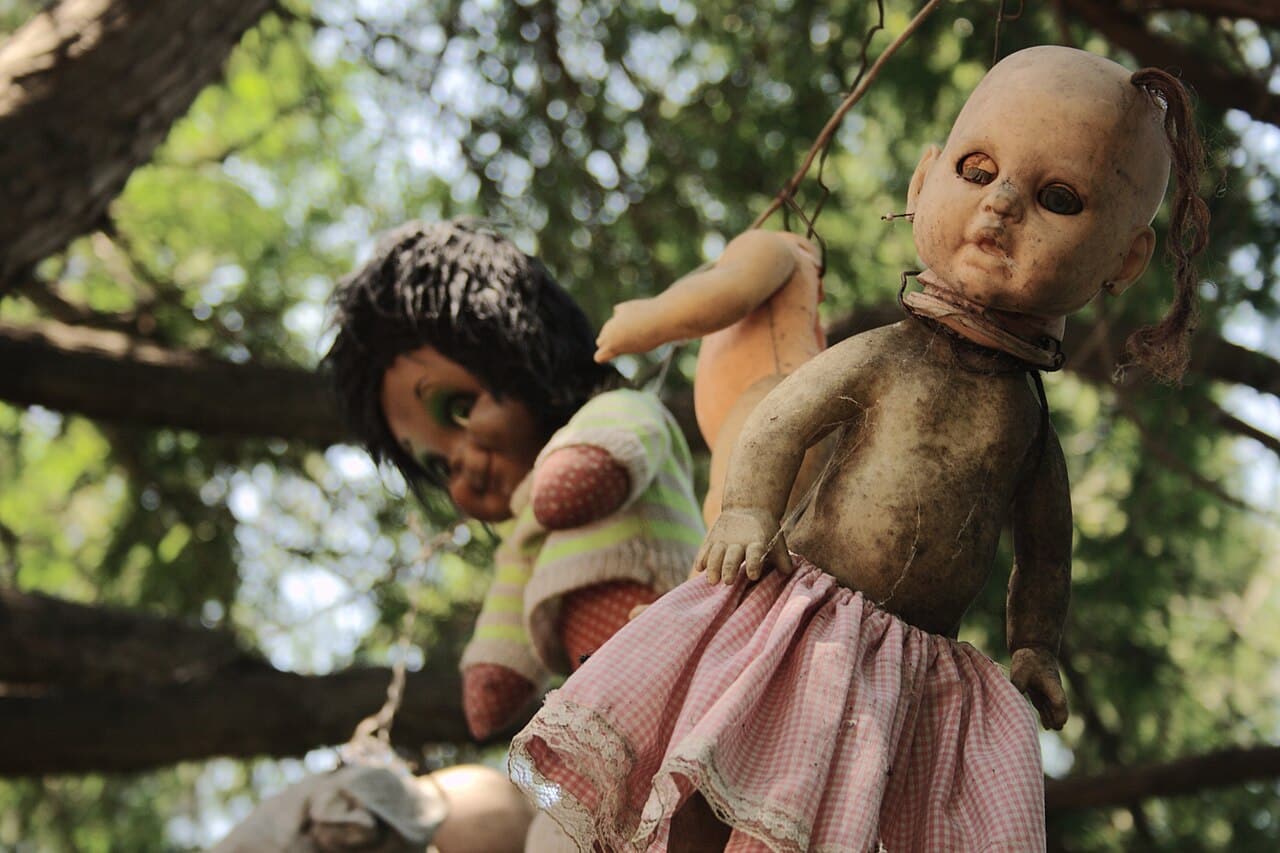
- The Island of the Dolls, or La Isla de las Muñecas, is located in the canals of Xochimilco near Mexico City and is covered with hundreds of weathered, damaged dolls hanging from trees and structures.
- According to legend, island resident Julián Santana Barrera discovered the body of a drowned girl in a nearby canal and later hung a floating doll from a tree to honor her spirit and protect the island.
- Santana continued collecting dolls for decades, finding them in canals and trash or trading goods for them, eventually covering the island with dolls and doll parts.
- Santana reportedly believed the drowned girl haunted the island, while visitors have claimed that the dolls move their heads and limbs, open their eyes, whisper, and make unexplained noises.
- Skeptical theories suggest that wind, animals, deteriorating doll mechanisms, unusual lighting, and psychological expectations can explain many paranormal experiences, while the dolls may also represent memorials, protective objects, or outsider art.
- Santana died in 2001 near the same canal associated with the girl’s supposed drowning, strengthening the supernatural legend, while tourism, television, books, and online media have transformed the island into an internationally famous paranormal destination.

Introduction
One of Mexico’s oddest and most terrifying landmarks lies deep in the canals of Xochimilco, to the south of Mexico City’s center. La Isla de las Muñecas, or the Island of the Dolls, is a small chinampa covered in hundreds of dolls and doll parts hanging from trees, attached to structures, and strewn about the property. Decades of sun, rain, insects, and vegetation have ruined many of them. Some have no eyes. Others have lost arms, legs, or heads. Their bodies rot in the wind; their shattered faces peer from the branches. The island has been billed as a haunted tourist trap, although the story originated not with a tourist attraction in mind, but with one guy, Julián Santana Barrera, and his claim he encountered the soul of a drowned child.
Isla de las Muñecas is an artificial island in the canals of Xochimilco, formed in the late 20th century from the legacy of Julián Santana Barrera, who, it is said, began collecting dolls after finding a drowned girl and dedicated his life to hanging them to pacify her spirit. The dolls cover trees and structures throughout the island, creating a strange scene that tourists visit for its unsettling ambiance and folk-art importance (“Artful Diplomacy: Art as Latin America’s Ambassador in D.C.,” 2008; Biase, 2017). This vignette has been examined in research on material culture, performance, and island esthetics, where dolls operate as objects that blur the lines between play, ritual, and memory (“Artful diplomacy: Art as Latin America’s ambassador in D.C. ,” 2008; Wood, 2022).
The Island and the Story of Julián Santana Barrera
The Island of the Dolls is located in Xochimilco, a large network of canals and artificial islands used for agriculture called chinampas. Well before dolls immortalized one particular chinampa, this wet habitat was a major element of the cultural landscape of the Valley of Mexico. Santana’s island is relatively small and features basic houses surrounded by dense foliage and water. What sets it apart visually from the neighboring residences is the astonishing quantity of dolls hanging in it. Official tourism literature from Mexico City characterizes the place as a surreal scene of hundreds of figures, weathered by years of exposure to the elements, who seem to look at visitors from the foliage (Mexico City Government, n.d.). The traditional account of the island, which begins with Don Julián Santana Barrera, who resided there mostly alone. Jones and Flaxman (2017) recount that Santana found the body of a drowned girl in a nearby canal more than fifty years ago. He was terribly upset by her passing. A few days later, he was alleged to have found a doll floating in the canal. He thought it might have belonged to the dead girl so he hung it on a tree to mark her grave and to offer serenity to her spirit. He also imagined the doll would guard the island from evil (Jones & Flaxman, 2017).
One doll was not the end of the gesture. Santana began accumulating more and more of them. He pulled abandoned dolls out of waterways and garbage and, according to reports, swapped fruit or other items for more dolls. He didn’t necessarily want dolls in excellent condition. He left things like empty eye sockets, missing limbs, scarred faces, and other symptoms of degradation as they were. Over time even undamaged dolls become more and more ugly from exposure to the environment. The outcome was not a meticulously organized show but an accumulating collection of castaway objects scattered around the island (Discovery, 2019; Jones & Flaxman, 2017).
What began as an offering seemed to have become an obsession that haunted Santana for decades. Eventually, he believed the dolls were real children he had rescued from drowning, according to Jones and Flaxman (2017). He was also said to believe the dead girl still haunted the island. Other reports further characterize Santana as feeling that the dolls were psychic protection or that they helped to pacify the restless presence linked with the drowned child (Guinness World Records, 2022). And the distinction is significant, because it seems that Santana didn’t just think of the dolls as scary decorations. He thought they had their uses. They may be memorials or offerings or guards or walls between him and what he thought lived on the island.
But there is a significant flaw with the story. The drowned girl has never been definitively shown to be real. Some reports say members of Santana’s own family were in disbelief he had actually found a child’s body. Discovery (2019) said the girl’s relatives asked if she even existed. The uncertainty makes the story not simply a story of sorrow but something more complex. Maybe Santana saw somebody really drowning. Something else may have happened to him that changed the way it was told. The girl could have been a figment of local legend or maybe Santana’s own convictions. Without solid documentation, the drowning should be seen as part of the legend of the island, rather than an independently proven historical event.

Paranormal Activity and the Island’s Atmosphere
The mystery surrounding the girl did not hinder the development of legends of paranormal activity. Visitors and local storytellers believe the dolls move their arms or heads, open their eyes, whisper, whistle, or otherwise act as though they are alive. Some versions of the mythology claim that spirits inhabit the dolls, bringing them to life after dark. Guinness World Records (2022) provides information on traditions that say the dolls whisper, move their limbs, and tilt their heads but stresses that there is no way to prove that the dolls are genuinely haunted. Stories like these have helped turn the island from one man’s weird collection into a famous site in contemporary ghostly legend.
The dolls of Isla de las Muñecas are a complex junction of tradition, memory, and material culture. They are an artistic installation molded by local traditions and storytelling, showing how communities turn everyday materials into readable cultural symbols. When scholars discuss dolls in the Caribbean and Latin American contexts, they tend to view them as vehicles for memory and social meaning, not simply as playthings. This connects to larger discussions of how dolls function in literature and art as symbols of cultural identity and gendered memory (see related discussions of dolls and memory in Caribbean and Latin American studies for examples). Wood (2022) and “Artful Diplomacy: Art as Latin America’s Ambassador in D.C.” (2008) are both relevant sources.
The reports are a tremendous contribution to the environment itself. The wind through the trees can make a weather-beaten doll hanging from a limb move. The fixed eyes appear to follow an observer as the light changes. Mechanical dolls may move or make noise when damaged, as loose parts may move. Animals, insects, plants, water, and the movement of branches can also produce surprising sounds. An island already known for ghosts is one where visitors are likely to hear or see ambiguous movements and noises in the way they expect. What would be heard elsewhere as an animal sound can become a whisper in the midst of hundreds of decomposing dolls.
Psychology may have something to do with the island’s evil reputation. Dolls are caught between human objects and inhuman items. They have faces and eyes and limbs and bodies that you can recognize, but they are definitely fake. This similarity is all the more unsettling in the wake of damage. A doll with an empty eye socket or missing limb is recognizably human in form while simultaneously seeming dead or disfigured. The presence of hundreds of similar objects near an observer amplifies the effect. Thus, some of the island’s creepy atmosphere might be due to the interaction of human perception, anticipation, environmental conditions, and the dolls themselves, not because of any paranormal activity.
Another option would be a cultural or folklore explanation. The island exemplifies how a personal story can evolve into a collective legend. Santana’s collection offered the concrete proof from which stories could arise. Unlike many ghost stories, the Island of the Dolls has something real for tourists to see and touch. The dolls are real, even if their supposed supernatural behavior cannot be proven. Every rotting face is a reminder of the story of the drowned girl. Every new visitor that tells the story helps keep it alive. So the spot is both a physical place and a living legend that continues to grow.
Santana’s Death and Competing Theories
The most bizarre thing in the story happened at the conclusion of Santana’s life. He died in 2001 in the same waters where the girl was allegedly drowned. According to Jones and Flaxman (2017), Santana himself was drowned in the canal and some followers thought it was the ghosts of the dolls that killed him. Other accounts obfuscate the matter. One tale is that a mysterious force in the sea was calling to him; Santana told his nephew soon before he died. His nephew found him in the canal later. Some accounts say the cause of death was drowning, whereas other sources suggest Santana experienced a heart attack and fell into the sea (Guinness World Records, 2022). Whatever his specific medical conditions, his death near the site where he said the girl died made for an almost ideal ending to the legend.
To those who believe in the paranormal, the incident is a significant coincidence. Santana spent decades trying to placate or defend himself from a spirit tied to the canal, only to die near that same water. One supernatural theory is that he was finally taken by the female. Another theory is that spirits tied to the dolls were to blame. Jones and Flaxman (2017) interpret the island not so much as a site of demonic activity but as a place connected to a man who felt himself haunted by a dead girl and who may have been driven more into obsession by those ideas. From a skeptical perspective, Santana’s death was tragic but normal, and the fact that it resembled the fabled death of the girl only provided storytellers with a wonderful coincidence on which to build a more powerful supernatural tale.
The dolls themselves can be interpreted in many ways. They could be an elaborate memorial constructed by a grief-stricken or terrified guy. These may have been protection charms in Santana’s own spiritual worldview. The collection could also be considered a sort of outsider art, built piece by piece, rather than the formal design usually connected with an art installation. But above all, the dolls show the power of repetition. One hanging doll from a tree may appear weird. Hundreds of decaying dolls scattered across a remote island make for an atmosphere that may instill terror in even the most skeptical visitors.
Tourism and Cultural Impact
Thanks to tourism, the legend has spread far beyond Xochimilco. Television programs, books, websites, travel pieces, paranormal investigations, and online videos have all featured the island. After Santana’s death, visitors have also donated dolls, continuing the collection and its mystique (Discovery, 2019). The official Mexico City tourism website now identifies the island as one of the mysterious sites connected to the mythology of Xochimilco (Mexico City Government, n.d.). In this way a private passion was incorporated into the public character of the region.
That popularity has had a wider cultural impact. The Island of the Dolls pulls together various themes that viewers keep coming back to: abandoned objects, imagery of childhood, death, solitude, spirits, and strange coincidence. The dolls are instantly recognized from photographs and require little explanation to make you feel uncomfortable. At the same time, the place shows how paranormal tourism can turn local tradition into an internationally renowned destination. Visitors don’t have to think the dolls are possessed. The allure lies in the opportunity to enter a location rich in a dark legend.
The island also explores the link between mythology and historical fact. To retell the story unqualifiedly risks passing off dubious details as truth, especially the existence and death of the nameless girl. But to disregard the whole myth because its supernatural claims can’t be proved is to miss what makes the island culturally important. There is no dispute that Santana accumulated dolls over several decades, and the collection became inextricably linked with stories of death and haunting. The existence of the ghost was less significant to the formation of the legend than Santana’s apparent conviction in its existence. His deeds built the physical landscape in which folklore could go on long after his death.
Conclusion
The Island of the Dolls continues to be upsetting because its story lives in the shadowy space between fact and myth. The dolls are alive. There was a real Julián Santana Barrera. Over the decades his collection was real and his death in 2001 added another level of grief to the place. The drowning girl and the ghostly spirits said to possess the dolls are far less certain. But those uncertainties have become a key part of the island’s identity. What began with one man hanging dolls in the trees became a timeless story of loss, obsession, dread, and the supernatural. Whether people see the island as a haunted place, a strange memorial, outsider art, or the product of a single man’s troubled mind, La Isla de las Muñecas demonstrates how a personal belief can evolve into folklore powerful enough to make a piece of land one of the world’s most recognizable paranormal destinations.
References
Artful diplomacy: Art as Latin America’s ambassador in D.C. (2008). https://doi.org/10.18235/0006398
Biase, E. D. (2017). “El disparo de argón”, de Juan Villoro: la ciudad bajo la tormenta. Ángulo Recto Revista De Estudios Sobre La Ciudad Como Espacio Plural, 8(1 y 2). https://doi.org/10.5209/rev_anre.2016.v8.n1.53347
Discovery. (2019, October 31). The Island of the Dolls has a murky and terrifying history. Discovery. Discovery article
Guinness World Records. (2022, October 26). The haunting story of the man who built the Island of Dolls. Guinness World Records article
Jones, M. D., & Flaxman, L. (2017). Demons, the devil, and fallen angels. Visible Ink Press.
Mexico City Government. (n.d.). Isla de las Muñecas. Mexico City. Mexico City tourism page
Wood, Y. (2022). Blanco y negro, piel y máscaras, el cuerpo en el arte del Caribe. Lecturas desde Frantz Fanon. Ístmica Revista De La Facultad De Filosofía Y Letras, 1(29), 67–91. https://doi.org/10.15359/istmica.29.5

Leave a Reply