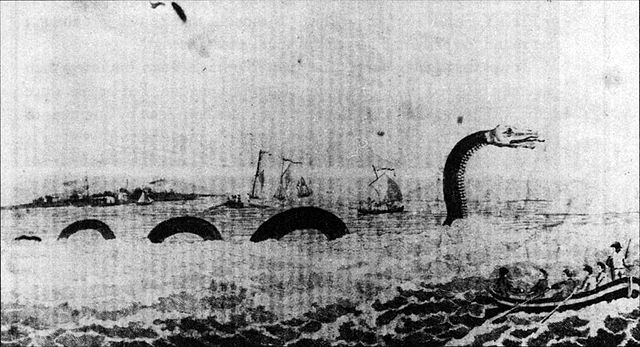
For well over two hundred years, an enigmatic being that has fascinated locals and visitors alike has been linked to the seas off the shore of Gloucester, Massachusetts. The Gloucester Sea Serpent became known as one of the most persistent cryptozoological enigmas in America and a notable part of New England legend. First recorded in 1817, sightings of this enigmatic marine creature set up a scientific inquiry, media frenzy, and continuous discussion regarding what precisely lies under the seas of Cape Ann. The story of the Gloucester Sea Serpent provides an intriguing look at how maritime cultures understand unknown events and how such stories change with time.

Overview
Across several sightings, physical descriptions of the Gloucester Sea Serpent stayed surprisingly constant, implying either a shared source or a really unique creature. Usually, witnesses spoke of an animal with a serpentine body between 50 and 100 feet (ca. 30 m) long that moved in vertical undulations instead of the horizontal motions typical of most sea creatures. Witnesses described the monster as having a horse-like or serpent-like head elevated above the water, along with noticeable eyes and nostrils. Dark-colored, often with markings or a lighter underbelly, its body was typically characterized as black, brown, or dark gray. Many stories described a sequence of humps that were visible above the water’s surface as the animal moved, suggesting a segmented body (Soini, 2010).
The behavioral features ascribed to the sea serpent set it even further apart from known marine creatures of the period. Unlike whales or big fish that surface momentarily to breathe, the Gloucester Sea Serpent was often seen holding a position at the water’s surface for long durations, often remaining visible for hours. Witnesses said the beast swam at remarkable speeds, estimated between 12 and 15 miles per hour (ca. 24 km/h), far quicker than most large marine animals. Perhaps most interestingly, the serpent showed no obvious fear of boats and sometimes came close to ships for close inspection. People never reported it acting violently; instead, it seemed solely interested in the seaside activities of Gloucester’s nautical population.
Local legends about the animal become profoundly ingrained in the cultural identity of Massachusetts’ North Shore. While some saw the serpent as a warning of approaching storms or maritime catastrophe, others thought a sighting was a harbinger of prosperous fishing. Seaside businesses took use of the myth to draw visitors; children were warned against swimming too far from shore lest they meet the monster. An early scientific group, the Linnaean Society of New England, even created a unique committee to look into the event and promised a significant prize for evidence of the creature’s existence. Lending the legend an extraordinary degree of legitimacy for cryptid stories, this committee gathered many sworn testimonials from renowned community members, including sea captains, merchants, and pastors (Brown, 1990).
The evolution of the Gloucester Sea Serpent story throughout time illustrates evolving cultural views about inexplicable events. Thorough records and research handled the first wave of sightings in 1817 with extraordinary scientific seriousness. By means of local art and literature, the serpent became somewhat romanticized throughout the Victorian era as a strange but mostly benign spirit. The serpent was increasingly pushed into the domain of folklore and tourist draw as scientific doubt became more evident in the early 20th century. Though the animal stays deeply rooted in regional culture, showing up in festivals, municipal symbols, and as a marketing tool for coastal tourism, modern readings have tried to reconcile historical narratives with modern zoological understanding (Garland, 1995).

Theories
Ranging from the commonplace to the remarkable, many ideas have been put forward to account for the Gloucester Sea Serpent event. The most scientifically conservative interpretation points to misidentifications of known marine animals, especially the basking shark, which can reach lengths over 25 feet (ca. 8 m) and sometimes swim in a way that produces a sequence of visible humps. Perhaps a line of seals swimming in formation or gigantic oarfish, which can reach over 30 feet (ca. 9 m) with clearly serpentine bodies, are other possibilities. Though it goes against current paleontological knowledge, more speculative theories suggest surviving colonies of prehistoric marine reptiles like plesiosaurs. Some cryptozoologists have proposed a yet-unidentified species of elongated pinniped (seal relative) or perhaps a massive sort of eel (France, 2023).
Undoubtedly, psychological and societal elements helped to shape the story as well. Later sightings following initial reports drew attention and mass suggestion may have shaped them. The remote nature of early maritime societies, coupled with the intriguing mysteries of the ocean depths, created an ideal environment for the emergence of such stories. Though interpretations were tainted by the constraints of biological knowledge at the time, the regularity of tales from trustworthy witnesses—including seasoned seamen familiar with normal marine fauna—suggests that something unique was actually being witnessed.
With more than 200 verified sightings spread across several decades, the Gloucester Sea Serpent is still one of the most well-documented cryptozoological occurrences in American history. Unlike many cryptid stories, the Gloucester phenomenon was looked into concurrently by knowledgeable witnesses gathering sworn testimonials and trying to use scientific techniques on the enigma. The ongoing similarity of stories over generations points at least to an intriguing case study on how societies understand uncommon natural events and at most to the tempting prospect that something really unfamiliar previously patrolled Cape Ann’s seas (Rieppel, 2022).
Conclusion
The story of the Gloucester Sea Serpent reflects more than just a fascinating footnote in New England’s maritime history; it captures the intricate interaction between coastal towns and the enigmatic ocean that supports and occasionally endangers them. Its influence on regional identity and folklore is unquestionable, whether the monster was a misidentified recognized species, an as-yet-undiscovered marine animal, or a product of cultural imagination. The persistence of the story reflects people’s ongoing curiosity about the unknown and their inclination to create stories about unexplainable events. Though maybe the mystery itself is what makes the Gloucester Sea Serpent such a lasting and intriguing part of American folklore, marine science is still finding new species in the ocean depths, leaving open the possibility that some natural explanation could eventually be found for what those Gloucester residents saw from their shores two centuries ago.
References
Brown, C. M. (1990). A natural history of the Gloucester sea serpent: Knowledge, power, and the culture of science in Antebellum America. American Quarterly, 42(3), 402-436.
France, R. (2023). Disentangled: Ethnozoology and environmental explanation of the Gloucester Sea Serpent. BRILL.
Garland, J. E. (1995). Gloucester on the Wind: America’s Greatest Fishing Port in the Days of Sail. Arcadia Publishing.
Rieppel, O. (2022). Sea-Serpentism. The Origin and Early Evolutionary History of Snakes, 90, 113.
Soini, W. (2010). Gloucester’s Sea Serpent. Arcadia Publishing.




Leave a Reply