
The Ansbach Wolf terrorized the Bavarian countryside in the early 18th century, becoming one of Germany’s most notorious predators and evolving into a powerful folk legend. Allegedly between 1685 and 1704, this creature killed hundreds of people—mostly women and children—in the woods surrounding Ansbach, fostering a terror that spread throughout the whole area. Margrave Georg Friedrich II’s epic hunt against the wolf brought an end to its reign of terror; his triumph over the animal changed a straightforward predator into a complicated symbol that would be kept and reinterpreted for centuries to come.

Description
Those who said to have seen the Ansbach Wolf described its physical look in vivid and sometimes exaggerated language. Witnesses described the Ansbach Wolf as being significantly larger than a typical wolf, standing nearly three feet tall at the shoulder and having a body length exceeding six feet. Its coat was reported to be exceptionally dark, nearly black in some lighting, with unique scarring on its face and sides indicating past run-ins with hunters. Contemporary reports characterized its eyes as unusually bright and intelligent, with an amber light visible from enormous distances at night, making them most remarkable and contributing to the animal’s magical reputation (Lenders, 2023).
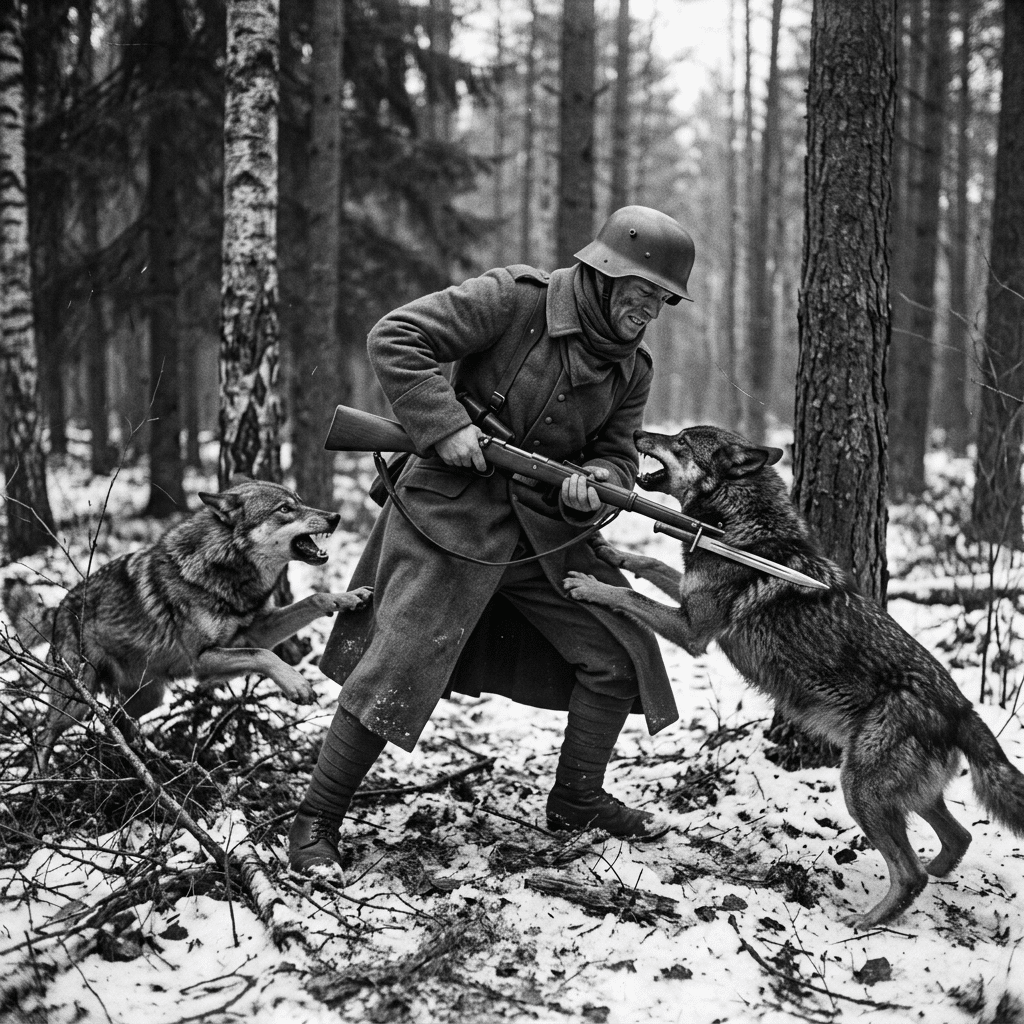
The wolf’s actions strayed far from normal wolf behavior, which sparked conjecture regarding its actual character. Unlike typical wolves that usually shun human interaction, the Ansbach Wolf aggressively sought human prey, showing a rare audacity when near isolated farmhouses and towns. Striking when victims were most vulnerable—when women were collecting herbs or when children were caring for livestock away from adult supervision—it showed extraordinary ingenuity. Witnesses said the wolf went by livestock to chase human victims, which was most troubling given the animal’s clear predilection for human flesh over more easily accessible meat. This conduct helped support beliefs that the animal was more than just a regular animal.
The story of the Ansbach Wolf evolved in a cultural setting when wolf assaults posed real danger to rural areas. Across medieval and early modern Europe, wolves were both a physical threat and a strong emblem of the wilderness pushing civilization’s frail borders. The Ansbach Wolf appeared during a time of severe suffering during the Thirty Years’ War, when decreased game populations would have pushed predators to seek other food sources—including humans (Rheinheimer, 1995). Against this backdrop, the strange aggressiveness of the Ansbach Wolf changed it in the public imagination from simple animal to monster, with some villagers supposing it to be a werewolf or the reincarnation of a harsh lord punished for his brutality.
Margrave Georg Friedrich II’s large hunt in 1704 that eventually took down the beast marked the climax of the Ansbach Wolf legend. Stuffed and displayed in a dramatic posture, the wolf preserved its terrible look for posterity in the palace collection. Still visible today, this taxidermy specimen is a fascinating physical relic that has preserved the energy of the story across three centuries. The preserved wolf allowed succeeding generations to encounter the beast firsthand while reinterpreting its relevance according to evolving cultural viewpoints, therefore bridging historical truth and myth.
Reflecting evolving views of nature and the supernatural, the story of the Ansbach Wolf changed greatly with time. The wolf represented the perilous natural world that logical people had to overcome and govern in the 18th century. Some viewed the wolf during the Romantic period of the 19th century as a misunderstood being, maybe even a victim of human encroachment in the wilderness. Scientific knowledge in the twentieth century led to fresh interpretations; some academics believed the wolf could have been rabid, which would account for his atypical violence. Some suggested it could be an escaped exotic animal or a hybrid wolf-dog, explaining its odd look and behavior.

Beast of Gévaudan Comparison
Though the Beast of Gévaudan, its more renowned French rival, gained considerably more reputation across Europe, the Ansbach Wolf closely resembles it. Though the Beast of Gévaudan supposedly killed over one hundred people in a far shorter time between 1764 and 1767, causing a national catastrophe that drew the notice of King Louis XV personally, the Ansbach Wolf claimed scores of lives over almost two decades. Though the Beast of Gévaudan profited from the more advanced communication networks of the late 18th century, allowing its narrative to circulate more widely and quickly than the earlier German predator, both animals worked in remote, mountainous areas where inhabitants were isolated and defenseless. Official records, newspapers, and letters gave the French case more thorough documentation, hence offering historians richer primary sources than those accessible for the Ansbach Wolf (Smith, 2011).
Physical descriptions of these animals show intriguing similarities that imply shared mythical effects on eyewitness recollections. Unlike the Ansbach Wolf, the Beast of Gévaudan was described as unusually enormous with unique traits distinguishing it from regular wolves—including reddish hair, odd markings, and exceptionally large jaws and claws. Witnesses in all instances described behavior incongruous with regular wolf predation: strategic hunting, an ability to dodge traps, and apparent immunity to weapons. Perhaps most importantly, both animals were said to show nearly human intelligence and intentionality; the Beast of Gévaudan was said to target women and children specifically, sometimes tearing off clothing while leaving flesh untouched—details that stoked speculation about werewolves or sexually driven human murderers masquerading in animal hides.
The resolution and cultural afterlives of these two legendary predators followed diverse paths that reflect much about their varied national settings. While aristocratic authority oversaw a single, conclusive hunt that killed the Ansbach Wolf, the Beast of Gévaudan story concluded more ambiguously, with many claiming to have slain the creature and continuing arguments about whether one or many animals were responsible for the assaults. While the German case stayed more simply a story of human victory over natural danger, the French case became intertwined with pre-revolutionary politics; some saw the beast as a metaphor of the nobility’s predation on the common people. Though the Ansbach Wolf has stayed mostly a regional legend, perhaps because its preserved remains anchor it more firmly to historical reality than its French counterpart, both animals have enjoyed revival in popular culture. The Beast of Gévaudan has motivated far more literary works, movies, and television shows—most notably the 2001 film Brotherhood of the Wolf (Fehlmann, 2020).
Modern Impact
Modern environmental and conservation initiatives have changed the symbolic relevance of the Ansbach Wolf. The victory of civilization over untamed nature, once celebrated, is now sometimes viewed through the lens of humanity’s troubled relationship with animals and has been reversed. Once regarded as a clear triumph, the extinction of the wolf is today seen by some as representative of humanity’s inclination to demonize and destroy what it fears instead of understanding it. This progression shows how ancient folklore still speaks to modern issues, reflecting more general cultural changes in attitudes toward predators, wildness, and environmental care.
Psychological readings have given the Ansbach Wolf story another angle. Embodying concerns that spanned from economic instability to religious uncertainty in post-Reformation Germany, the creature has been studied as a representation of societal worries during a volatile historical era. Many blamed a former deceased mayor for being a ghost in wolf form. Some academics have observed that the wolf attacks grew stronger during times of social upheaval, implying that the animal was a convenient target for more complicated and spread-out society concerns. One way to interpret the hunt’s spectacle and the public exhibition of the wolf’s body is as ritualistic activities that enabled the group to deal with and conquer these shared worries.
Still relevant today, the Ansbach Wolf shows up in books, art, and even local tourism marketing. Guided tours of Ansbach usually include the renowned taxidermy specimen as a highlight; local museums have displays on the animal. From several angles, including sympathetic depictions that speak to the animal itself, modern fiction authors have reinterpreted the narrative of the wolf. Featured in videos examining the historical interaction between people and predators, the creature shows how a particular historical event can reflect more general features of the human experience spanning generations.
Conclusion
Ultimately, the Ansbach Wolf is much more than a straightforward case of a predatory animal; it reflects the intricate interaction between historical events and the legends we spin to grasp them. Starting as a genuine danger to a particular society, the wolf changed into a many-sided emblem that still changes via narrative and cultural reinterpretation. Its preserved remains provide a physical link between the past and now, therefore enabling every generation to face the beast again and find its relevance to modern issues. The lasting interest in the Ansbach Wolf shows how deeply such stories are ingrained in our shared consciousness, exposing our ongoing need to derive meaning from our interactions with the wild and the unknown.
References
Fehlmann, M. (2020). The Beast of Gévaudan as a history of the changing perceptions of fatal human–wolf interaction. In Managing the Return of the Wild (pp. 12-28). Routledge.
Lenders, H. J. R. (2023). ‘Uuluesheued!’The Historical Significance of the Wolf to Early Indo-Europeans. Boydell & Brewer.
Rheinheimer, M. (1995). The belief in werewolves and the extermination of real wolves in Schleswig‐Holstein. Scandinavian Journal of History, 20(4), 281-294.
Smith, J. M. (2011). Monsters of the Gévaudan: The making of a beast. Harvard University Press.
Starr, M. (2015, October 29). Wolves among us: Five real-life werewolves from history. CNET. Retrieved April 14, 2025.


Leave a Reply