Attracting millions of annual visitors who come to honor the 16th president, the Lincoln Memorial is among America’s most famous monuments. Beyond its historical and cultural importance, though, this grand marble monument has become caught in rumors of the mysterious and inexplicable. Visitors and employees have experienced unusual events over decades that defy logical explanation, transforming this emblem of togetherness and endurance into a focus for paranormal conjecture. The architectural grandeur of the memorial, its rich history, the several supernatural claims connected with it, and the continuous conflict between believers and critics about these enigmatic events are investigated in this essay.

Description
Anyone who climbs the 58 steps of the Lincoln Memorial will immediately be struck by its majesty. The main chamber Built in the Greek temple style by architect Henry Bacon, its 36 Doric columns capture the Union’s state at Lincoln’s death. Inside sits Daniel Chester French’s exquisite 19-foot marble monument of a meditative Lincoln, staring eastward over the Reflecting Pool toward the Capitol behind. Inscriptions of Lincoln’s Gettysburg Address and his Second Inaugural Address cover the inside walls, therefore fostering a serious and respectful environment. Lincoln’s legacy is symbolically connected to the continuing American experience in democracy by the memorial’s placement at the western end of the National Mall, therefore producing a strong sight line (Concklin, 1927).
Dedication rituals on May 30, 1914, marked the beginning of the memorial’s building, which finished in 1922. Its development occurred during a time of national healing, decades following the Civil War‘s split of the country. The decision to celebrate Lincoln in such a public way reflected America’s will to respect the president who had kept the Union intact during its worst crisis. The site has seen several turning points in American history throughout the years, notably Martin Luther King Jr.’s “I Have a Dream” speech delivered at the 1963 March on Washington. By coating its marble with decades of emotional and historical relevance, the memorial has evolved from an homage to one man to a hallowed sanctuary for the nation’s ongoing quest for equality and justice (Thomas, 2002).

Haunted Memorial
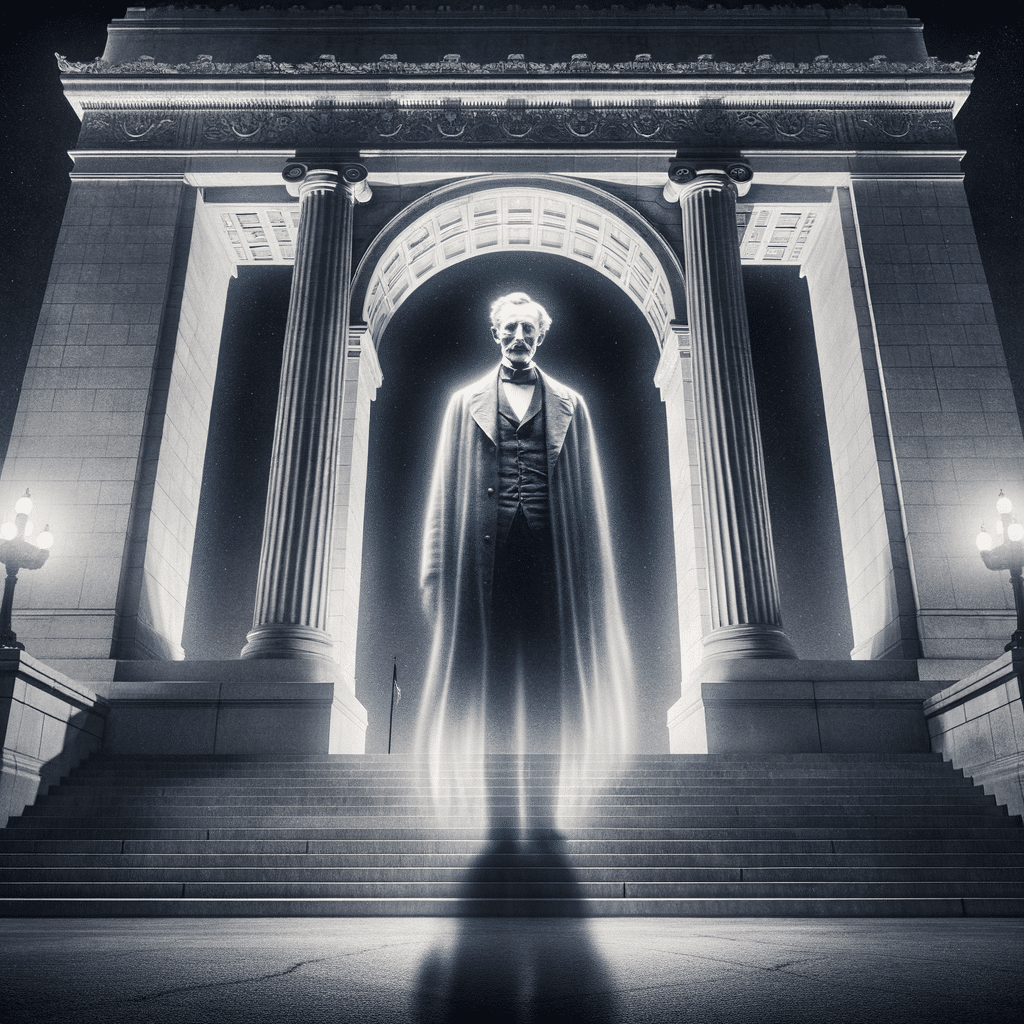
Reports of paranormal activity at the Lincoln Memorial started soon after it was finished and have lasted all through its lifetime. The most often reported claim is of Lincoln’s ghost, a tall, bearded man dressed in historical attire who seems to be at the monument or on the steps and then disappears when approached. Late at night, maintenance staff have heard footsteps and voices in the empty room; other guests say they have seen shadowy figures or orbs in pictures taken within the memorial. Other stories call for abrupt cold patches, inexplicable equipment failures, and the feeling of being watched when nobody else is around. Stories from security guards claiming to have seen Lincoln’s monument move or his marble eyes follow them as they turn about are maybe the most fascinating (Lunis, 2014).
Some of the more convincing paranormal tales center on emotional reactions that guests go through in the monument. Many have complained of extreme sadness, particularly around dawn or dusk, that passes away when they leave the building. Others talk of strange feelings of calm or the clear sense of a loving presence looking over them. Reports of Lincoln’s appearance tend to surge during major national crises or times of upheaval; some people assume that his spirit returns during periods when the country most needs his wisdom and direction. Strong residual energy claimed by psychics who have visited the location suggests that the emotional weight of history might have engraved itself on the stone of the memorial.
Beyond basic ghost sightings, the Lincoln Memorial has a ghostly reputation, including more complex otherworldly ideas. Some paranormal investigators note that the memorial’s alignment with other Washington, D.C., monuments points to sacred geometry that opens a channel for spiritual energies. Others point out that the memorial rests on ground formerly marshy and unfit for building, necessitating significant preparation that alters the natural surroundings—a common occurrence in many ghost stories. A tiny but dedicated group of researchers holds that the memorial acts as a portal or thin space where the curtain between worlds is especially porous, hence explaining the many reports of unusual events at the location.
Analysis
Critics provide more ordinary theories for the claimed events. Experts in architectural acoustics note that the design of the memorial generates odd sound patterns that may easily be confused for supernatural voices and cause whispers and echoes. The thermal characteristics of the marble and the ventilation system of the structure can cause abrupt temperature fluctuations that guests would view as cold areas. Skeptic explanations also heavily rely on psychological elements; the power of suggestion, expectancy, and the human inclination to pattern-seek all help to create paranormal interpretations of everyday events. Seeing such a historically important site devoted to a murdered president naturally primes guests to have strong emotions that can be misattributed to supernatural sources (Tarlow, 2007).
Research in psychology and neuroscience provides more background for these encounters. The phenomenon of pareidolia—our brain’s inclination to identify familiar patterns like faces in random stimuli—helps to explain why some guests might find movement in the statue’s features. With their interaction of shadows and the somber ambiance, the specific lighting conditions inside the memorial produce an environment fit for such perceptual illusions. Furthermore, the memorial’s reputation as a site of national mourning and collective trauma could set off what psychologists refer to as “grief hallucinations,” brief sensory experiences connected with processing great loss that are entirely normal but could be taken as paranormal encounters (Zhou & Meng, 2020).
The conflict between believers and doubters about Lincoln Memorial hauntings parallels more general cultural perceptions about the paranormal. For believers, especially those of immense historical significance whose unresolved business can bind them to sites of significance during their life, these events serve as proof that consciousness endures beyond death. Many Americans find great emotional resonance in the idea that Lincoln, who died by murder before seeing his ideal for a reunited country completely fulfilled, would linger at his memorial. Critics, on the other hand, see these assertions as examples of how emotional investment and historical relevance could skew interpretation and perception of everyday events, hence generating myths that grow self-perpetuating as they are spread and exaggerated across time.
Whether one believes the Lincoln Memorial’s paranormal claims to be real spiritual events or expressions of collective psychology, their continuation reflects the powerful bond Americans have with this monument and the man it honors. Apart from a physical manifestation of Lincoln’s legacy, the memorial provides a psychological forum where the country keeps processing its complicated past and goals. Within this framework, the ghost stories and supernatural assertions constitute still another layer of cultural significance, mirroring how Americans view their past and include historical people in a continuous national narrative. The ghostly customs around the memorial have evolved into essentially modern mythology that enables guests to emotionally connect with history in ways that facts and dates by themselves cannot do.
Conclusion
Ultimately, the Lincoln Memorial is a monument to architectural genius as well as a storehouse of American goals, aspirations, and anxieties—including those that show up as paranormal beliefs. Whether Lincoln’s soul wanders the memorial’s hallways or these events result from the human yearning to connect with history or the power of suggestion is still a question of personal opinion. Unquestionably, the memorial’s ability to arouse strong emotional reactions in visitors attests to Lincoln’s continuing relevance in the American psyche. People will continue to experience something transcendent in the presence of the massive marble figure gazing out across the National Mall, so ensuring that the line separating history from mystery, between the rational and the supernatural, remains as flexible and interesting as the legacy of Abraham Lincoln itself.
References
Concklin, E. F. (Ed.). (1927). The Lincoln Memorial, Washington. US Government Printing Office.
Lunis, N. (2014). A Haunted Capital. Bearport Publishing.
Tarlow, P. E. (2007). Dark tourism: The appealing ‘dark’side of tourism and more. In Niche tourism (pp. 47-58). Routledge.
Thomas, C. A. (2002). The Lincoln Memorial & American Life. Princeton University Press.
Zhou, L. F., & Meng, M. (2020). Do you see the “face”? Individual differences in face pareidolia. Journal of Pacific Rim Psychology, 14, e2.



Leave a Reply