Six Key Points About Dhanushkodi’s Paranormal Reputation
-
People perceive Dhanushkodi as haunted due to the 1964 hurricane that claimed more than 1,800 lives there.
-
People who visit temple ruins say they hear ghostly train whistles, see ghosts, and hear voices that aren’t there.
-
In the abandoned town, there are unexplained chilly patches and moving lights, even though there is no electricity.
-
There are many possible explanations, from natural acoustics to leftover energy from catastrophic deaths.
-
Local fishermen do rituals to live with spirits and show guests around.
-
Even though scientists have tried to explain them, Dhanushkodi’s ghost stories still draw tourists and inspire the media.

Introduction
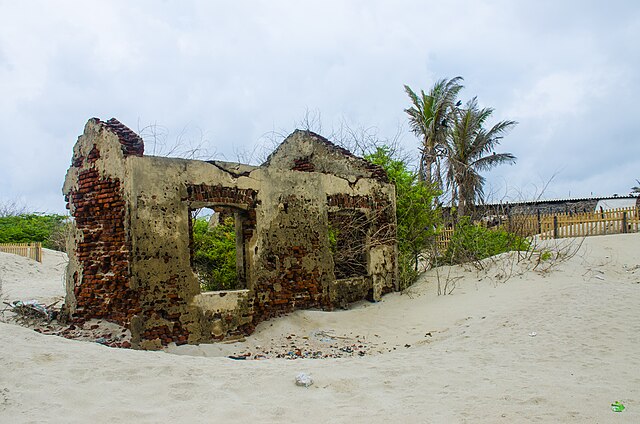
Dhanushkodi is a deserted strip of land near the southeastern coast of India, where the Bay of Bengal meets the Indian Ocean. It gestures toward Sri Lanka. Dhanushkodi used to be a busy port town, but now it is a hauntingly beautiful ruin with the remains of buildings dispersed over a gorgeous white sand beach. The calm blue seas wash against the shores of this deserted village, making it seem eerily tranquil despite the horror that happened there. Many ghost stories and paranormal tales have been told about this secluded place, which is located near the easternmost point of Pamban Island in Tamil Nadu.
Description
Dhanushkodi’s past is full of both myths and tragedies. Hindu mythology says that Lord Rama built a bridge from here to Lanka to save his wife, Sita, from the evil king Ravana. This is where the town gets its name: “Dhanush” means “bow,” and “Kodi” means “end,” which is where Rama broke his bow (Chatterjee, 2024).
Dhanushkodi was a busy port with a railway station, customs office, post office, and many homes until 1964. On December 22, 1964, a massive cyclone with winds exceeding 170 mph unexpectedly struck the town. It caused tidal surges that were almost 20 feet high (Raoa, 2017). The disaster killed more than 1,800 people, including all 115 people on the Pamban-Dhanushkodi passenger train, which was totally swept away by the roaring water (Srisangeerthanan, 2015).
The strange things that have happened at Dhanushkodi since the terrible cyclone have become more detailed and diversified throughout the years. Fishermen who pass by the old railway tracks often say they hear a ghostly whistle that sounds like it’s coming from the ruins. This phenomenon happens a lot on nights when the weather is like it was during the deadly storm. The ghostly sounds are said to be very precise, occurring around the time the doomed train would have made its last trip (Dhanaseeli, 2019). People that live in the area talk about dark figures that show up for a short time among the collapsing buildings, move with purpose, and then disappear when someone gets close or acknowledges them. Most of the time, people see these ghosts near the old neighborhoods, where the hurricane killed many families without warning. The specifics of these individuals often match those of known victims, such as specific attire or physical traits remembered by family members who are still alive.
Witnesses said they heard disembodied voices near the wreckage of the local temple and post office as terrified inhabitants were trying to escape the rising floods. The sounds seemed to be calling for help or saying prayers in Tamil and English. People say that these voices have a unique echoing quality that sets them apart from regular human speech. These voices frequently appear to originate simultaneously from various locations. Some who were there say the voices get louder and more numerous every December, around the accident’s anniversary. Researchers who study the weather have found that paranormal activity reports go up a lot in all of Dhanushkodi’s ruins during the monsoon season, when conditions are similar to those of the 1964 storm. Temple ruins are especially linked to unexplained cold spots, where temperatures can drop by several degrees in small areas even though the weather in coastal Tamil Nadu is usually hot and humid (Gowthaman et al, 2013).
The weird lights that many people have seen moving across the land after sunset are probably the most intriguing thing. These lights, on the other hand, move in strange ways, sometimes hanging in position before speeding across the ruins at inconceivable speeds. Their motion is different from the regular patterns of fishing boats or headlights from faraway cars. Local fishermen, knowledgeable about the natural light phenomena in the area, are especially worried about these lights, believing they are the souls of people who died in the accident and are still looking for a way out. People who love photography have tried to take pictures of these lights, which have caused a lot of debate. Some people say that the orb-like shapes are just lens flare or dust particles, while others say they are proof of a supernatural presence. It is difficult to explain these light occurrences in a normal way because there is no electricity at all in Dhanushkodi.

Analysis
Dhanushkodi’s status as a paranormal place has had a big impact on popular culture. A number of Tamil and Malayalam horror movies have used the ghost town as a location or inspiration because of its creepy atmosphere and sad history. Documentary filmmakers often go there to shoot atmospheric films that show off the site’s historical importance and its reputation for being haunted. Travel blogs and paranormal investigative websites often list Dhanushkodi as one of India’s most haunted places. The attraction draws dark tourism fans from all over the world. These reports have spread on social media, with viral videos claiming to show unusual things happening at the location getting millions of views and making it even more famous as a paranormal hotspot.
Different ideas try to make sense of the strange things that happen at Dhanushkodi. Skeptics say that the noises and sights are just natural events, such as the strange sounds that wind makes when it blows through the ruins, the optical illusions that moonlight makes when it reflects off the sea, or the psychological effects of understanding the site’s sad history. Some parapsychologists think that the violent murders of so many people may have left behind what they call a “residual haunting,” which are energy imprints that play back like records when specific conditions are met. Hindu spiritual gurus have a different perspective. They assert that the location’s mythological significance places it at a unique intersection of spiritual forces, facilitating seamless transitions between worlds. The town’s seclusion and desolation have only added to these notions, as the lack of people and modern technology are said to have let paranormal forces stay undisturbed.
Even though the government said the area was uninhabitable after the 1964 disaster, a tiny group of fishermen has moved back to the borders of the devastated town, giving us intriguing new views on the paranormal allegations. These people often function as unofficial guides for visitors, telling them both historical facts and ghost stories with the same level of confidence. Many of these fishermen claim to have learned how to coexist with the ghosts and demonstrate their respect by performing modest rituals or making offerings before entering specific locations. The stories told by these fishermen often combine genuine knowledge of the area’s natural events with a strong belief in otherworldly beings, creating a distinct folklore that evolves with each retelling. These local stories often stress that the spirits are not evil, but rather lost souls looking for recognition of their sad fate.
Dhanushkodi’s reputation for paranormal activity has sometimes made it harder to protect its archaeological and historical sites. Those who document or maintain the ruins say that their equipment has broken, they have had unexplainable accidents, and they have felt ill, all of which they think are caused by supernatural forces. Some teams working to preserve the ruins have incorporated local spiritual traditions into their daily routines to “please” the spirits before beginning their work. It’s fascinating that these experiences have led to a unique way of preserving history in the area, where scientific methods and respect for indigenous spiritual beliefs may live together. Officials in charge of making the area a tourist destination must always find a balance between practical needs and being sensitive to the area’s tragic history and its reputation for being haunted (Anilkumar, 2017).
The scientific community is also interested in Dhanushkodi, but for a different reason. Marine biologists look at the strange ecosystem that has grown up around the ruins, while meteorologists look at the strange weather patterns that made the 1964 cyclone so deadly. Geologists say the area is near a fault line and that the land changes slowly but steadily, which may explain some of the recorded data. Acoustics experts have written about how the way the ruins are arranged makes strange sound corridors where sounds from far away can be magnified or distorted in ways that appear uncanny. However, these scientific answers don’t often take away from Dhanushkodi’s reputation as a paranormal place, because tourists are usually more interested in the strange atmosphere than in logical explanations.
Conclusion
Ultimately, Dhanushkodi serves as a poignant illustration of the power of nature and the delicate distinction between history and legend. Its abandoned houses, which are spread out across gorgeous beaches, make it look like the past is preserved in time, letting visitors literally stroll among the ruins of tragedy. Reports of strange occurrences in Dhanushkodi have become an integral part of its identity. They could be the product of sorrowful spirits, natural events that are misread because of tragedy, or just the fact that people like to find meaning in emptiness. As India works to make this remote area more tourist-friendly, the ghost town is a powerful reminder of how a disaster can turn a thriving community into a place of legend, where the lines between the living and the dead, the real and the supernatural, seem to blur with each wave that hits its haunted shores.
References
Anilkumar, P. (2017). HISTORICAL BACKGROUND OF RAMA SETU BRIDGE. Twenty Third Issue, 250.
Chatterjee, A. K. (2024). Ram Setu and delusions of archaeological grandeur: The politics of obscuring a sacred geology. Shima, 18(2), 184-207.
Dhanaseeli, J. D. P. (2019). Pamban Rail Bridge–A Historical Perspective. specialty journal of humanities and cultural science, 4(4-2019), 18-23.
Gowthaman, R., Kumar, V. S., Dwarakish, G. S., Mohan, S. S., Singh, J., & Kumar, K. A. (2013). Waves in Gulf of Mannar and Palk Bay around Dhanushkodi, Tamil Nadu, India. Current Science, 1431-1435.
Raoa, A. R. (2017). The town that disappeared–Dhanushkodi-a Case Study.
Srisangeerthanan, S. (2015). Tropical cyclone damages in Sri Lanka. Wind Engineers, JAWE, 40(3), 294-302.


Leave a Reply