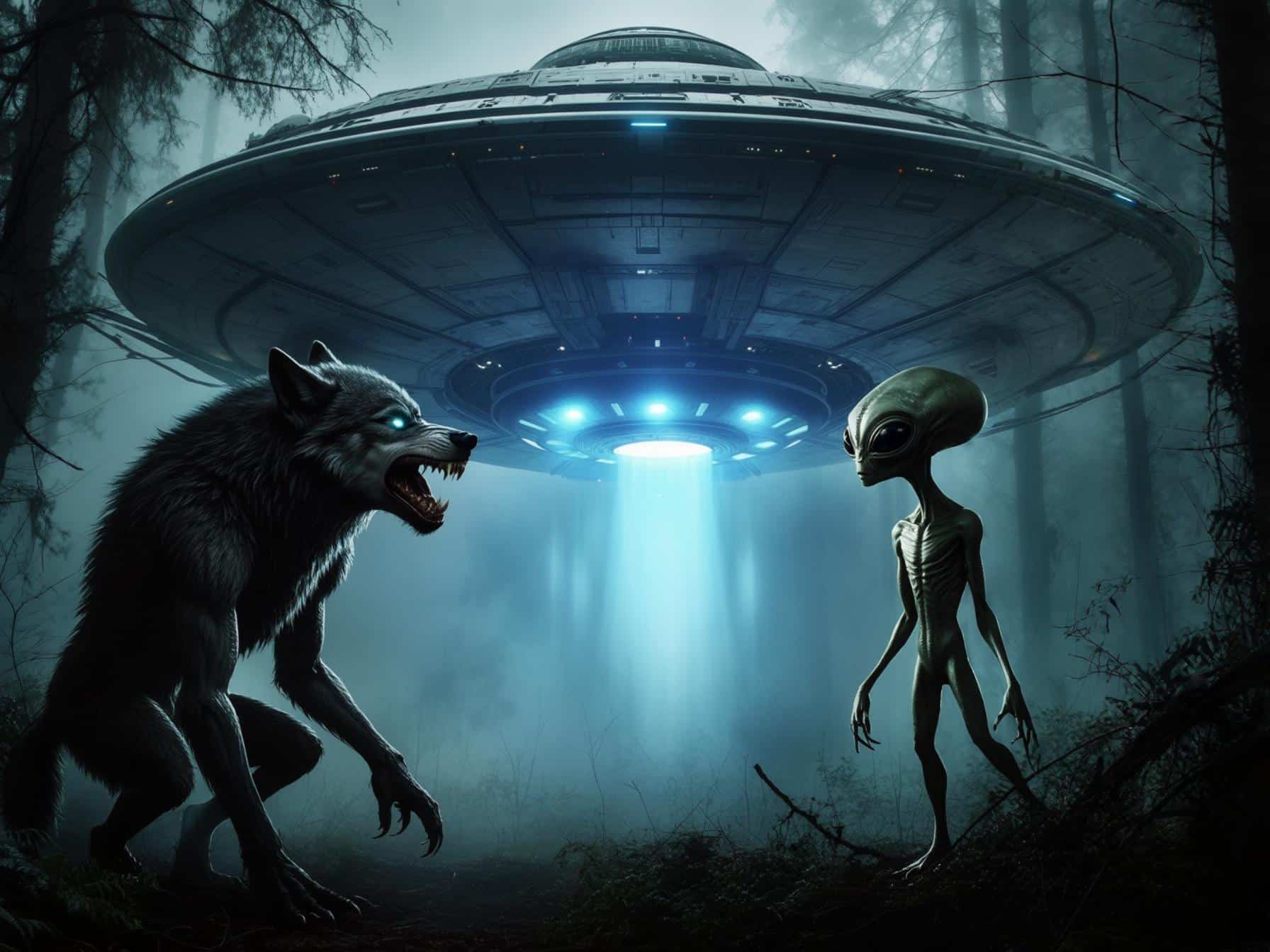
Werewolves, UFOs, and Aliens: Key Points
-
Werewolves and UFOs, though from different traditions—one ancient and one modern—both reflect humanity’s enduring fascination with the unknown and the supernatural.
-
Werewolves symbolize the struggle between human civility and primal instinct, often serving as metaphors for transformation, rage, and repressed emotion.
-
UFOs represent modern fears and hopes about the cosmos, emerging from twentieth-century technological change and raising questions about alien life and our place in the universe.
-
Some paranormal theorists link werewolf and UFO sightings, suggesting these creatures might be alien experiments, interdimensional beings, or manifestations of overlapping realities.
-
Skeptics argue that these connections arise from human psychology—pattern-seeking, cultural storytelling, and misidentification of natural events rather than true evidence.
-
Despite the lack of proof, the merging of werewolf and UFO lore continues to influence media and belief, showing how myth and mystery evolve together to express timeless human curiosity.

Introduction
People have always been interested in things that are strange and challenging to explain. Werewolves and unidentified flying objects (UFOs) are two of the most intriguing things that people have been interested in for a long time. At first glance, these two seem to be in very different worlds. One is based on old stories and primal fear, while the other is based on modern science fiction and ideas about life on other planets. But in the 20th and 21st centuries, researchers and people who have had experiences have started to link the two. This meeting of myth and modernity suggests werewolves and UFOs are quite similar.
Investigating their potential relationship elucidates the ways in which humans confront the unknown, reinterpret ancient myths, and manifest enduring anxieties in novel expressions. Some people think that the fact that werewolf and UFO sightings happen at the same time is more than just a coincidence. It shows how old archetypes can change to fit new technological times. People are interested in both creatures, which shows how they combine mythology and modern mystery to make sense of things that aren’t straightforward to explain.
Overview
Werewolves are one of the oldest creatures in human mythology. They come from early European, Norse, and even ancient Greek traditions that go back thousands of years. Zeus transformed King Lycaon into a wolf in Greek mythology as a punishment for his disrespect. This is where the idea of a human-wolf hybrid comes from. People in medieval Europe believed in werewolves a lot, and this was often because they were afraid of witches and demons. People thought that those who were lycanthropes would change into wolves when the full moon shone and roam the countryside, attacking people or animals.
In folklore, the werewolf curse meant losing control over one’s humanity and becoming bestial and forbidden. In popular culture, werewolves have changed over time. Once hunted at night, they are now sad, cursed characters due to their dual nature. Modern movies and books, like The Wolf Man (1941) and An American Werewolf in London (1981), have made them symbols of change, rage, and repression, mixing psychological depth with supernatural horror. People are still interested in werewolves because they show the conflict between civilization and instinct.
UFOs, on the other hand, are products of a more advanced age, but they, like werewolves, tap into deep human fears and awe. The first big wave of UFO sightings happened in the 1940s, when the world was going through many changes, like the end of World War II and the start of the atomic age. During combat, pilots saw “foo fighters,” which were glowing orbs that followed their planes. Kenneth Arnold’s sighting of “flying saucers” near Mount Rainier in 1947 caused a media frenzy. Later that year, an alien craft reportedly crashed in New Mexico during the famous Roswell incident.
Since then, there have been more and more reports of strange lights, metal discs, and beings from other worlds. UFOs captivate people, making them feel less alone in the universe or as if they’re under the scrutiny of unknown forces. Like werewolf stories, UFO stories often happen in remote or rural areas, where the dark and unknown make people more imaginative and awed. Both subjects thrive on the tension between skepticism and belief, showing how people of their time see the unknown.
While the connection between werewolves and UFOs may seem odd, numerous stories depict them in similar scenarios. In today’s world of paranormal research, witnesses sometimes talk about having similar experiences, like seeing strange lights in the sky and then meeting big, two-legged wolf-like creatures. People in places like Bray Road in Wisconsin, Fayette County in Pennsylvania, and parts of rural England have reported seeing “dogmen” or “wolfmen” near where UFOs were seen or strange energy events happened.

Analysis
Some ufologists think that these beings are either biological experiments or extraterrestrial scouts—genetically modified beings sent to watch. Some think the werewolf is an interdimensional being that appears during high electromagnetic activity, not an alien. This concept could also explain why UFOs show up at the same time. This theory suggests that both werewolves and UFOs are manifestations of “thin places” where reality briefly intersects with an alternate dimension. It gives a cosmic or dimensional explanation that combines old myths with new, unproven science.
Researchers of the paranormal have built on these theories in intriguing ways. Some people, like British writer Nick Redfern, have looked into the idea that UFOs, cryptids, and supernatural beings could all be parts of the same thing, which the late John Keel, author of The Mothman Prophecies, called “ultraterrestrials.” People used to think that the beings they saw were fairies, demons, or werewolves. Now, though, they might look like aliens or visitors from another planet, depending on who is looking at them.
This hypothesis suggests that belief, language, and collective consciousness shape how people deal with the unknown. In this sense, the werewolf’s change and the UFO’s sudden appearance are both examples of times when normal reality gives way to the strange. These times, whether they are old or new, remind us that mystery tends to change based on the stories we tell and the tools we make.
Nevertheless, skepticism persists as an essential counterbalance to these theories. Skeptics contend that the perceived associations between werewolves and UFOs stem more from human pattern recognition than from genuine correlation. From a psychological standpoint, both phenomena frequently manifest under analogous emotional and environmental circumstances: nocturnal settings, solitude, stress, and the presence of ambiguous stimuli, such as distant illumination or rustling sounds. These situations can cause pareidolia, which is when the brain sees shapes or patterns that aren’t there.
Folklorists also say that stories about shapeshifters and strange lights have been around for a long time, but they didn’t start to mix until recently, when the paranormal field became more connected. As new technologies come out, so do new ways to explain old fears. The werewolf and the UFO may just be two different ways of telling stories and being amazed. People reinterpret mystery based on their time, whether it’s through old superstitions or modern science fiction.
Impact
Even though there are doubts, linking werewolves and UFOs has had a big effect on culture. The mix of old myths and new mysteries has had an effect on books, movies, podcasts, and YouTube channels that look into “crypto-ufology,” a new field that combines cryptid lore with speculation about aliens. Online communities share stories of dogmen near places where aliens are said to have landed, and fiction writers write stories that treat both events as part of a larger cosmic ecosystem. These stories mix science and folklore, keeping both alive in the digital age.
This combination has also changed how people think about their experiences, giving them new ways to make sense of the inexplicable. These hybrid myths speak to our need to discover meaning in a world that is getting more complicated and less certain. This phenomenon is particularly prevalent in an era where the distinctions between science, spirituality, and entertainment are frequently indistinct. They also show that storytelling is still one of the best ways for people to confront fear, curiosity, and the need to connect with something bigger than themselves.
Conclusion
Although the notion of a link between werewolves and UFOs may lack empirical substantiation, it signifies a profound aspect of human imagination. Werewolves remind us of our animal instincts, the part of us that doesn’t want to be controlled. UFOs are a symbol of the endless unknown that lies beyond the stars, a mystery we can’t reach. They represent two extremes of human curiosity: the inner and the outer, the self and the universe.
The theories that link them, whether they involve aliens, interdimensional gateways, or psychic projection, may never be proven, but they show how much people want to understand things that are bigger than them. Ultimately, the connection between werewolves and UFOs may pertain less to monsters or spacecraft and more to the persistent aspiration to reconcile the divide between myth and enigma, terrestrial and celestial realms, as well as fear and awe.
References
Arnold, K. (1947, June 25). I saw nine flying discs. East Oregonian.
Baring-Gould, S. (1865). The book of were-wolves: Being an account of a terrible superstition. Smith, Elder & Co.
Clark, J. (1998). Strange and unexplained phenomena. Visible Ink Press.
Keel, J. A. (1975). The Mothman prophecies. Saturday Review Press.
Redfern, N. (2010). The NASA conspiracies: The truth behind the moon landings, censored photos, and the face on Mars. New Page Books.
Shepard, L. (Ed.). (1978). The lore of the werewolf. Crescent Books.
Universal Pictures. (1941). The Wolf Man [Film]. Directed by George Waggner.
Universal Pictures. (1981). An American Werewolf in London [Film]. Directed by John Landis.
Vallee, J. (1969). Passport to Magonia: From folklore to flying saucers. Henry Regnery Company.
Young, S. (1996). UFOs: Fact or fiction? Enslow Publishers.

Leave a Reply