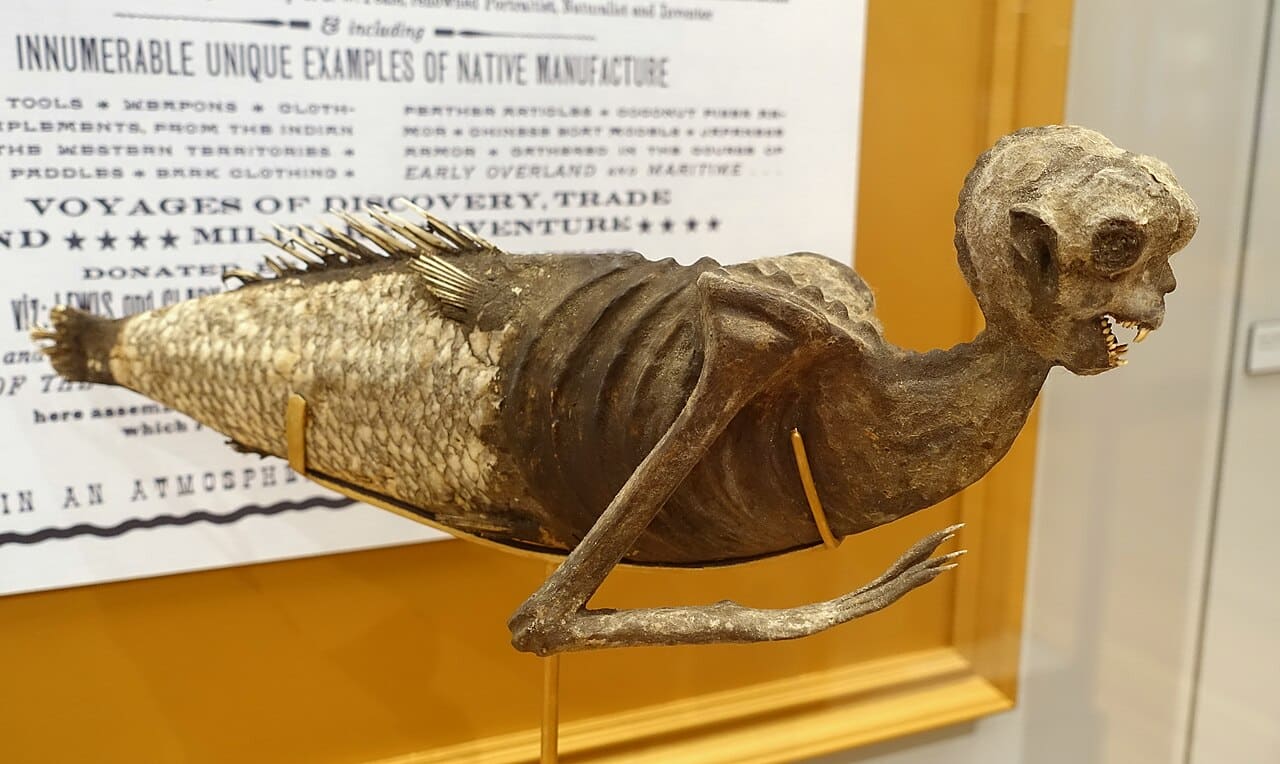
Feejee Mermaid: Key Points
- The Feejee mermaid was a nineteenth and twentieth century freak show attraction advertised as a mummified mermaid from “Feejee,” or Fiji (DeMello, 2024).
- Physically it was nothing like the beautiful woman on Barnum’s handbills, being roughly three feet of blackened, dried tissue with a gaping mouth and raised arms, most likely a taxidermied monkey’s head and torso sewn to a fish tail.
- Barnum did not own it but leased it from Boston showman Moses Kimball, and promoted it in July 1842 by having Levi Lyman pose as “Dr. Griffin,” an English naturalist, before displaying it on Broadway, at the American Museum, and on tour.
- Its true origins were Japanese rather than Fijian, since Japanese tradition includes ape-faced merfolk called ningyo or gyojin, and fishermen built such figures from monkey and fish parts for sideshows before European exhibition and Dutch traders carried one to America.
- Many viewers doubted the specimen, and critics like John Timbs mocked the “credulous persons” who paid to see it, though skepticism only fed Barnum’s ticket sales.
- Theories differ on both its construction, which may have involved wood, cloth, and papier maché as well as monkey and fish, and its fate, either the 1865 American Museum fire or the 1880 Boston Museum fire.

Introduction
In the summer of 1842, throngs on Broadway paid to see a little, blackened, shriveled object that they were informed was the corpse of a mermaid hauled from the waters near Fiji. It wasn’t a mermaid; Kimball had purchased it from the estate of an American sailor named Samuel Barrett Eades, who bought it from Dutch merchants after it had been displayed in Japan and elsewhere. The type has survived even though the celebrity individual almost certainly has never been anywhere near Fiji. It was a composite, stitched and dried, and it became one of the most renowned scams in the history of American entertainment. As DeMello writes, the Feejee mermaid “was a popular freak show attraction during the nineteenth and twentieth centuries, purported to be a mummified mermaid from ‘Feejee’ (Fiji)” (DeMello, 2024). Its tale is really three stories, woven into one: the story of a physical thing manufactured by skilled hands in Japan, the story of a promotional strategy engineered by P. T. Barnum, and the story of a far older human yearning to believe that the sea contains beings with fins.
The Feejee Mermaid is a mummified composite creature with a primate upper body and fish tail, produced and marketed as a real mermaid. This is how it is defined in contemporary study. Its shape and some description of its making are noted several times in historical and critical publications, including Bondeson’s detailed study of the subject and the discussion of the piece’s later distribution in Barnum’s shows (Ressel & Meehan, 2017; Hoekstra, 2009). It has been described as a chimera-type object that reflects the esthetics of 19th-century curiosity cabinets and the period’s obsession with hybrid naturalia (Ressel & Meehan, 2017; Hoekstra, 2009; Sussman et al., 2018). In later museum discourse, the mermaid is recast as an archetypal case of hoax economics, in which publicity, showmanship, and consumer credulity mix with scientific authority (Springhall, 2004; Scribner, 2017).
The Object Itself
Begin with the thing itself, for the gap between the advertized mermaid and the real mermaid is the whole engine of the hoax. Barnum’s handbills featured a beautiful woman with flowing hair and a graceful tail, the mermaid of European painting and poetry. What visitors actually saw was around three feet of desiccated tissue. It was a small, dried-out, dark-looking, and ugly creature around 3 feet long, Barnum himself said. Its mouth was open, its tail was turned over and its arms were flung up, so that it seemed to have perished in extreme agony” (Harris, 1981, p. 63, quoted in DeMello, 2024). The mouth hung open. Teeth appeared. The thin arms were lifted as if in a final spasm, and the fingers curled up near the face. Coarse hair clung to the scalp and to portions of the chest where scales and skin met in a seam an attentive eye might locate. The lower part was definitely fish, tapering into a tight, rigid tail. The upper half was likely the head and shoulders of a small monkey, taxidermied and attached to the fish body (DeMello, 2024). It was not attractive. It pushed you away, and that was part of the attraction.

From Japan to Broadway: The Mermaid’s Lineage
The thing’s lineage goes backward over two oceans from Broadway. The mermaid did not belong to Barnum. He leased it from Moses Kimball, a Boston showman who had been displaying it in his museum, and Kimball had purchased it from the estate of an American sailor named Samuel Barrett Eades, who had bought it from Dutch merchants after it had been displayed in Japan and elsewhere, and the type has survived even if the celebrity individual had been noted in Europe as early as 1822 (DeMello, 2024). What Barnum contributed was not the species, but the publicity. He arranged for a colleague, Levi Lyman, to masquerade as an English naturalist, “Dr. Griffin,” and placed letters in New York newspapers to prepare the audience for the scientist’s visit even before the mermaid was disclosed. The creature was exhibited on Broadway in July 1842 with other oddities, including an orangutan and a ventriloquist, before traveling to Barnum’s American Museum, touring the American South, and shuttling between New York and Kimball’s museum in Boston (DeMello, 2024). That was the sideshow economy summarized. Entrepreneurs like Barnum combined novelty acts like disabled performers, sword swallowers and fire eaters, strange animals, and outright fabrications into single itinerant attractions tied to circuses, carnivals, and dime museums (DeMello, 2024). In this trade, a fake creature was called a gaffe, and Barnum was a master of the form, having also exhibited “What Is It?,” a reported undiscovered monster that was actually two men presented as something they are not (DeMello, 2024).
Barnum’s Publicity and the Skeptical Public
Barnum’s traveling exhibition technique, which relied on dramatic claims and the already existing culture of popular entertainment in the United States and Europe, helped make the mermaid a success. Academic descriptions highlight how Barnum’s advertising language was key to the construction of a mystique for the mermaid, and the object itself was an example of “humBUG” culture in the entertainment world (Ressel & Meehan, 2017; Hoekstra, 2009; Kinzinger, n.d.). Analysis of Barnum’s advertisements, audience engagement, and the wider context of 19th-century American museum practice suggest the public’s curiosity and willingness to engage in interpretive speculation about the mermaid’s authenticity (Ressel & Meehan, 2017; Springhall, 2004; Scribner, 2017).
Not everyone was buying it, and the record shows that many patrons didn’t really care. Some visitors certainly believed, while others treated the exhibit as a puzzle or a joke. Looking back a few decades later, the writer John Timbs was openly contemptuous of the whole business, recalling that “less than half a century ago, a pretended mermaid was one of the sights of a London season, to see which credulous persons rushed to pay half-crowns and shillings with a readiness which seemed to rebuke the record” (Timbs, 1869, p. 33, quoted in DeMello, 2024). Barnum knew something Timbs did not know. Doubt is a ticket seller. But a customer who pays to choose for himself has still paid.
Folklore, Competing Theories, and the Science of Wonder
The scam is less significant than the folklore surrounding the object, which originates from non-Western traditions. Ningyo, or fish-human, and gyojin, or fish-man, had been part of Japanese tradition for a long time, but they were not the enticing maidens of European folklore. They were frequently painted as ape-faced and unlovely, menacing rather than erotic, and in Japanese sideshows of the eighteenth and nineteenth centuries, fisherman made mermaid figures from the taxidermied bodies of monkeys and fish (DeMello, 2024). These statues circulated as curiosities, as temple items, and as commodities for foreign purchasers. Their craftsmen were noted for their exceedingly high level of craftsmanship. Barnum’s mermaid was possibly one of these Japanese contraptions that had made their way to America through European exhibitions and Dutch trade (DeMello, 2024). There is a gentle ironicism here. Something that was based on the religious and legendary imagination of one culture was repackaged for audiences that knew neither Fiji nor Japan as a zoological specimen from the South Pacific, and the misleading name remained.
The theories concerning the mermaid divided into two lines: what it was made of and what happened to it. On composition, the dominant explanation for a long time has been monkey plus fish, and DeMello follows that view (DeMello, 2024). Other investigators have clouded the issue by claiming that surviving specimens of this type vary widely and may include carved wood, papier maché, wire, cloth, fish skin, animal hair, and clay, so that “monkey and fish” is a convenient shorthand, rather than a proven formula for every example (Nickell, 2005). Two leading candidates exist for the destiny of the item. Barnum’s mermaid may have been lost in the fire at Kimball’s Boston Museum in 1880 or may have burned in the fire that destroyed the American Museum in 1865 (DeMello, 2024). There is no indisputable record to settle the issue. Over the years several museum specimens have been presented as the original, and such identifications have tended to be considered with skepticism by researchers (Bondeson, 1999; Levi, 1977). Today, such figurines are still on exhibit in Japan and elsewhere, and the type has survived even if the celebrity individual may not have (DeMello, 2024).
One of the key interpretive themes that runs across the literature is that the Fiji Mermaid embodies late Enlightenment and nineteenth-century amazement, when logical inquiry and interest in abnormal forms were mutually inclusive. Several works set the mermaid within the framework of broader theories of wonder, monstrosity, and the politics of display—claiming that such items reveal how public culture navigates trust in scientific authority while indulging in sensationalized imagination (Scribner, 2017; Gust, 2024; Sussman et al., 2018). Other authors link the Fiji Mermaid to 19th-century Atlantic and worldwide circuits of trading, advertising, and travel and point out the importance of showmen like Barnum in creating taste and belief. The mermaid thus provides insight into the techniques through which museums, fairs, and circuses generated information as amusement, frequently collapsing distinctions between empirical investigation and spectacle (Springhall, 2004; Hoekstra, 2009; Scribner, 2017).
Conclusion
The Feejee mermaid lives to tell the tale because it is a near-perfect example of the manufactured late Enlightenment object that was ugly, small, and obviously assembled. But the apparatus around it, the false naturalist, the planted letters, the lovely lithographs, and the price of admission made it into a phenomenon. Its history is a long chain of hands, from Japanese craftsmen working in their tradition of ningyo, to Dutch traders, an ambitious sailor, a Boston museum owner, and lastly the showman who knew publicity better than anybody of his century. Its folklore shows how civilizations view the barrier between humans and fish in many different ways, charming in one telling and horrific in another. Its hypotheses demonstrate the record’s limitations—we still don’t know for sure what it was created from or how it ended. All we can say is that people lined up to see it and some of them knew better and went anyhow.
References
Bondeson, J. (1999). The Feejee mermaid and other essays in natural and unnatural history. Cornell University Press.
DeMello, M. (2024). Feejee mermaid. In Bigfoot to Mothman: A global encyclopedia of legendary beasts and monsters. Bloomsbury Academic.
Gust, O. (2024). Of mermaids and monsters: Transgender history and the boundaries of the human in eighteenth- and early-nineteenth-century Britain. Gender & History, 36(1), 112–129. https://doi.org/10.1111/1468-0424.12769
Harris, N. (1981). Humbug: The art of P. T. Barnum. University of Chicago Press.
Hoekstra, H. E. (2009). The evolution ringmaster. Cell, 139(3), 454–455. https://doi.org/10.1016/j.cell.2009.10.013
Kinzinger, S. (n.d.). The wonders of calculation in nineteenth-century American experience and literature. https://doi.org/10.18130/v3gm4c
Levi, S. C. (1977). P. T. Barnum and the Feejee mermaid. Western Folklore, 36(2), 149–154.
Nickell, J. (2005). Secrets of the sideshows. University Press of Kentucky.
Ressel, A., & Meehan, K. (2017). Chimera. Screenworks, 7(3). https://doi.org/10.37186/swrks/7.3/4
Scribner, V. (2017). “Such monsters do exist in nature”: Mermaids, tritons, and the science of wonder in eighteenth-century Europe. Itinerario, 41(3), 507–538. https://doi.org/10.1017/s0165115317000663
Springhall, J. (2004). “On with the show”: American popular entertainment as cultural and social history. History Compass, 2(1). https://doi.org/10.1111/j.1478-0542.2004.00088.x
Sussman, H., Salter, G., & Colley, A. C. (2018). Victorians live. Victorian Literature and Culture, 46(1), 259–273. https://doi.org/10.1017/s1060150317000420
Timbs, J. (1869). Eccentricities of the animal creation. Seeley, Jackson and Halliday.




Leave a Reply