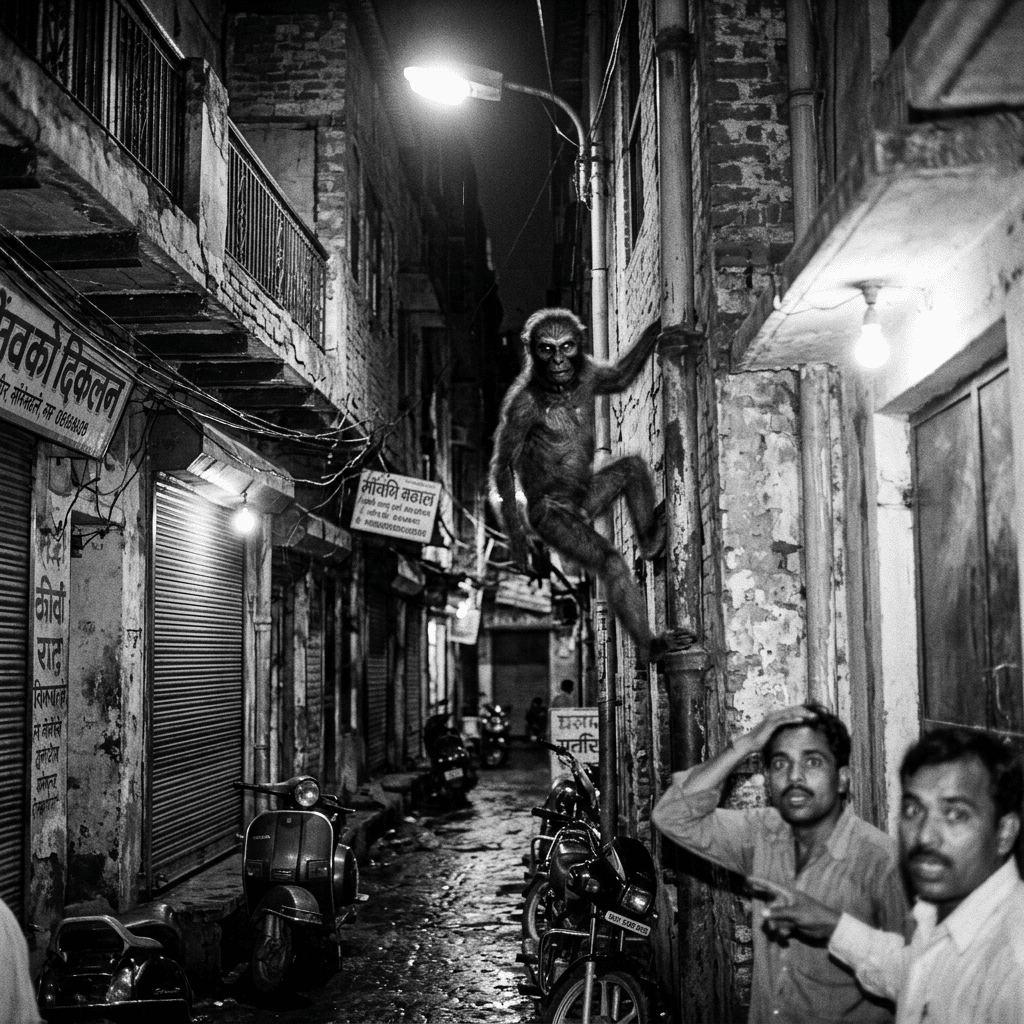
Monkey Man of Delhi: Key Points
- In May 2001, Delhi was gripped by roughly two weeks of panic over a “monkey man” said to be clawing and biting sleepers at night, with 397 attack calls reaching police between May 10 and 25.
- Physical descriptions were wildly contradictory, ranging from a hairy muscular ape-man to a short bespectacled man to a helmeted figure with metal claws, glowing red eyes, and flashing chest buttons.
- The reported behavior broke from ordinary monkey nuisance because the creature attacked rather than stole, striking rooftop sleepers during blackouts and vanishing without leaving tracks.
- Real harm followed: dozens were injured and hospitalized, a Hindu mystic was beaten by a mob, and two people died in falls caused by fright.
- Folklore and media fed each other, as Delhi’s thousands of free-roaming macaques, Hanuman traditions, press nicknames, and sensational coverage supplied a ready template that generated more sightings and hoaxes.
- Investigators concluded it was mass hysteria driven by heat, power cuts, poverty, and fear, with injuries consistent with accidents rather than animal attacks, and the scare faded once coverage stopped and blackouts eased.

Introduction
The monkey man of Delhi is a creature who frightened a city of millions, then departed as swiftly as it came. Few urban legends have done that. For almost two weeks in May 2001, inhabitants of the Indian capital reported being clawed, bitten, and chased by a primate-like attacker that sneaked across roofs in the dark and escaped before anyone could get an image of it. Hospitals full of scratched and injured patients. Stick-wielding vigilante bands patrolled the alleys. At least two persons died in terrified falls, and police received close to four hundred emergency calls (DeMello, 2024). But a body, bones, fur, or a clear photograph never appeared. So the monkey man is not regarded as a zoological discovery but as one of the greatest documented mass hysterias of the twenty-first century, in which heat, poverty, rumor, and a city literally full of monkeys conspired to generate a monster.
Descriptions of the Creature
The “Monkey Man” is an urban legend about a dreaded nocturnal entity or phenomenon said to assault or terrorize citizens in Delhi during the late 20th and early 21st centuries. It is a myth that has been examined in anthropological and sociological contexts within wider discourses on urban dread, modernity, and multi-species cohabitation in Indian cities (Gandhi, 2012). Delhi’s urban environment and the monkey population interface with human worries about safety, governance, and the social fabric of the city as described by several sources (Gandhi, 2012; Ganguly & Chauhan, 2018; Solomon, 2016).
Descriptions of the creature were vivid and utterly conflicting. Some witnesses described a black, powerful, hairy ape-like creature leaping from building to building, while others believed the offender was a short, thin guy in spectacles (DeMello, 2024). Estimates of height varied from about four feet to about eight. Many tales added metallic details that seemed more mechanical than biological: a helmet, shining claws or steel gloves, glaring red eyes, and three buttons on the chest flashing like lights. One or two stories even had the object on roller skates or moving like a remote-controlled robot. Other witnesses spoke of something more like a shapeshifter, with one individual claiming to have witnessed a four-foot monkey turn itself into a cat (DeMello, 2024). Most sightings, in fact, were merely shadows. The creature was observed when it was seen at all, at night and at a distance, for a second or two, and most of what was passed off as eyewitness testimony was simply a second-hand retelling of what someone else claimed to have seen (Radford, 2021).
Reported Behavior and the Course of the Panic
The monkey man’s stated behavior was as shaky as its body. What disturbed Delhi was not robbery, for urban macaques steal from people all the time and people are used to that but predation. The creature was apparently attacking people directly, clawing and biting scores of them over a period of roughly two weeks (DeMello, 2024). It happened at night, typically during power outages, and it liked people who were asleep. The detail is important. The attacks came amid a brutal heatwave that saw families sleep on rooftops and in courtyards, unable to bear the stifling air in their houses and exposed in the dark (DeMello, 2024). Witnesses said it would rip at bed sheets, pounce without notice, then leap away over walls or four storeys and vanish. It never talked. The panic’s history can be traced almost minute by minute. It just came in, hurt someone, and went away.
The history of the panic One can track the history of the panic virtually minute by minute. Reports started in and around Ghaziabad, just east of the capital, and reached police in mid-May 2001 before expanding into East and Northeast Delhi, with a brief echo in Mumbai (DeMello, 2024; Verma & Srivastava, 2003). Between 10 and 25 May, 397 people reported an attack by phone to the control room of the Delhi police (Verma & Srivastava, 2003). The newspapers and television picked up the tale, and the attention fueled the phenomenon: more reporting caused more sightings, more sightings produced wilder reporting, and opportunists manufactured hoaxes (DeMello, 2024). Witnesses say police distributed artists’ sketches, launched hotlines, deployed thousands of officers on the streets and offered a reward of fifty thousand rupees. Vigilante groups, both armed and unarmed, arose, intent on hunting the monster down (DeMello, 2024). The mood grew sour. A mob attacked a short Hindu mystic, believing him to be the beast in disguise (DeMello, 2024). Two persons, one of them a pregnant woman, perished from sheer-fright falls (DeMello, 2024). Then the story was done. The reports ceased, the coverage vanished, and most importantly, there were no devoted witnesses remaining to keep feeding fresh encounters once the cameras were gone (DeMello, 2024).

Folkloric and Cultural Foundations
The worry took on the form of folklore much before any scratch was reported. Delhi has thousands of free-roaming rhesus macaques who compete with humans for food, water, and space; thus, monkeys are an everyday, sometimes hostile presence in daily life (DeMello, 2024). The image of a powerful human-like ape is known in Hindu culture and charged with the immense religious significance of monkeys as represented by Hanuman. The press assigned labels such as the Black Monkey and the Face Scratcher, which spread through the community like the old tales of night-stalking attackers in the town. The public came up with explanations that included all the belief systems available. Some said it was only a monkey. Others said monkey man. A few mentioned a visitor from outer space (DeMello, 2024). The police even suggested sabotage by foreign intelligence agents in masks! It’s an old pattern. In nineteenth-century Britain, the story has been related to Spring-heeled Jack and, abroad, to phantom attacker scares, all of which are situations in which an ambiguous assault becomes a named and embodied monster once rumor provides the template (Bartholomew, 2001).
Explanations, Evidence, and Urban Governance
Theories regarding what really happened are either gullible or clinical, and the evidence strongly favors the latter. The monkey man sits with animals like Orang Pendek in cryptozoological readings, although the case furnishes just testimony and wounds (DeMello, 2024). A medical board examined the victims and found that most of them were adult males from the low socioeconomic strata and had little formal education (Verma & Srivastava, 2003). It also found that most of the incidents occurred between midnight and dawn, when blackouts were common, and that the injuries themselves, which consisted mainly of multiple linear abrasions, were consistent with accidental causes and did not fit an animal attack. Of those tested, a little less than ninety-five percent had some injury and many were hospitalized. The injury was indeed genuine (DeMello, 2024). It was just damage done by darkness, packed rooftops, stairways, stampedes, mob violence, and panic. Others inflated or reinterpreted their prior injuries when they received attention and sympathy. When offered attention and sympathy, others inflated or reinterpreted prior injuries (Radford, 2021). Scientists and police alike came up with a psychosocial explanation: fear, stifling heat, electricity outages, poverty, spectacular media coverage, and the mundane existence of monkeys combined to create a predator (DeMello, 2024). Critically, the panic subsided when the power company stopped the rolling blackouts in the poorer districts so people could sleep inside with fans.
Gandhi’s ethnography (cited in the source given by the candidate) explores the capture of monkeys in Delhi by municipal authorities, residents, and planners, showing how urban governance, modernization, and multi-species coexistence generate ambivalent attitudes toward monkeys and associated urban management practices (Gandhi, 2012). This places stories such as the Monkey Man in broader discussions about urban policy, ceremonial eating habits, and the moral economy of city space (Gandhi, 2012). The Monkey Man narrative is also situated in the wider context of human–monkey relations in Delhi, including the long history of urban rhesus macaques and the public debate about their management. Some authors examine the understanding of monkeys in religious and cultural meanings (e.g., related to Hanuman) and the influence of such meanings on human behaviors in urban settings, including feeding that impacts macaque populations (Grigorovich, 2024; Ganguly & Chauhan, 2018).
Conclusion
The monkey man of Delhi survives because it tells more about people than it does about apes. No one was ever caught. Hundreds were harmed. Three families mourned. An entire city restructured their nights around a creature that was just rumor and shadow. The tale illustrates how rapidly a credible local element, an angry urban macaque in this example, can be amplified by heat, darkness, inequity, and relentless television coverage into something with claws, red eyes, and a metal helmet. It also illustrates how quickly such a being fades away once the media coverage stops and the attention shifts. Delhi’s monkey man was never a species to be discovered. It was a portrait of a summer, sketched by frightened people on rooftops, and it remains a useful warning of the physical devastation a completely fictional monster can do.
References
Bartholomew, R. E. (2001). Monkey man delusion sweeps India. Skeptic, 9(1), 13.
DeMello, M. (2024). Monkey man of Delhi. In Bigfoot to Mothman: A global encyclopedia of legendary beasts and monsters. Bloomsbury Academic.
Gandhi, A. (2012). Catch me if you can: Monkey capture in Delhi. Ethnography, 13(1), 43–56. https://doi.org/10.1177/1466138111431512
Ganguly, I., & Chauhan, N. P. S. (2018). Daily behavioural activity patterns and reproductive ecology of urban rhesus macaques (Macaca mulatta) in human dominated landscape and its implication in management. Journal of Applied and Natural Science, 10(4), 1101–1108. https://doi.org/10.31018/jans.v10i4.1886
Grigorovich, I. (2024). Line is death: Animal fugitivity and urban planning. Humanimalia, 14(2), 289–300. https://doi.org/10.52537/humanimalia.19062
Radford, B. (2021, May 21). The monkey man panic: 20 years later. Skeptical Inquirer. https://skepticalinquirer.org/exclusive/the-monkey-man-panic-20-years-later/
Solomon, D. A. (2016). Interpellation and affect. Humanimalia, 8(1), 1–34. https://doi.org/10.52537/humanimalia.9651
Verma, S. K., & Srivastava, D. K. (2003). A study on mass hysteria (monkey men?) victims in East Delhi. Indian Journal of Medical Sciences, 57(8), 355–360.

Leave a Reply