Coleman Frog: Key Points
- In the 1880s, Fredericton lodge keeper Fred B. Coleman claimed to have tamed a Killarney Lake bullfrog that grew to forty two pounds on June bugs, whiskey, and buttermilk before poachers dynamited the lake.
- Coleman had the frog stuffed for his hotel lobby, and in 1959 his son’s widow donated it to the York Sunbury Historical Society Museum.
- It remains the Fredericton Region Museum’s most famous holding, and the museum has kept the mystery alive by refusing scientific testing.
- Skeptics have long called it a promotional figure for a cough remedy, with one former society president dismissing it as a “patent fake.”
- A 1988 conservation report found canvas, paint, and wax rather than skin, and even the record goliath frog weighed only eight pounds.
- The exhibit endures because the story outlasts the truth. It is a fun story.

Introduction
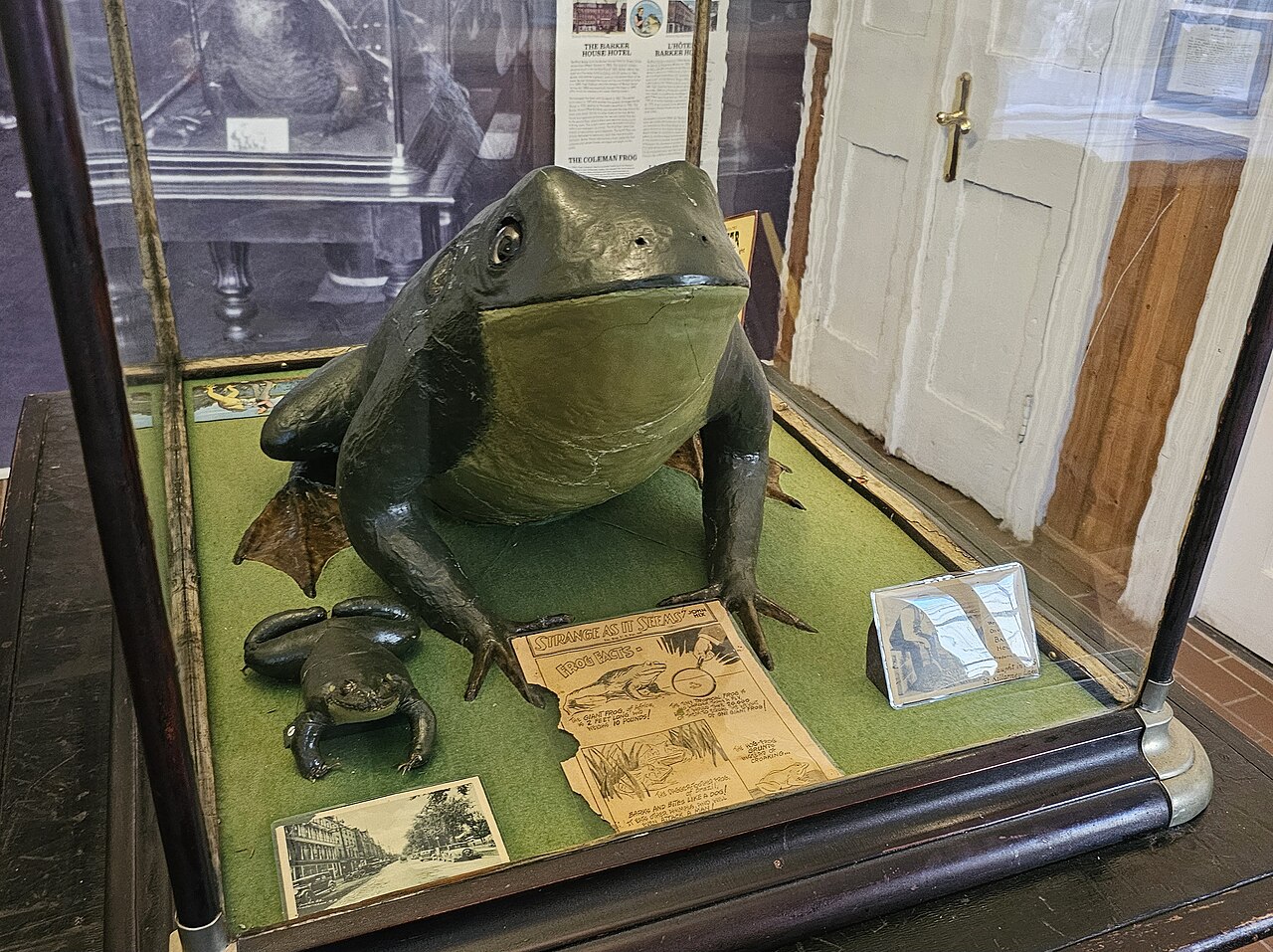
The Coleman Frog is one of Canada’s most durable pieces of small town folklore, a supposedly forty two pound bullfrog that sits in a glass case in Fredericton, New Brunswick, and refuses to be either fully believed or fully dismissed. Its story combines a tall tale from the 1880s, a hotel keeper with a gift for exaggeration, a museum with a stubborn attachment to its most popular artifact, and a conservation report that quietly undermines the whole legend. Radford and Nickell (2006) treat the frog as a cousin of the region’s lake monster traditions in Lake Monster Mysteries, an example of how a local yarn can harden into an exhibit and then into a civic identity. What makes the case interesting is not really the question of whether a giant frog once lived in Killarney Lake. It is the question of why so many people have wanted the answer to stay unsettled.
The Coleman Frog also sits within a much older tradition of frog folklore. In several traditions the frog appears as a creature connected to water, fertility, and boundary crossing phenomena, often linked to rain, floods, or agricultural cycles. Comparative discussions of amphibian imagery highlight how frogs function as symbols tied to fertility and the cyclical renewal of nature, a theme echoed in ethnographic and folkloristic analyses that treat water associated beings as mediators between worlds or states of being (Maciá, 2009; Peña, 2015). The frog’s association with water and transformation is a recurrent motif in world folklore studies that frame frogs within cosmological narratives and seasonal change (Maciá, 2009; Peña, 2015).
The Tall Tale and Its Afterlife
The narrative itself is charmingly absurd. In the 1880s, Fred B. Coleman operated a lodge near Killarney Lake, roughly eight miles from Fredericton, and claimed to have befriended an enormous bullfrog living there (Radford & Nickell, 2006). Coleman said he made a pet of the animal. Guests reportedly fed it June bugs, whiskey, and buttermilk, a diet that supposedly explained its extraordinary growth to forty two pounds. The frog was said to tow canoes and to race tomcats for the amusement of visitors. Its end was suitably dramatic: poachers dynamited the lake to harvest fish, the frog was killed in the blast, and the grieving Coleman had the body stuffed and set up in the lobby of his hotel, where it became a conversation piece for decades. In 1959, his son’s widow donated the specimen to the York Sunbury Historical Society Museum (Radford & Nickell, 2006). That donation transformed a barroom curiosity into a museum artifact, and with that change came a new kind of authority.
Today the frog remains on public display in Fredericton, at what is now called the Fredericton Region Museum, and it is arguably the institution’s best known holding (Fredericton Region Museum, n.d.). Visitors climb the stairs expecting a joke and often leave slightly unsettled by the thing itself, which is large, oddly proportioned, and painted an implausible green. Journalists have long treated it with affectionate irony. Writing in the Daily Gleaner, one reporter described the exhibit as being on view “as big as life, yea, bigger” (Brewer, 1973). The museum has generally leaned into the attention rather than resolving the mystery, and requests for scientific testing have been declined, a stance that keeps the debate comfortably alive. In practical terms, the frog now functions less as a zoological specimen and more as a piece of civic heritage, a mascot for a city that enjoys having something no other city has.

The Evidence Against the Frog
The authenticity debate is nearly as old as the artifact. Local skeptics have long argued that Coleman never stuffed a frog at all, and that he simply purchased a promotional display figure once used to advertise a cough remedy that promised to relieve “the frog in your throat” (Phillips, 1982). In Mysterious Canada, Colombo (1988) records that a former president of the historical society called the object a “patent fake” and said it should have been discarded years earlier, while other officials avoided the subject and quietly resisted proposals for scientific examination. The dispute has never been formally settled, and the exhibit’s long career as a talking point and tourist attraction has arguably depended on that fact. Ambiguity is the product.
The physical evidence, however, is not especially ambiguous. Joe Nickell examined the museum’s own files rather than the sealed case, and what he found was decisive enough. A 1988 condition report by the Canadian Conservation Institute described the sixty eight centimeter object, nearly twenty seven inches, as a “large, possibly stuffed frog,” then noted numerous wrinkles in the so called skin, a “fabric impression underneath,” and “a yellowed canvas” visible through cracks in the surface (Radford & Nickell, 2006). The report also recorded an overall layer of dark green paint with additional colors applied on top, wax apparently present beneath the paint, and translucent feet that seemed to consist partly of wax. A nineteenth century taxidermist might well have used wax and paint (Encyclopaedia Britannica, 1960). Canvas is the problem. As Radford and Nickell (2006) argue, canvas showing through the paint suggests that no genuine skin lies between the two, and that fabric was used as a substitute for hide.
Biology reinforces the point. The largest frog species known is the African goliath frog, Conraua goliath, and a record specimen measured about fourteen inches sitting and weighed eight pounds, one ounce (The Guinness Book of Records, 1999). Coleman’s pet would therefore have been roughly twice as long and five times as heavy as the biggest frog science has documented, and it would have belonged to a species, the American bullfrog Rana catesbeiana, that normally weighs a couple of pounds at most. Whiskey and buttermilk do not explain that gap. Nothing does.
Why the Fake Endures
Several theories account for the object’s origin. The advertising figure hypothesis remains the most popular and fits the canvas and wax construction well. A second possibility is that Coleman commissioned a fabricated frog outright as promotional sculpture for his hotel, which would make the artifact a genuine piece of nineteenth century commercial art rather than a fraud in the criminal sense. A third possibility, harder to rule out entirely, is that a real frog skin formed the original core and was so heavily repaired, repainted, and rebuilt over the decades that little of the animal survives. Notably, the historical society has never mounted a serious public defense of authenticity, and its own officials have at times described the object as a publicity piece rather than a specimen (Colombo, 1988).
The frog’s staying power makes more sense alongside its role in fable traditions that convey moral or social lessons. Scholarship on animal fables and allegorical tales shows frogs appearing as key characters in instructive stories, illustrating broader claims about the function of folklore to transmit cultural values and social norms (Calvo, 1985; Maciá, 2009; Sazonov et al., 2021). Cross cultural examinations of fables emphasize how animal figures like frogs work as cognitive tools to teach ethics, behavior, or social expectations (Calvo, 1985; Maciá, 2009). A frog that grows to impossible size on whiskey and buttermilk belongs to that lineage more than to zoology.
Conclusion
The Coleman Frog therefore survives on its merits as a story rather than as a specimen. The documentary trail, the material analysis, and the basic limits of amphibian physiology all point in the same direction, and even the institution that displays it has declined to defend it as genuine. Yet the exhibit endures, and its endurance is the real phenomenon worth studying. Fredericton has kept an almost certain fake in a glass case because the fake is more useful, more entertaining, and frankly more honest about itself than most tourist attractions manage to be. Radford and Nickell (2006) note that people have argued since the 1880s over which is the bigger whopper, the frog or the claim that it is authentic. The answer is fairly clear. The joke, happily, is still funny.
References
Brewer, J. (1973, March 30). Famous Fredericton frog dates back to city’s founding. Daily Gleaner (Fredericton, N.B.).
Calvo, J. H. (1985). “Stultifera et festiva navis” (De bufones, locos y bobos en el entremés del Siglo de Oro). Nueva Revista de Filología Hispánica, 34(2), 691–722. https://doi.org/10.24201/nrfh.v34i2.613
Colombo, J. R. (1988). Mysterious Canada: Strange sights, extraordinary events, and peculiar places. Doubleday Canada.
Encyclopaedia Britannica. (1960). Taxidermy.
Fredericton Region Museum. (n.d.). Home. https://www.frederictonregionmuseum.com/
The Guinness book of records. (1999). Guinness Publishing.
Maciá, L. M. (2009). Motivos filo esópicos en el Midrás: Fábulas y anécdotas de rabinos en Levítico Rabbá 22,4. Sefarad, 69(2), 281–302. https://doi.org/10.3989/sefarad.2009.v69.i2.596
Peña, E. M. (2015). Versiones y distribución geográfica del mito de “El origen de las manchas de la luna” en la tradición oral indoamericana. Revista de Filología y Lingüística de la Universidad de Costa Rica, 24(2), 115. https://doi.org/10.15517/rfl.v24i2.20944
Phillips, F. H. (1982, April 22). Coleman frog a fake? Daily Gleaner (Fredericton, N.B.).
Radford, B., & Nickell, J. (2006). Lake monster mysteries: Investigating the world’s most elusive creatures (1st ed.). University Press of Kentucky.
Sazonov, V., Kupp-Sazonov, S., Bulgakov, M., Емельянов, В. М., Selz, G., Fink, S., van der Toorn, K., Becking, B., Horst, P. V. D., Prunera, E. S., & Carazo, C. O. (2021). Folklore: Electronic Journal of Folklore, 84. https://doi.org/10.7592/fejf2021.84



Leave a Reply