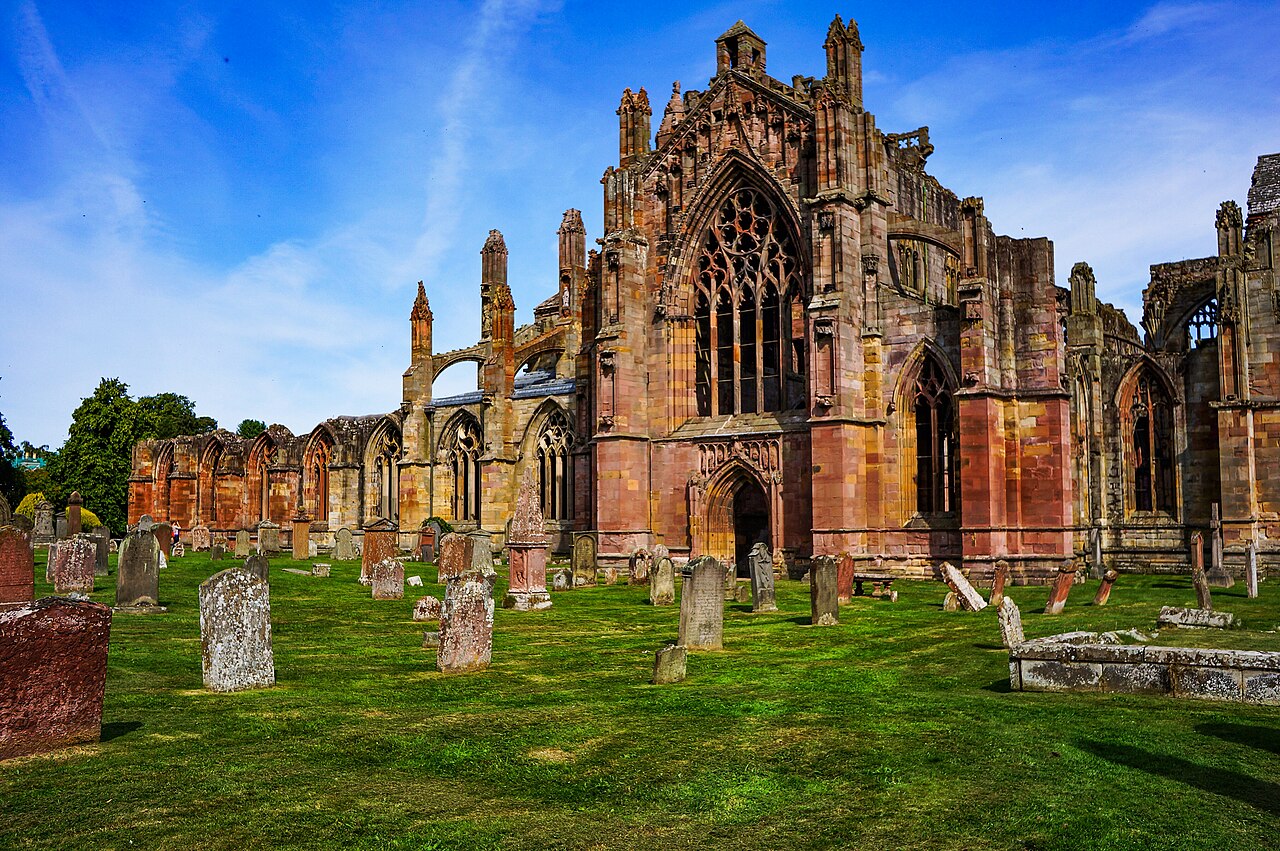
Melrose Vampire: Key Points
- William of Newburgh, writing in the late 1190s, recorded that a worldly chaplain nicknamed the dog priest was buried at Melrose Abbey in 1196 and then rose from his grave to torment the cloister and his former patroness.
- Monks kept vigil at the grave, and when the corpse emerged one of them struck it with an axe; the next morning the exhumed body was found bleeding and undecayed, so it was burned outside the abbey precinct, after which the hauntings ceased.
- Medieval Europe had no vampires, since the word only arrived in the eighteenth century through Balkan cases, and the Melrose creature instead belongs to the older revenant tradition of heavy, stinking, physically animate corpses.
- Revenants were thought to walk at night, haunt people they had known in life, and be repelled by prayer and consecrated ground, and they were often associated with outbreaks of plague, with dismemberment and burning as the standard remedy.
- Scholars have variously read the story as misinterpreted bodily decomposition, as evidence of belief that vitality lingered in the corpse, as social commentary on the political disorder of the 1190s, and as a critique of worldly clerical masculinity.
- Burnt and mutilated human remains from the deserted village of Wharram Percy in Yorkshire, dated between the eleventh and fourteenth centuries, offer the first solid archaeological confirmation that fear of revenants shaped real burial practice in England.

Introduction
In the final pages of a twelfth-century English chronicle, buried amid reports of monarchs, sieges, and church politics, a Yorkshire canon took time to tell his readers about a dead priest who would not rest in his grave. The narrative takes place in the Scottish Borders, specifically at Melrose Abbey, during the spring of 1196, and its subject, known as the Hundeprest, the dog priest, or simply the Melrose vampire, has been recorded in history as the Hundeprest, the dog priest, or simply the Melrose vampire (Historic Environment Scotland, 2024). It is one of the earliest and most vivid stories of the walking dead in the historical record of Britain and predates Bram Stoker by about seven hundred years. But to label it a vampire narrative takes some consideration. This story belongs to a complex medieval history of the restless dead with its terminology, its logic, and its treatments (Caciola, 1996). Understanding this heritage is critical to understanding the events that transpired at Melrose.
Revenants, Not Vampires: The Medieval Vocabulary of the Restless Dead
There were no vampires in medieval Europe, per se. The phrase itself is a latecomer to Western languages, introduced in the eighteenth century from Slavic and Balkan use, popularized by the sensationalist Habsburg investigations into instances like those of Peter Plogojowitz and Arnold Paole in the 1720s and 1730s (Barber, 1988). Instead, medieval Europe had revenants: corpses that physically and grossly rose from their graves to bother the living (Gordon, 2015). English and Anglo-Norman writers in the twelfth and thirteenth centuries record such cases with surprising frequency and one of the most graphic is found in the Life of St. Modwenna by Geoffrey of Burton, in which two runaway peasants from Stapenhill return to haunt Drakelow and are finally quieted when their hearts are cut out and burned (“Archaeological Finds Prove,” 2017). Walter Map and Caesarius of Heisterbach give other examples and similar figures are found across the broader region, from the Icelandic draugr to the Greek vrykolakas (Caciola, 2017; Gordon, 2015). To summarize, the revenant was no unusual import. This was a recognized danger, and the usual fix was brutally physical: digging up the offender, dismembering or decapitating the body and burning it (Mays et al., 2017).

William of Newburgh and the Melrose Narrative
The story of Melrose comes from William of Newburgh, an Augustinian canon who entered Newburgh Priory in Yorkshire as a boy and spent the rest of his life there and who wrote his Historia rerum Anglicarum in the late 1190s at the invitation of Ernald, abbot of Rievaulx (Editors of Encyclopedia Britannica, n.d.; Perisanidi, 2023). In Book Five of that work are four revenant accounts, generally known as the Buckinghamshire ghost, the Berwick ghost, the Hounds’ Priest and the ghost of Anantis, a place often connected with Alnwick (Joynes, 2001). The Melrose account of the four is the most elaborately worked out. His subject had been chaplain to a wealthy and well-born woman and had, William’s testimony has it, utterly ignored the responsibilities of his duty. He was a zealous hunter, more interested in hounds and horns than in the treatment of souls, a trait that earned him the epithet “Hundeprest,” or “dog priest” (Scottish Vampires, n.d.). He was buried, after he died, in the churchyard of the Cistercian monastery at Melrose, thanks to the kindness of his patroness and her interest. The grave could not contain him. He started walking at night. His first reaction was to push his way into the cloister where he had no right to be. This story revolves around the concept of a boundary. Monks at prayer prevented him from entering the threshold of the sanctuary, and he was forced out onto the fields and byways (Historic Environment Scotland, 2024). He went to the house of the lady he had served and hung over her bedchamber, groaning and muttering, until she was nearly driven insane with horror. She turned to the abbey for aid. Monks were sent to keep watch at the burial and William comments drily that her substantial donations to the house made her a claimant worth satisfying (Joynes, 2001). Midnight came and passed. The observers, all except one, fled to a nearby house to warm themselves, cold and bored. Scarce were they gone when the corpse emerged from the ground. The last monk kept his ground and swung the ax he was carrying, lodging it deep in the thing’s flesh. It roared, turned, and fled, the monk chasing it back into the soil. At daybreak the grave was opened. Blood oozed from the ruffled earth, and there was the body, evidently fresh, with a large gash in it. The monks took the corpse out of the monastery limits and burned it to ashes, which they then scattered (“Scottish Vampires,” n.d.; Wayland, n.d.). Melrose was quiet.
The Nature of the Medieval Revenant
William’s monster is not the pale aristocrat of later tales. It is a heavy, dirty, corporeal object, a corpse in motion rather than a spirit (Vyongewa, n.d.). The medieval revenants are foul-smelling, bloated, and dark, crushing and smothering their victims with sheer weight, while the legend of the Anantis from the same chapter describes the unearthed body as bloated beyond measure and gorged with blood (Joynes, 2001). Their powers are limited but terrible; they walk only at night, they usually stay near the area where they died and torment the individuals who knew them best, and they can be repelled by prayer and by consecrated ground (Caciola, 2017). In certain of William’s stories, like those of Berwick and Anantis, the revenant’s activity is associated with outbreaks of plague, so that the walking corpse is both a symptom and cause of contagion (Gordon, 2015). It’s the blood drinking that popular retellings like to accentuate. Many later retellings of the Melrose story have the Hundeprest drink the lady’s blood (Sedgwick, n.d.; “Who Was William of Newburgh,” 2024), but William’s actual text is less specific, and the vocabulary of bloodsucking is more strongly attached to other writers and other situations (Joynes, 2001). The vampiric information William does provide is more subtle and, in its own way, more chilling: the wound bleeds, the corpse seems alive, and the grave itself runs red.
Scholarly Interpretations and Archaeological Evidence
Scholars have read the story in many ways. Barber (1988) claimed that the physical characteristics in such reports are essentially true forensic observations but misread through folklore. Decomposition generates bloating, reddish skin, flowing blood, and a cadaver that looks eerily undecayed when exhumed. Caciola (1996, 2017) has demonstrated that the culture of the Middle Ages contained competing models of death, one spiritual and one material, and that many believed residual vitality was retained by the corpse itself, which explains the fact that fire, and not exorcism alone, was the ultimate remedy; her work on wraiths, revenants, and ritual remains the standard point of departure for the subject (University of California, San Diego, n.d.). These kinds of stories, Schmitt (1998) said, were part of the Church’s long-term mission of controlling the dead and channeling their claims into penance and prayer. Gordon (2015) reads William’s four episodes as societal commentary, suggesting that their location in Book Five encourages comparison between the disordered corpse and the disorderly men of the 1190s, with contemporary ideas of disease providing the connecting logic. As Perisanidi (2023) has pointed out, the Hundeprest is a symbol within clerical society, as a hunting chaplain to a wealthy patroness is a walking condemnation of a worldly and unsuitably masculine way of monastic life. Others underline the geography, noting that the Borders and northern England had been absorbing centuries of Scandinavian influence and that William’s revenants closely resemble the draugr of the sagas (Sedgwick, n.d.; Wayland, n.d.). All these findings archaeology has supported. supported through archeology. In 2017, Mays et al. published a study of the bones of people from the deserted village of Wharram Percy in Yorkshire, dating from the eleventh to fourteenth centuries, and concluded that the best explanation for the treatment was fear of revenants, as the people had been decapitated, dismembered, and burned after death (“First Evidence in England,” 2017; “Medieval Villagers Warded Off ‘Zombies,’” 2017; “New Archeological Evidence,” 2017; “Scientists Uncover Medieval Remains,” 2017).
Conclusion
So the Melrose vampire is less a curiosity than a window. The Hundeprest, without the subsequent trappings of cloaks and castles, reveals to us what the medieval dead were really terrified to do: intrude, oppress, transmit sickness, and refuse the boundaries that the living had put around them. His story is also clearly morally charged, as he was a priest who loved hunting more than his parishioners and who bought his grave with a patron’s money, making him the precise kind of man expected to return incorrectly (Perisanidi, 2023). Whether we read him in terms of the chemistry of decomposition, the theology of the lingering soul, or the political fears of the 1190s, the account remains one of the most detailed revenant narratives to survive from medieval Britain. Long before the name “vampire” was ever uttered in Western Europe, the monks of Melrose stood over an open grave with an ax and a bonfire, doing what their tradition instructed them to do.
References
Archaeological finds prove that fear of the walking dead was very real to medieval minds. (2017, April 11). The Conversation. https://theconversation.com/archaeological-finds-prove-that-fear-of-the-walking-dead-was-very-real-to-medieval-minds-76068
Barber, P. (1988). Vampires, burial, and death: Folklore and reality. Yale University Press.
Caciola, N. (1996). Wraiths, revenants and ritual in medieval culture. Past & Present, 152, 3–45. https://www.academia.edu/1515462/Wraiths_Revenants_and_Ritual_in_Medieval_Culture
Caciola, N. M. (2017). “Night is conceded to the dead”: Revenant congregations in the Middle Ages. In L. N. Kallestrup & R. M. Toivo (Eds.), Contesting orthodoxy in medieval and early modern Europe: Heresy, magic and witchcraft (pp. 17–33). Palgrave Macmillan. https://doi.org/10.1007/978-3-319-32385-5_2
Editors of Encyclopaedia Britannica. (n.d.). William of Newburgh. Encyclopaedia Britannica. https://www.britannica.com/biography/William-of-Newburgh
First evidence in England of burning dead bodies to keep them from rising. (2017). Atlas Obscura. https://www.atlasobscura.com/articles/zombie-body-mutilation-england-wharram-percy
Geoffrey of Burton. (2002). Life and miracles of St Modwenna (R. Bartlett, Ed. & Trans.). Oxford University Press.
Gordon, S. (2015). Social monsters and the walking dead in William of Newburgh’s Historia rerum Anglicarum. Journal of Medieval History, 41(4), 446–465. https://doi.org/10.1080/03044181.2015.1078255
Historic Environment Scotland. (2024, October). The Melrose vampire. Historic Environment Scotland Blog. https://blog.historicenvironment.scot/2024/10/the-melrose-vampire/
Joynes, A. (2001). The “History of the Events of England” of William of Newburgh. In Medieval ghost stories: An anthology of miracles, marvels and prodigies. Boydell Press. https://www.cambridge.org/core/books/medieval-ghost-stories/history-of-the-events-of-england-of-william-of-newburgh/E228BF3F7EFA163FB1804ED43590A8AC
Mays, S., Fryer, R., Pike, A. W. G., Cooper, M. J., & Marshall, P. (2017). A multidisciplinary study of a burnt and mutilated assemblage of human remains from a deserted mediaeval village in England. Journal of Archaeological Science: Reports, 16, 441–455. https://doi.org/10.1016/j.jasrep.2017.02.023
Medieval villagers warded off “zombies” by mutilating human remains, study finds. (2017). ScienceAlert. https://www.sciencealert.com/MEDIEVAL-VILLAGERS-WARDED-OFF-ZOMBIES-BY-BURNING-AND-MUTILATING-HUMAN-REMAINS-STUDY-FINDS
New archaeological evidence throws light on efforts to resist “the living dead.” (2017, April 3). Phys.org. https://phys.org/news/2017-04-archaeological-evidence-efforts-resist-dead.html
Perisanidi, M. (2023). Religious masculinities in William of Newburgh’s Historia rerum Anglicarum. Historical Research, 96(273), 283–297. https://doi.org/10.1093/hisres/htad008
Schmitt, J.-C. (1998). Ghosts in the Middle Ages: The living and the dead in medieval society (T. L. Fagan, Trans.). University of Chicago Press.
Scientists uncover medieval remains of the first English “living dead.” (2017). The Independent. https://www.independent.co.uk/news/science/archaeology/archaeology-scientists-find-medieval-remains-english-vampires-yorkshire-wharram-percy-a7663121.html
Scottish vampires: The dark legend of the undead priest of Melrose. (n.d.). Discover Scottish Borders. https://discoverscottishborders.com/scottish-vampires-the-dark-legend-of-the-undead-priest-of-melrose/
Sedgwick, I. (n.d.). Ancient revenants in the Borders and Cumbria. Icy Sedgwick. https://www.icysedgwick.com/northern-vampires/
University of California, San Diego. (n.d.). Nancy Caciola. Department of History. https://historyweb.ucsd.edu/people/faculty/caciola.html
Vyongewa. (n.d.). Medieval zombie? Medieval vampire? You decide. Medium. https://vyongewa.medium.com/medieval-zombie-medieval-vampire-you-decide-9b2cd6106b0b
Wayland, M. J. (n.d.). Vampires of Scotland and England borders. MJ Wayland. https://www.mjwayland.com/mysteries/vampires-of-the-borders/
Who was William of Newburgh, the English historian who wrote about vampires? (2024, February 27). AIPT. https://aiptcomics.com/2024/02/27/william-newbury-newburgh-vampires/
William of Newburgh. (1856). The history of William of Newburgh (J. Stevenson, Trans.). Seeleys. (Original work published ca. 1198)

Leave a Reply