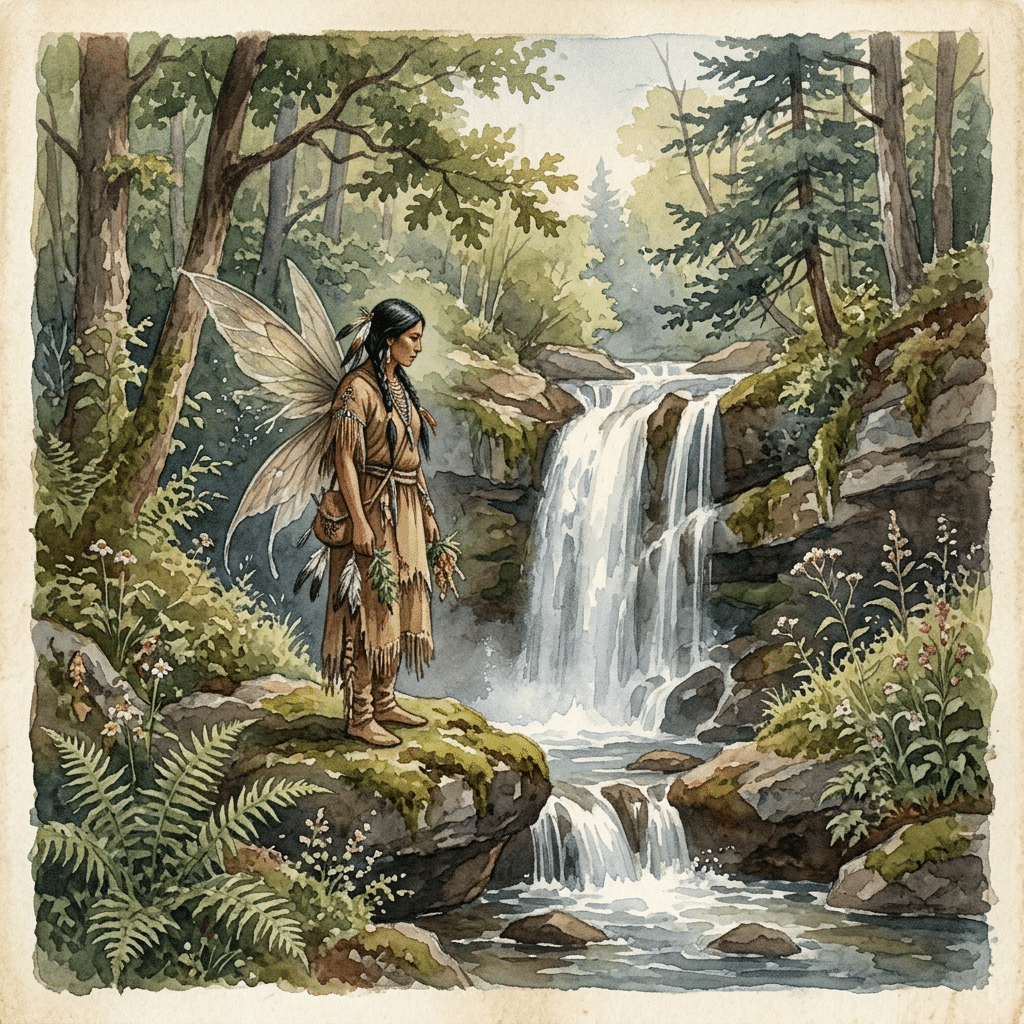
The Nunnehi: Key Points
- The Nunnehi, “the people who live anywhere,” are an immortal parallel people of the southern Appalachians, loosely called Cherokee fairies.
- They look like ordinary Cherokee people and are known mainly by invisibility, drumming, and disembodied singing.
- They are generous but disorienting hosts, and they defended Nikwasi with invisible warriors from the mound.
- Mooney recorded their lore around 1887 to 1890, including Removal tales of towns carried into mountains and rivers.
- Their powers are invisibility, immortality, illusion, and prophecy; their weaknesses are noise, human failure, and withdrawal.
- Theories range from mound builder memory to Removal testimony to paranormal visitors, though “fairy” was Mooney’s word.

Introduction
Few figures in Cherokee oral tradition are as quietly fascinating as the Nunnehi. The name is written as Nûñnĕ′hĭ by the ethnographer James Mooney and transliterated in the syllabary as ᏅᏁᎯ. The name is generally translated as “the people who live anywhere,” but the English have long favored the looser and more evocative translations “the Immortals” or “the people who live forever.” Writers who grab for a familiar parallel call them Cherokee fairies. The connection is not worthless, for the Nunnehi share with European fairies a hidden country, a love of music, a habit of borrowing human company, and a deadly unpredictability about time and place. The comparison is inaccurate, too. The Nunnehi are not gods, spirits of the dead, or spirits of nature, plants, or animals. They are a parallel people, alive, totally alive, dwelling in the same mountains as the Cherokee, and stepping across into view now and then. To comprehend them is to understand how the southern Appalachians were viewed as an occupied region, not an empty wilderness.
Identity and Appearance in Cherokee Mythic Tradition
Nunnehi are a kind of immortal or semi-immortal creatures in Cherokee mythology that live in the world with humans. In literature, the Nunnehi are typically situated alongside other supernatural entities within the mythic landscapes of the Cherokee, where they contribute to explanations of natural occurrences, cultural customs, and moral lessons (e.g., tales of Kanati the Hunter and Selu the Corn Goddess establish the broader sacred framework in which the Nunnehi reside). This perspective is congruent with scholarly approaches to Cherokee mythic worlds that stress holy narratives as fundamental to identity and worldview (Loftin & Frey, 2019; Hada, 2009).
The Nunnehi aren’t anything special physically, and that’s the goal. When they want to be noticed, they appear as regular Cherokee men, women, and children, wearing the same clothes, speaking the same language, and maintaining the same houses and cornfields and council houses. No wings, no shimmering skin, no insect delicacy. They are not the usual companions in the literature, the Yunwi Tsunsdi, or Little People, described as being knee-high or child-sized, attractive, and well-proportioned, with black hair hanging nearly to the ground. The two groups have not always been neatly divided by storytellers, and some tales treat the names as overlapping. The earlier material often shows the Nunnehi as full-statured. Their genuine physical quality is lacking. Most of the time they are invisible, and what people experience is proof instead: drumming in the high balds, singing that resonates across a cove, the smell of smoke, a warm current of air rising from a hole in the ground on a chilly day, and footprints where no one trod.

BY JAMES MOONEY
Hospitality, Healing, and Defense
They are gregarious and generous and a bit unsettling. They are renowned hosts. One of Mooney’s best stories, acquired from his Cherokee informant Wafford, is about a ten- or twelve-year-old boy who was building a stone fish trap in the Nottely River when a man came along on the bank and told him he had worked long enough and sent him up the river for dinner. The boy ate up. The family was kind. One individual he recognized from his village came in and greeted him, and he was immediately at peace. When they took him home the next morning, the house, the cornfield, the orchard, and the fence were gone, and behind him there was nothing but rocks and trees. They had searched all night for his body in the river and his family. The neighbor he had seen at dinner stated he had been out all day looking and had never seen him. And that was how they knew. It’s a theme throughout the tradition. The Nunnehi save lost hunters, feed the malnourished, guide the freezing home through snow, and warn of imminent tragedy. However, each act of generosity carries a subtle sense of dislocation. Hunters who heard their dances and headed toward the sound realized that it was moving, slipping away behind them or to the side, never arriving.
While Nunnehi are not always strictly hospitalities of healing in all sources, Cherokee spiritual beliefs often associate entities like Nunnehi with healing and protecting roles in the lives of the community. Talk of holy entities, cosmology, and ritual knowledge often overlaps with ethnographic and scholarly discussions of Cherokee healing traditions and medicine. This connection is consistent with the broad assertion that spiritual beings are woven into social, health-related conceptualizations of the world, as has been examined in analyses of Cherokee medicine, spirituality, and the interaction with Christian influences (Lowe, 2002; Fitz, 2002).
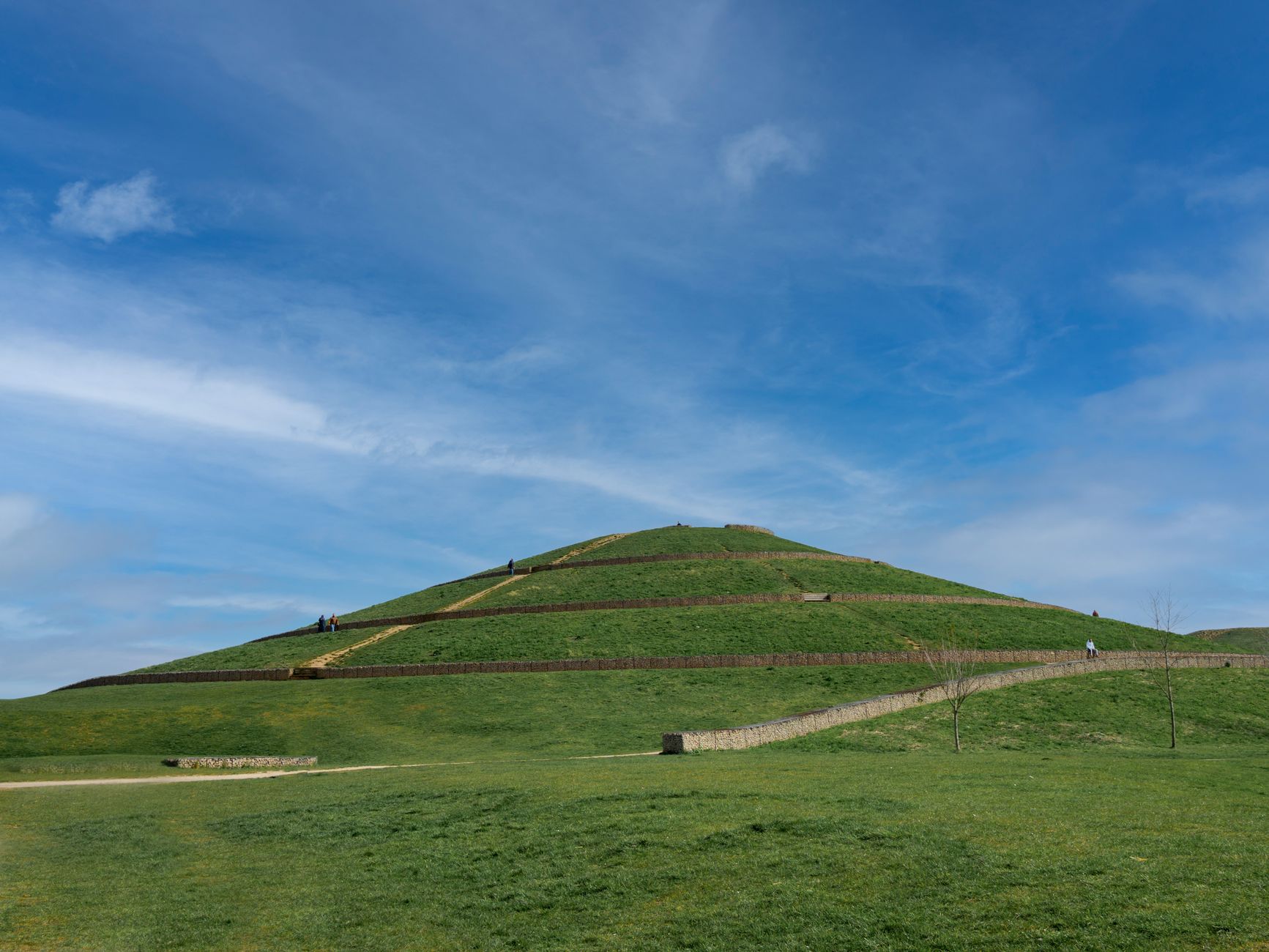
And fighting. The most popular of the Nunnehi stories is about Nikwasi, the old mother town on the Little Tennessee, where a mound still exists in the heart of Franklin, North Carolina. “Just before morning, some unknown enemy forces emerged from the southeast and attacked us.” The Nikwasi fighters were swamped. Then a stranger stepped up to the chief, instructed him to withdraw his soldiers and said he would take up the fight himself. The chief thought that it was a headman from a neighboring village coming with reinforcements. Then the hill opened up. Hundreds of painted and armed warriors poured out and as soon as they were outside of the settlement, they disappeared from sight. The invaders saw arrows flying and blows falling but could not see who struck them. The few survivors were spared, informed they’d earned their defeat by attacking a quiet community, and sent home as messengers. Then the Nunnehi returned to the hill.
Sacred Cosmology, Removal, and Historical Memory
The nunnehi are interwoven in a Cherokee sacred cosmology and mythic economy and, within narrative and ceremonial contexts, contribute to explanations of natural occurrences, moral order, and communal identity. This positioning resonates with scholarly depictions of sacred stories as vital to Cherokee identity and worldview and understandings of myth as a lived practice rather than a mere archive (Loftin & Frey, 2019; Hada, 2009). The Nunnehi are part of a larger web of legendary entities (e.g., Kanati, Selu) that make up a holy matrix for subsistence, social organization, and spiritual existence. This network is detailed in studies of Eastern Cherokee myth that look at the creation, hunting, and farming narratives as the foundation for cultural values and life-ways, where Nunnehi are present as beings contributing to the moral and spiritual landscape (Loftin & Frey, 2019).
The historical backbone of the tradition continues well through the nineteenth century. Mooney collected his material primarily from among the Eastern Cherokee between 1887 and 1890 and published Myths of the Cherokee under the Bureau of American Ethnology at the turn of the century (Mooney, 1900). His informants located Nunnehi townhomes as specific, discoverable locations: Pilot Knob, the mound beneath Nikwasi, a magnificent townhome beneath Blood Mountain at the head of the Nottely, a place beneath the Hiwassee near the mouth of Shooting Creek. Some of the most complex stories are around the forced removal of 1838. In “The Removed Townhouses,” inhabitants along the Valley River and Hiwassee heard unseen voices predicting wars and sorrow, urging them to live under the mountains and by the river. Conditions were terrible. Come to the house. Move fast. Stay silent. In one town, on the seventh day, there was a roar from the mountains that became thunder, and the house shook as the townhome was raised, and someone shouted. The Nunnehi, startled, dropped half of their load, which created the mound at Setsi; they then carried the remaining load away, making their folk invisible and immortal. On the Hiwassee they were brought under the river instead. On warm days when the wind rippled the surface, you could hear them chatting below. Snagged up, dragged. Fish. Kinsmen reaching out, refusing to be forgotten. Another version, much repeated, has the Nunnehi roll back a massive stone to show a beautiful country inside the mountain. Some families entered without looking back; some refused and were marched west. The Cherokee who remain in the homeland today are said to descend from the ones who stayed near.
Powers, Protocol, and Competing Interpretations
Their nature is what gives them power. Their main power is invisibility, which they can use at will and extend to large towns and villages. They are immortal, or at least ageless. They can pass that on to humans who accept their invitation. They possess a form of glamor that causes houses and orchards to disappear behind a guest, as well as a skill similar to ventriloquism that projects the sound of their drums, rendering any pursuit futile. They shift buildings and dirt. They know the future enough to warn of it. They are almost invulnerable in warfare, hitting without being struck. Their shortcomings are more subtle, more intriguing. One terrified voice can spoil their task. Setsi shows they are intimidated by noise. Their strength is partly dependent on ours, for they require human cooperation in the shape of fasting, solitude, patience, and the discipline of not looking back. No one who goes looking for them will ever discover them. Above all, they retreat. Mooney stated that the Nunnehi became angry when the white settlers took over the region and left some townhomes for good. The drumming on the balds is said to have ceased around the time of the Removal.
The folklore around them is full of etiquette. Accept any gifts the Nunnehi may offer you with grace, and do not question them. They shouldn’t be bothered in their houses. Those who spend a significant amount of time with the Nunnehi are often instructed to remain silent about their experiences for a specific number of years, and those who speak too soon may face danger, a rule that is also applicable to the Little People. The same country is crowded with related figures: the Yunwi Amayinehi or water-dwellers; the mischievous De’tsata, who conceal a hunter’s arrows; and the vanished town of Kanasta, whose residents went into the mountain and left smoke rising from an empty valley.
Theories regarding what the Nunnehi are have multiplied for more than a century, and they reflect as much about the theorists as the subject. The most venerable scholarly ploy is euhemerism, in which the Immortals are folk memories of real peoples: mound builders whose handiwork survived after their names were lost, or refugee tribes living discreetly in distant coves, or earlier dwellers ousted by Cherokee expansion. The second approach is comparative: fairy belief is near universal, and Appalachia in particular saw Cherokee tradition side-by-side with Scots-Irish and English fairy lore for generations, with plenty of opportunity for mutual reinforcement. The Cherokee material is clearly older than that contact. A third approach, now the most compelling to many readers, reads the Removal narratives as testimony rather than fantasy: stories of towns carried into the mountains are stories of survival, of the families who hid in the highlands and became the Eastern Band, and of a homeland that refused to be emptied even when the law said it was. There are environmental readings as well that suggest the odd acoustics of high coves, wind on treeless balds, and true warm air vents. There are fringe readings that include the Nunnehi in modern paranormal categories, including the interdimensional and extraterrestrial hypotheses popularized by writers such as Jacques Vallée. With all this we have a reasonable criticism of the overall effort. Mooney was an outsider working in the language of his age; the word fairy was his shortcut, not a Cherokee notion, and the use of the moniker in fiction and role-playing games has muddied a legacy that belongs to real people.
Folklorists and scholars of Cherokee myth stress that myth and legend are not simply entertainment but serve as markers of cultural values and the sacred logic of existence. In this respect, Nunnehi are a genre of holy knowledge—myths revealed through dream, vision, and ritual expression—that imparts knowledge about lineage, land, and communal obligations (Vest, 2012; Loftin & Frey, 2019). In contemporary Cherokee life, Christian and Cherokee religious sensibilities coexist, as noted in ethnographic and legendary literature. In some analyses, Nunnehi stories are read through a syncretic religious imagination, in which native spiritual creatures are thought to coexist with and are reconfigured through Christian paradigms. This coexistence is part of the larger Cherokee epistemology, notably among the Eastern Cherokees, and is examined in works that address religious interpretation and mythological worldviews (Loftin & Frey, 2019; Fitz, 2002).
Conclusion
The Nunnehi live on because they answer a question no theory quite dissolves—what it means for a place to be filled by more than the individuals you can count. They are friendly and elusive, human in appearance and inhuman in habit, defenders of a certain country in particular valleys, and the legends about them are still told by Cherokee storytellers who neither insist on their literal truth nor abandon it. The mound at Nikwasi remains, now surrounded by streets and parking lots, and in 2019 it came under the stewardship of an effort established to safeguard it. The upper balds remain naked. Whether the drumming is heard as archeology, as metaphor, as trauma transmuted into hope, or as exactly what the stories say it is, the Nunnehi tradition’s basic claim remains the same and rather humbling: the mountains were never empty, the hidden people are still there, and they are not forgotten by those who hope not to be forgotten themselves.
References
Fitz, K. (2002). Native and Christian: Religion and Spirituality as Transcultural Negotiation in American Indian Novels of the 1990s. American Indian Culture and Research Journal, 26(2), 1–15. https://doi.org/10.17953/aicr.26.2.2428722t48470808
Hada, K. (2009). Even the Snow Is White: Displacement and Literary Ecology in Diane Glancy’s Pushing the Bear. American Indian Culture and Research Journal, 33(1), 131–142. https://doi.org/10.17953/aicr.33.1.q2p97w5735426h01
Loftin, J. D., & Frey, B. (2019). Eastern Cherokee Creation and Subsistence Narratives: A Cherokee and Religious Interpretation. American Indian Culture and Research Journal, 43(1), 83–98. https://doi.org/10.17953/aicrj.43.1.loftin-frey
Lowe, J. (2002). Cherokee Self-Reliance. Journal of Transcultural Nursing, 13(4), 287–295. https://doi.org/10.1177/104365902236703
Mooney, J. (1900). Myths of the Cherokee (Nineteenth Annual Report of the Bureau of American Ethnology, 1897–98, Part 1). Government Printing Office.
Vest, J. H. C. (2012). The Legend of Jump Mountain: Narrative Dispossession of the Monacan in Postcolonial Virginia. American Indian Culture and Research Journal, 36(3), 99–116. https://doi.org/10.17953/aicr.36.3.6jt8367282957424

Leave a Reply