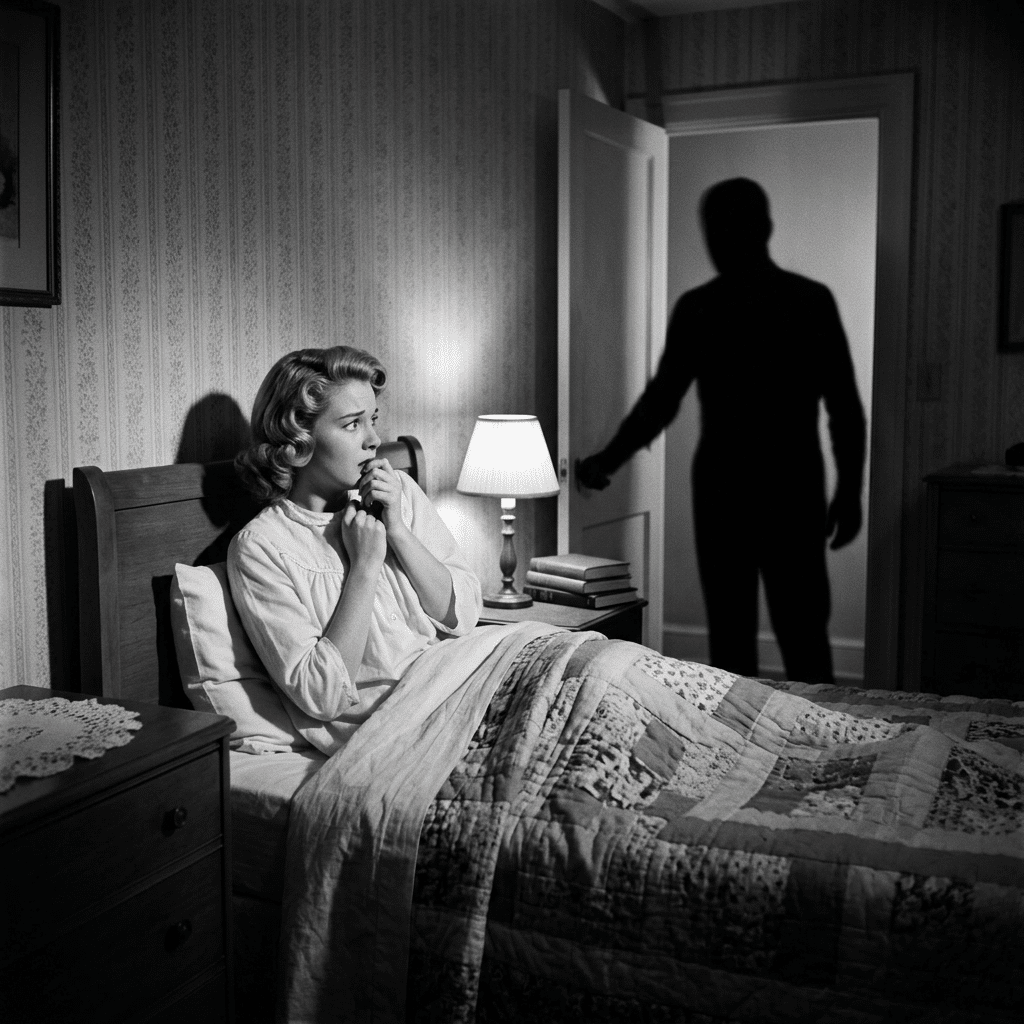
Types of Shadow People: Key Points
- The Watcher is a flat, average-height silhouette that stands motionless in doorways and at bedsides, doing nothing but generating the sense of being observed. Light and calm attention dissolve it, and it echoes older figures like Nalusa Falaya and the djinn.
- The Hat Man is oddly specific: tall, thin, coated, and wearing a wide-brimmed fedora, appearing at the edge of sleep and radiating dread without moving. His lore traces to the 2001 Hatman Project and links tightly to sleep paralysis.
- The Mist Form is a shapeless drift of dark smoke, read in folklore as leftover energy rather than an intelligence. Airflow, sunlight, and time disperse it, and pareidolia on dust and low-light noise explains it well.
- The Tall Shadow is elongated past human proportion, solid rather than flat, and territorial enough to advance on sleepers and fill doorways. Often called demonic, it is said to drain energy and to retreat from light and refused fear.
- The Quick Mover is a peripheral blur that crosses a hallway and vanishes before you can turn, traditionally seen as a harmless passing spirit. It matches passage hallucinations documented in Parkinson’s patients in 2000.
- Their consistency across centuries and continents points to either real entities or something structured in human perception. Tellingly, the traditional remedy is composure rather than ritual, since fear is the one thing the witness controls.

Introduction
The sighting of a shadow person is one of the most ubiquitous, constant, and difficult-to-explain reported experiences. The same fundamental item is described by witnesses all throughout North America, Latin America, Europe, and Asia, a dark humanoid shape, blacker than the room around it, standing where nothing should stand (Wikipedia, n.d.). Some see it once and forget it; others claim to have had encounters for years. The intriguing thing about the phenomenon is not that it happens but that it arranges itself into recognizable types. Thousands of mostly independent reports collected online and in paranormal literature (Pararational, n.d.; The Minds Journal, n.d.) have generated popular taxonomies naming the Watcher, the Hat Man, the Mist Form, the Tall Shadow, and the Quick Mover. Whether they are spirits, hallucinations, or something stranger, each species has its look, habits, reputed powers and limitations, and complex folklore history. The only honest way to handle the matter is to treat them as separate categories and not as a single undifferentiated boogeyman.
Syndrome-Like Setup for Shadow Encounters
The evidence supports a syndrome-like model in which ghostly experiences (including experienced presences, shadows, and related anomalies) occur in conjunction with cognitive-perceptual and affective processes that might be characterized as interlocked symptoms. In a conceptualization known as Haunted People Syndrome (HP-S), Laythe et al. (2021) link subjective ghostly episodes with somatic-sensory sensitivities, paranormal beliefs, and contextual factors, emphasizing a syndrome-like pattern rather than isolated experiences (Houran & Laythe, 2022). Houran and Laythe propose a similar model, with environmental, perceptual, and belief-based variables combining to create haunt-type experiences, focusing on transliminality, belief, and environmental signals (Houran, 2007; Houran & Laythe, 2022; Simmonds-Moore, 2023). These sources collectively argue (Houran, 2007; Simmonds-Moore, 2023) that the Five Kinds of Shadow People are not universally veridical external occurrences, but that the phenomenology is modified by cognitive set, belief frameworks, and environmental context. Where disagreement exists between accounts or between research, it is usually in the strength of the environmental cues and beliefs involved, rather than in the basic claim that perception and interpretation are regarded as an energy residue, not an intellect, but are central to the experience (Dagnall et al., 2020; Simmonds-Moore, 2023).
The Five Kinds of Shadow People
The Watcher is the most frequently described, the least dramatic. Physically it is read as a flat human outline, average height, sometimes slightly slumped, occasionally hinting at a coat or long garment, and it has no face (Gods and Monsters, n.d.). Witnesses insist that it is not a cast shadow, as it is darker than the blackness behind it. Its behavior is nearly totally determined by stillness. It can be found in doors, at the foot of beds and at the end of hallways. It watches but does not come near, speak, or react when spotted (Pararational, n.d.-b). Its core credited power is precisely that: the ability to create presence and to make an empty room feel as though it is occupied, sometimes accompanied by chest pressure, temperature decreases, and muted sound (Cheyne et al., 1999). Its vulnerabilities are few, as direct light, direct visual focus, and a calm witness typically make it disappear (The Minds Journal, n.d.). The Watcher is, in folklore, a member of an elderly family. The Choctaw told of Nalusa Falaya, a long black entity that traveled along the edge of dusk, while Islamic tradition speaks of jinn who occupy the same area as humans but cannot be seen (Wikipedia, n.d.). Theories are sharply divided. Believers refer to it as a neutral observer or an ancestral presence. Researchers refer to the feeling of a presence. Blanke et al. (2014) experimentally induced a feeling of a presence in healthy participants by creating sensorimotor conflict and showed that the brain can project a copy of the self outwards and experience it as another person standing nearby.
The Hat Man is the most acute figure in the inventory and the oddest, because his details scarcely differ between witnesses. He is tall and slim, clothed in a suit or a long coat, with a wide-brimmed hat, sometimes characterized as a fedora (All That’s Interesting, n.d.-a). He is completely featureless, lacking a face, but other versions add dim spots of light to indicate the location of his eyes. His manner is characterized by dramatic constraint. He approaches the edge of sleep, stands still, and glowers but does not act (IFLScience, n.d.). His only clear vulnerability is waking up, as he vanishes almost immediately after the body catches up with the head. Powers are said to be paralysis, dread, and a sense of judgment rather than simple observation. The folklore here is extremely young and unusually traceable, beginning with Timothy M. Brown Jr., who started The Hatman Project in 2001 following his personal experience and gathered reports going back decades (All That’s Interesting, n.d.; Brown, 2001; IFLScience, n.d.). He also has international cousins, like the Hombre del Sombrero of Latin America (The Week, 2020). Theories are hotly debated. Believers describe an interdimensional entity or a demonic intellect that preys on the vulnerable. to the susceptible. Skeptics point to his close link with sleep paralysis, a condition described by about 7.6% of the general population and 28.3% of students at least once (Sharpless & Barber, 2011), and with delirium, such as diphenhydramine (Wikipedia, n.d.). Cultural priming probably does the rest, because if an image is in wide enough circulation, a frightened brain will grab for it.
The Mist Form is the least humanoid of the five and the most difficult to characterize with any real confidence. It looks like a drifting patch of dark smoke or fog, sometimes resolving a nebulous head and shoulders out of its center and other times presenting nothing but swirling edges (Pararational, n.d.). It drifts across rooms, hovering, thinning, reassembling, and moving slowly and aimlessly, uninterested in being noticed. Folk interpretation regards it as an energy residue—a spiritual smudge left by extreme emotion, disease, or death in a place—rather than an intellect (The Minds Journal, n.d.). Its associated strengths are atmospheric, restricted to heaviness in the air and abrupt coolness, while its limitations are ordinary, as wind, sunlight, and time seem to remove it. The Tall Shadow is historically the oldest shape in the whole game, for smoke and vapor have long been the visual vocabulary of the soul in European and Asian ghost stories (Gods and Monsters, n.d.). Theories vary from a persistent mental imprint to deflationary theories based on pareidolia, the erroneous attribution of meaningful information to ambiguous visual patterns, a well-known feature of ordinary perception and pathological populations alike (Fénelon et al., 2000).
The Tall Shadow is most often described as frightening. Physically it is extended beyond human proportion, frequently seven feet or more, broad-shouldered, completely black, and sometimes gifted pale or luminous eyes by the witness (The Minds Journal, n.d.). Often described as three-dimensional, a hole in the room rather than a stain on the wall. It is territorial in its behavior. Unlike the Watcher, it approaches individuals and moves to the side of beds, leans over those asleep and fills doors entirely (Pararational, n.d.). It is most often recorded in ancient buildings, basements, and abandoned locations, which supports the folk belief that it is tied to a place and only becomes hazardous when it attaches itself to a person and accompanies them home. The catalogue’s main claims for its abilities include oppressive pressure, electrical interference, and an aggressive energy drain that leaves observers drained. It is said to be vulnerable to attention and denial, light, prayer, and the protective formulas previously employed against demons (Gods and Monsters, n.d.). It is part of the demonic group in folklore and is commonly compared to the Choctaw Nalusa Chito and hostile jinn (Wikipedia, n.d.). The chest pressure and threatening intruder so often associated with this figure are indeed the Intruder and Incubus factors identified in sleep paralysis by Cheyne et al. (1999) and these clusters are strongly echoed in the global nite hag tradition (Wikipedia, n.d.-a). Critics note that
Almost everyone has arguably seen the type called the Quick Mover. It appears as a dark smudge, humanoid but motion-blurred, traversing a corridor or doorway in peripheral vision and gone before one can turn one’s head (Pararational, n.d.). Witnesses never describe faces or limbs, only motion and blackness. It is characterized by avoidance, never staying, and seeming to be traveling rather than visiting. Its weakness is direct vision. The traditional versions regard it as a messenger or a passing spirit and generally as harmless (The Minds Journal, n.d.). This is also the category with the most powerful conventional explanation. Fénelon et al. (2000) reported passage hallucinations in 33% of the minor hallucination group in their sample of 216 parkinson’s disease patients, describing fleeting sideways images of a person or animal at the edge of sight, which matches the Quick Mover nearly identically. Peripheral vision is tuned to detect motion, not detail, and reports ambiguous shapes as potential agents. This mistake is biologically cheaper than the alternative.
Environmental and Ambient Influences
Environmental and ambient elements are invoked often as influential but not determinative. Ambient variables (lighting, air quality, temperature, infrasound, and electromagnetic fields) have been examined in relation to haunt-type experiences in a review of environmental psychology (Dagnall et al., 2020) with mostly null or inconsistent findings, indicating that the environment may modulate, rather than fully explain, ghostly reports. Similarly, Houran and colleagues point to embedded cues and ambient setting as catalysts that engage with the percipients’ predispositions to generate haunt-type experiences (Laythe et al., 2021; Houran, 2007; Simmonds-Moore, 2023). Dagnall et al. also report that the discipline is in its infancy and that rigorous measurement and evaluation of Gestalt environment-person interactions are needed to clarify explanatory power (Dagnall et al., 2020). As illustrated by Drinkwater et al. (cited in the wider literature), anticipation, prior reputation, and social context all inform experiences, supporting the idea of bidirectional environment-person effects in paranormal tourism and related contexts (Drinkwater et al., 2020; Paul, 2020; Simmonds-Moore, 2023). All in all, the shadow/haunt experience is likely to be conceived as a perceptual event influenced by the environment, rather than as a solitary supernatural event.

Culture, Interpretation, and Belief
A common theme is the powerful influence of ideas about the paranormal, religious ideologies, and social desirability on the content of reports and their interpretation. The role of belief systems and social context in biasing phenomenology and interpretation of events is further highlighted by Laythe et al., including how client belief and mental health state may color attribution and distress (Laythe et al., 2021). As Houran, Lange, and others describe, perceptions are filtered by belief systems, locus of control, and attributional frameworks, which might bias the experience to danger detection or agency interpretation (Houran, 2007; Houran & Laythe, 2022; Laythe & Houran, 2022). Drinkwater et al. consider how cognitive-affective components and anticipatory biases might be reflected in consumer enchantment and situational enchantment, linking “enchantment” to a more general motivational system that affects how people engage with ambiguous stimuli, and again pointing to interpretive bias in haunt-type experiences (Drinkwater et al., 2020). Reports of anomalous encounters are more frequent in haunted-area zones than in monitored control field investigations of haunted sites, which supports the idea of expectation and cueing effects rather than merely objective occurrences (Drinkwater et al., 2020). These sources agree that belief and socio-cultural background are powerful modulators of shadow-people experiences.
Conclusion
In total, these five categories tell us something vital whether or not any one of them is actual. Their uniformity across strangers, continents, and centuries indicates that they are either evidence of a genuine class of creatures or of something deeply structured in human perception, and perhaps both. There is a lot of scientific literature on sleep paralysis, presence hallucinations, and peripheral misperception, and it explains a lot and explains it well (Blanke et al., 2014; Cheyne et al., 1999; Fénelon et al., 2000; Sharpless & Barber, 2011). Explanation, however, is not dismissal, and the stories that brought forth the jinn, Nalusa Falaya, the nite hag, and the Hat Man were doing what people have always done, which is to give shape and a name to an experience that comes with neither. The practical knowledge related to the phenomenon is also consistent and it’s about calmness rather than firepower. Remain calm, remain grounded, recognize that not all shadows are adversaries, and simply state that not all shadows are enemies, and just say that only positive energy is welcome. These creatures are thought to feed on fear, and fear is the one thing a witness can control.
References
All That’s Interesting. (n.d.). The Hat Man: The shadow person who haunts victims’ dreams. https://allthatsinteresting.com/the-hat-man
Blanke, O., Pozeg, P., Hara, M., Heydrich, L., Serino, A., Yamamoto, A., Higuchi, T., Salomon, R., Seeck, M., Landis, T., Arzy, S., Herbelin, B., Bleuler, H., & Rognini, G. (2014). Neurological and robot-controlled induction of an apparition. Current Biology, 24(22), 2681–2686. https://doi.org/10.1016/j.cub.2014.09.049
Brown, T. M., Jr. (2001). The Hatman Project. http://thehatmanproject.com/
Cheyne, J. A., Rueffer, S. D., & Newby-Clark, I. R. (1999). Hypnagogic and hypnopompic hallucinations during sleep paralysis: Neurological and cultural construction of the night-mare. Consciousness and Cognition, 8(3), 319–337. https://doi.org/10.1006/ccog.1999.0404
Dagnall, N., Drinkwater, K., O’Keeffe, C., Ventola, A., Laythe, B., Jawer, M., Massullo, B., Caputo, G., & Houran, J. (2020). Things that go bump in the literature: An environmental appraisal of “haunted houses.” Frontiers in Psychology, 11, Article 1328. https://doi.org/10.3389/fpsyg.2020.01328
Drinkwater, K., Massullo, B., Dagnall, N., Laythe, B., Boone, J., & Houran, J. (2020). Understanding consumer enchantment via paranormal tourism: Part I—Conceptual review. Cornell Hospitality Quarterly, 63(2), 195–215. https://doi.org/10.1177/1938965520967920
Fénelon, G., Mahieux, F., Huon, R., & Ziégler, M. (2000). Hallucinations in Parkinson’s disease: Prevalence, phenomenology and risk factors. Brain, 123(4), 733–745. https://doi.org/10.1093/brain/123.4.733
Gods and Monsters. (n.d.). Shadow people: The faceless watchers of modern folklore. https://godsandmonsters.info/shadow-people/
Houran, J. (2007). Entropy and environmental mystery: A parapsychological perspective. Perceptual and Motor Skills, 105(2), 688–690. https://doi.org/10.2466/pms.105.2.688-690
Houran, J., & Laythe, B. (2022). Case study of recognition patterns in haunted people syndrome. Frontiers in Psychology, 13, Article 879163. https://doi.org/10.3389/fpsyg.2022.879163
IFLScience. (n.d.). Who is “the Hatman” and why do so many people see this creepy sleep paralysis character? https://www.iflscience.com/have-you-seen-the-hatman-reports-of-this-creepy-sleep-paralysis-figure-are-surprisingly-widespread-78630
Laythe, B., & Houran, J. (2022). Adversarial collaboration on a Drake-S equation for the survival question. Journal of Scientific Exploration, 36(1), 130–160. https://doi.org/10.31275/20222357
Laythe, B., Houran, J., Dagnall, N., & Drinkwater, K. (2021). Conceptual and clinical implications of a “Haunted People Syndrome.” Spirituality in Clinical Practice, 8(3), 195–214. https://doi.org/10.1037/scp0000251
Pararational. (n.d.). Types of shadow people: What each one means for you. https://www.pararational.com/types-of-shadow-people/
Paul, A. E. (2020). Haunting the body. Digital Literature Review, 7, 25–37. https://doi.org/10.33043/dlr.7.0.25-37
Sharpless, B. A., & Barber, J. P. (2011). Lifetime prevalence rates of sleep paralysis: A systematic review. Sleep Medicine Reviews, 15(5), 311–315. https://doi.org/10.1016/j.smrv.2011.01.007
Simmonds-Moore, C. (2023). Ghosted! Exploring the haunting reality of paranormal encounters. Journal of Scientific Exploration, 37(4), 705–713. https://doi.org/10.31275/20233259
The Minds Journal. (n.d.). 5 scary types of shadow people and their spiritual meaning. https://themindsjournal.com/types-of-shadow-people-in-the-dark/
The Week. (2020). Who is the Hat Man? “Shadow people” and sleep paralysis. https://theweek.com/97457/who-is-the-hat-man-the-nightmare-shared-by-dreamers-across-the-world
Wikipedia. (n.d.-a). Night hag. https://en.wikipedia.org/wiki/Night_hag
Wikipedia. (n.d.-b). Shadow person. https://en.wikipedia.org/wiki/Shadow_person


Leave a Reply