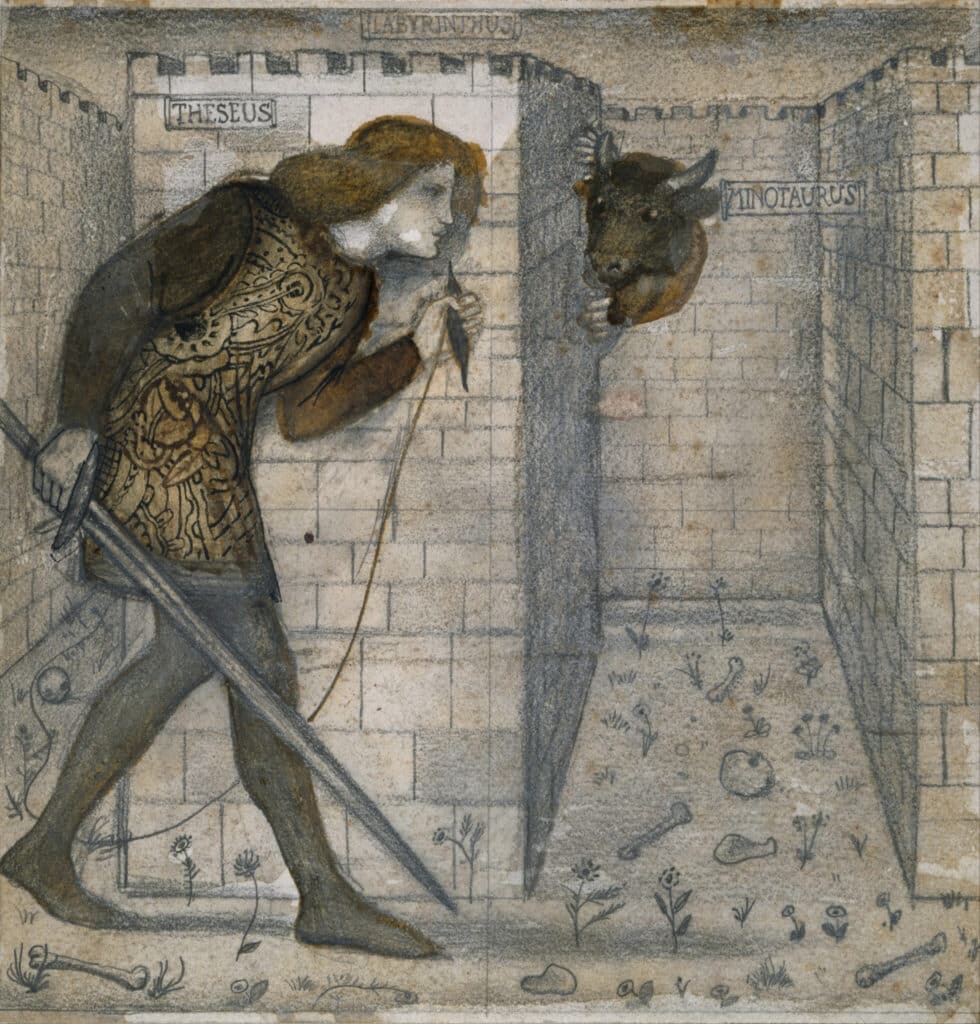
The Minotaur and Hostages: Key Points
- The myth’s structure is the structure of domination: a manufactured debt (the death of Androgeos) justifies a recurring levy, and the black-sailed ship arriving on schedule turns atrocity into routine administration.
- The Minotaur’s design is political rather than merely monstrous. It cannot be shown, cannot be killed by its own family, and eats nothing but people, which means Minos gets the terror while keeping his hands clean.
- Human tribute was ordinary practice in the ancient world, from Thutmose III holding Syrian princes and Zhou states exchanging hostage sons to Rome’s obsides and the later Ottoman devshirme.
- The myth fuses three distinct instruments at once. The youths are tribute because they arrive on a schedule, hostages because their fate depends on Athenian obedience, and victims of terror because their deaths produce nothing at all.
- Ancient and modern interpreters have rationalized the monster in revealing ways, whether as Plutarch’s sadistic general Taurus, Aristotle’s lifelong enslavement, Evans’s labyrinthine palace at Knossos, or the initiation ritual suggested by the bull-leaping frescoes and the sacrificial remains at Anemospilia.
- The bitter irony is that Athens celebrated Theseus for ending a levy of children and then built an empire that collected tribute, took hostages, and destroyed Melos, a pattern visible today in hostage diplomacy, forced child transfers, and violence hidden inside unphotographed facilities.

Introduction
There are few ancient myths as short and as politically intelligible as the story of the Minotaur. On the surface, it is a monster narrative—a fable featuring a maze, a hero, and a thread. Beneath that lies a story of how strong states take things from weak states, and how the most valuable thing a weak state can be compelled to give up is its children. The Athenians who recounted and retold this fable were not merely terrifying themselves with the image of a cannibal who had a bull’s head. They were recalling, or imagining, a time when a sea power across the water had ruled, and they were describing a mechanism that recurs throughout history: periodic tribute of human people enforced by terror, justified by a debt of blood and delivered out of sight. Read thus, the Labyrinth is not a fantasy. It is a description of what domination feels like to those who live under it.
The Myth and Its Ancient Sources
There is a common tradition of an annual tribute of seven youths and seven maidens to Crete to be devoured by the Minotaur, a monster born of Pasiphae and a bull, confined within a labyrinth designed by Daedalus. Theseus offers to kill the Minotaur and end the sacrifices using Ariadne’s thread and finally returns with Ariadne to Athens. When he returns, he forgets to adjust the sails of the ship, and his father mourns. These elemental points, general accounts, iconographic descriptions, and other sources in the set reveal these elemental points. in general accounts, iconographic descriptions, and other sources in the set. The sacrificial tribute and the birth of the Minotaur are illuminated, for example, in narrative surveys and iconographic discussions presented in Candidate (García, 2018, and related sources, which summarize the myth’s core sequence and the labyrinthine setting). The scholarly overview of Ariadne’s role and the figure of the Minotaur in later literary treatments (García, 2018; Galán, 1993) also reinforces Theseus’s voyage to Crete and his confrontation with the Minotaur, aided by Ariadne.
The story begins with a broken promise. Minos, competing for the throne of Crete, asked Poseidon for a sign, and the god sent a magnificent white bull from the sea on the understanding that it would be sacrificed back to him. Minos kept the animal. The punishment was aimed not at the king’s body but at his household and his name: Poseidon caused Minos’s wife Pasiphae to conceive a desire for the bull, and from that union came a child with a bull’s head and a man’s body. Minos could not kill it and would not display it. He commissioned the craftsman Daedalus to build the Labyrinth, a structure so intricate that its own builder barely escaped it, and there he hid the creature. Meanwhile his son Androgeos died in Attica, by jealousy or ambush or in a contest with the Marathonian bull, depending on the version. Minos went to war, or called down plague and famine, and Athens capitulated. The terms were these: seven young men and seven young women, chosen by lot, sent unarmed to Crete at fixed intervals, annually in some accounts, every seven or nine years in others. The ship carried black sails. Theseus, son of King Aegeus, volunteered for the third consignment. Ariadne, daughter of Minos, fell in love with him and gave him a sword and a ball of thread. He went into the maze, killed the thing at its center, followed the thread out, and sailed home with the surviving youths. He forgot to change the sails. His father, watching from the headland, saw black cloth on the horizon and threw himself into the sea.
The Labyrinth and the Monster as Political Instruments
The labyrinthine abode of the Minotaur is always analyzed as a central symbol: a literal and metaphorical prison whose architecture encodes psychological and existential dimensions. This theme is repeated in analyzes of Borges’s La casa de Asterión, where the Minotaur (Asterión) meditates on his confinement and fate within a labyrinth that is also his house (a Home/Labyrinth duality) (Álvarez, 1991; Henríquez, 2014; Imbert, 1960). In studies of Cortázar’s and Borges’s post-classical reworkings that re-center the Minotaur in relation to rationalism, otherness, and contemporary subjectivity (Dinu, 2021; Gabbay, 2014), the labyrinth’s role as a location of confinement and as a figure of interiority is reflected.
The creature merits a more careful examination; its design is the design of a political instrument. It possessed the head and tail of a bull and the body of a man, or, as Ovid preferred, a man-bull, a creature whose proportions were not agreed upon by any two ancient sources. It had a proper name, Asterion, the starry one, which is a curiously sensitive thing to assign to a monster. It was indescribable. It fed on human flesh, and human flesh only. That meant that it could not be nourished without a supply of people. It could not be shown publicly. It could not be slain by its family. It lived in the middle of a building whose only purpose was to keep it from being seen clearly. That is the goal of that combination. The Minotaur is a hunger that needs an administrative apparatus, a hidden but advertised violence, and a horror that the ruling family owns and disowns. Minos never lays a hand on an Athenian child. The maze looks after him.
The Minotaur is always shown as a chimera; his hybridity (half human/half bull) becomes a site of inquiry into themes of otherness, dread and desire. In contemporary literary criticism and art-historical writing, the Minotaur appears as a locus of interiority; Borges’s Asterión reconfigures the Minotaur as a rational, solitary entity whose existential state is emphasized rather than eliminated, and the monster becomes a comrade within a labyrinth of ideas (Álvarez, 1991; Henríquez, 2014). This redefinition is examined in relation to intertexts of Cortázar and Borges and their visualizations of the labyrinth as metaphysical space (Dinu, 2021; Gabbay, 2014).

Tribute, Hostages, and Terror in the Ancient World
Whether any Athenian ever traveled to Knossos under a black sail or not, the institution that the tale recounts was very real indeed. Ancient dominion was sometimes paid for in tribute, and that tribute was often made in bodies. In the fourteenth century B.C.E., Thutmose III, battling in Syria, brought the sons of vanquished city kings to Egypt, where they were nurtured at court, trained in Egyptian ways, and eventually returned home as faithful clients. The Nubian prince Hekanefer was buried with Egyptian gods and burial paraphernalia. The Bronze Age Near East was characterized by the systematic movement of high-status individuals, including royal girls sent for diplomatic marriages, princes held for treaty fulfillment, and specialists and craftsmen transported as gifts. During the Eastern Zhou period in China, vassal states swapped captive sons, the zhìzǐ. The Han court unilaterally seized hostage boys from minor polities as a routine control technique. Rome refined this practice and referred to it as kindness. The kids of client monarchs were taken to the capital as obsides, nurtured among the imperial children, and returned as rulers with Roman tastes and obligations. Herod sent his own boys, and his grandson Agrippa was raised in the company of the future emperors Caligula and Claudius. Caesar writes that the Gauls took up arms again partly because they were angry about the seizure of their children as hostages. Much later the Ottoman devshirme conscripted Christian boys from the Balkans, converted them, and made them warriors and officials of the state that took them.
The theme of the sacrifice of hostages to feed the Minotaur has opened up a rich field for political readings, including analogies with terrorism and state violence. Niño explicitly places the Minotaur within analyses of Aristotelian ontology, associating the myth with historical instances of hostage-taking and political terror and locating Ovid’s version and the Minotaur within the labyrinth of terror and state (Niño, 2020). Dinu also reads Cortázar and Borges’s postwar reworkings as critiques of grand narratives, with the Minotaur acting as a mirror for postmodern skepticism about totalizing narratives and the ethics of power (Dinu, 2021). The broader symbolic frame within which the Minotaur is situated as a figure of terror or brutality resonates in discussions of the myth’s reception in modern political and cultural contexts (e.g., Cortázar’s Los Reyes, Borges’s La casa de Asterión), where the violence of the Minotaur becomes a critique of myths about reason and progress (Dinu, 2021; Gabbay, 2014).
These were not the same systems. And the distinctions matter. A hostage serves as a guarantee, representing a life pledged for future conduct. Tribute is extraction, an occasional payment that defines and performs inequity. Terror is another matter, an intentional superfluity of cruelty, whose aim is to be remembered. All three are present in the Minotaur story, and the combination is perhaps the reason for its resilience. The youths receive tribute since they come on time. They are hostages; their destiny depends on the Athenians’ obedience or not. They are victims of fear because their deaths serve no economic purpose. Nothing emerges from the Labyrinth. That is what makes it unbearable, and that is what makes it work.
The selection of victims is equally deliberate. Seven men and seven women are chosen by lot from the noble households. A state that surrenders its young adults of both sexes surrenders its power to recreate itself, both biologically and politically. The lot falls on the elite, implicating and silencing every notable household in Athens. Resistance is a gamble with one’s children. Since the victims The unarmed victims clearly demonstrate their status as property rather than combatants; their status as property rather than combatants is evident. And since the pick is random, the fear is global. This is the psychological characteristic of state terror, as distinct from ordinary combat. No Athenian parent may adopt any technique or manner to be secure.
Ancient writers were also uncomfortable with the examination and continually justified it in significant ways. Plutarch, guided by Philochorus and a supposed Cretan legeman, states that the lads were not eaten; instead, he discusses the analyses of Aristotelian texts during the funeral games of Androgeos, where the winner, a harsh general named Taurus, abused them so severely that he created a horrific version of the Labyrinth. Duino Plutarch also mentions a lost book of Aristotle in which the Athenian boys were only enslaved for life in Crete, and generations later their ancestors were still traceable. The bull’s head is removed, and what remains is depressingly familiar: deportation, forced labor, and sexual exploitation. The officer’s savagery is one that the crown finds expedient to ignore. Maybe the monstrosity of the advertised violence and imperial administration is more apparent when recalled by its victims.
Modern Scholarship and Contemporary Resonances
Modern scholarship has tackled the tale from numerous sides and the hypotheses are not mutually exclusive. Excavating Knossos from 1900, Arthur Evans found a palace of dizzying complexity, rich with bull iconography, and dubbed the culture Minoan after the mythological monarch. Since then many have hypothesized that the Labyrinth is a folk recollection of the palace itself, its hallways and light wells and storerooms turned by distance into a maze. Thucydides thought Minos had led the first major navy in the Greek world, and the historical narrative that follows is that mainland cities formerly owed something substantial to a wealthier Cretan thalassocracy: trade concessions, protection payments, and perhaps levies of labor or of individuals. Theseus’ death of the Minotaur therefore encodes the final reverse, the passage of authority from Crete to the Mycenaean mainland, remembered by classical Athenians as deliverance. The nineteenth-century mythologists regarded the Minotaur as a solar god of the Baal and Moloch type, and the victory of Theseus represented the breakup of a tributary religious connection. Others preoccupy with ritual. The bull-leaping frescoes depict athletic young men and women leaping on or grappling with bulls; many academics interpret the activity as a rite of passage or an entrance test for admission to the elite, with the possibility that failure meant death. But the archeological record grimly confirms Minoan human sacrifice. There is the teenage male found bound on an altar at Anemospilia, with a bronze knife among his bones, and the butchered children excavated by Peter Warren at Knossos, their bones bearing the cut marks that characterize sacrificed animals. Another third line of interpretation is ritual and civic in another sense, related to Henri Jeanmaire and Pierre Vidal-Naquet, who interpreted Theseus as the ideal ephebe. The black sail, the voyage away from the city, the trial in darkness, the return with change of colors, the Delian embassy, which Athens maintained in supposed fulfillment of a vow, and the festivals in which boys carried vine branches and wore women’s clothing—all these elements look like the structure of an initiation, the passage of the young from the margins into full citizenship. There’s a fourth reading, which is frankly political. The unifier of Attica, Theseus, was strongly promoted in sixth- and fifth-century Athens as the founder hero of the city, enshrined by Cimon, who brought bones from Skyros in the 470s. The hero who abolished the tribute of children was a beneficial ancestor to a city that had just expelled Persia and was building an empire of its own.
That last statement has an irony worth sitting with. And within a generation of celebrating Theseus as the man who ended a levy of Athenian youth, Athens was collecting phoros from hundreds of subject communities, keeping the accounts on stone for public display, taking hostages from wavering allies, executing the men of Melos and enslaving the women and children, and debating the mass killing of the Mytileneans. Minos was the descendant of the liberator. This is not a quirk of Greek history but a structural trend. This is the first modern implication of the myth. Heroic deliverance narratives are remarkably effective in sanctioning new forms of control, because it is difficult for a state that remembers itself as a freed victim to see itself as an aggressor.
The second implication is methodological. Hostage taking has not gone back to the Bronze Age; it has been rebranded. Contemporary hostage diplomacy holds foreign nationals on trumped-up charges with the intention of trading them for later trade in convicts, money, or policy concessions, which defines contemporary hostage diplomacy. Foreign nationals are held on trumped-up charges with the intention of trading them for convicts, money, or policy concessions. It is mainly associated with Iran but is by no means exclusive to that country. International law still recognizes the forced transfer of children as a tool of domination and crime, from the residential and boarding school systems that took Indigenous children in Canada, the United States, and Australia for the express purpose of cultural erasure to the deportation of Ukrainian children into Russian custody and adoption, which resulted in an arrest warrant from the International Criminal Court. The abduction and conscription of child soldiers by armed groups is a rudimentary version of devshirme logic: take the young, cut them off from home, and rebuild them as instruments of the authority that stole them. Economic tribute also has modern analogs in loan frameworks and extraction arrangements that, on a schedule, transfer value from weaker to stronger economies, without anyone having to send a fleet. And political terror still depends on the architecture of the Labyrinth, on disappearance, on facilities whose insides are not photographed, on violence that is both hidden and broadcast, on the useful fiction that the monster at the center acts on its appetite, not on orders.
Conclusion
The Minotaur myth survives, uncomfortable with the examination. It’s about a system, significantly. The arrangement consists of identifiable parts: a manufactured deblegeman, a sheet to formalize it, a lottery to distribute fear evenly, a maze to conceal violence, and a creature at the center whose inhuman hunger allows the king to keep his hands clean. The Athenians thought of themselves as people who had once paid in children and they made a hero of the unwillingness to keep (2014). That refusal is the enduring political point of the story, and so is the fact that Theseus could not have succeeded on removal, for he required a word, a thread, and an insider eager to violate labor and own fate exploitation. It also conveys a warning, which Athens did not heed, that the monstrosity of advertised violence and imperialism can easily create such a situation. Every state that tells itself a story about the tribute it previously paid should ask itself what it is collecting, from whom, and whose children are on the dock.
References
Álvarez, N. E. (1991). Lectura y re-escritura: La mitopoiesis de “La casa de Asterión” de Borges. Revista Iberoamericana, 57(155–156), 507–518. https://doi.org/10.5195/reviberoamer.1991.4910
Borges, J. L. (1949). La casa de Asterión. In El Aleph. Losada.
Cortázar, J. (1949). Los Reyes. Gulab y Aldabahor.
Dinu, A. (2021). Viejos mitos para “nuevos” tiempos: El mito del Minotauro como reivindicación de la alteridad y espejo escéptico frente a los grandes relatos. Anuari de Filologia. Antiqua et Mediaeualia, 2(11), 53–62. https://doi.org/10.1344/afam202121136372
Gabbay, C. (2014). El poema dramático cortazariano “Los Reyes”: El hipertexto lírico como superación del mito trágico. Anales de Literatura Hispanoamericana, 43, 271–281. https://doi.org/10.5209/rev_alhi.2014.v43.47124
Galán, L. (1993). Atis y Teseo: El viaje en Catulo. Classica — Revista Brasileira de Estudos Clássicos, 47–54. https://doi.org/10.24277/classica.v0i0.754
García, M. B. (2018). Viaje de Ariadna hacia el Olimpo. Eikón / Imago, 7, 35–48. https://doi.org/10.5209/eiko.73567
Henríquez, M. M. H. (2014). The Minotaur: A look borgiana. Revista de Investigaciones de Uniagraria, 2(1), 65–71. https://doi.org/10.33133/riu-2-2014-74
Imbert, E. A. (1960). Un cuento de Borges: “La casa de Asterión.” Revista Iberoamericana, 25(49), 33–43. https://doi.org/10.5195/reviberoamer.1960.1947
Niño, C. (2020). Capítulo 1. El terrorismo no es un fenómeno nuevo, el concepto sí lo es. https://doi.org/10.15332/dt.inv.2020.00150



Leave a Reply