Gamayun: Key Points
- The Gamayun is a supernatural bird from Russian and Slavic tradition, usually depicted with the body and wings of a bird and the head or upper body of a beautiful woman.
- The Gamayun possesses extraordinary knowledge of the past, present, and future. Through its song, it can reveal secrets about creation, fate, gods, humans, and coming events.
- Although the Gamayun can provide wisdom, its song can also be dangerous. Some traditions claim that listeners may become so enchanted that they abandon their ordinary lives or even follow the bird to their deaths.
- The Gamayun may combine several traditions, including Greek and Byzantine bird-women, Russian birds of paradise, and the Persian Huma, a legendary bird associated with fortune, destiny, and kingship.
- Rather than simply being an evil monster, the Gamayun acts as an omen or supernatural messenger. It represents the idea that knowledge of the future can be both valuable and frightening.
- Russian artists and writers, particularly Viktor Vasnetsov and Alexander Blok, helped transform the Gamayun into an ominous symbol of prophecy, catastrophe, and Russia’s historical fate.

Introduction
Gamayun is one of the most fascinating supernatural birds in Russian and Slavic tradition. It is usually conceived as a mysterious bird associated with prophecy and the supernatural world. The Gamayun occupies an uncertain position between a monster, a divine messenger, an omen, and a symbol. In its best-known modern form, it has the body of a bird and the head or upper body of a beautiful woman. Its voice can reveal secrets and forecast the future, but hearing its message is not always a blessing. The creature thus illustrates a common theme in mythology: human beings desire answers even when acquiring them may bring sorrow. Its roots are equally complex. While the Gamayun is often considered a creature of Slavic folklore, it is thought to have evolved from a combination of Russian literary and artistic traditions, Iranian mythology, Christian conceptions of paradise, tales of exotic birds, and the wider European legacy of human-bird hybrids. Writers and artists eventually turned the Gamayun into a Russian emblem of destiny, calamity, and foreknowledge (DeMello, 2024; Kuznetsova, 2021; Özakın, 2024).
Appearance and the Prophetic Bird Tradition
Gamayun is traditionally depicted as a bird with a woman’s head. In Slavic tradition, it belongs to the same conceptual family as other heavenly birds, particularly Sirin and Alkonost, although each developed distinctive characteristics (Elhelw, 2020). Studies of Slavic mythic motifs similarly present Sirin, Alkonost, and Gamayun as a symbolic trio of celestial birds (Shkolna et al., 2021).
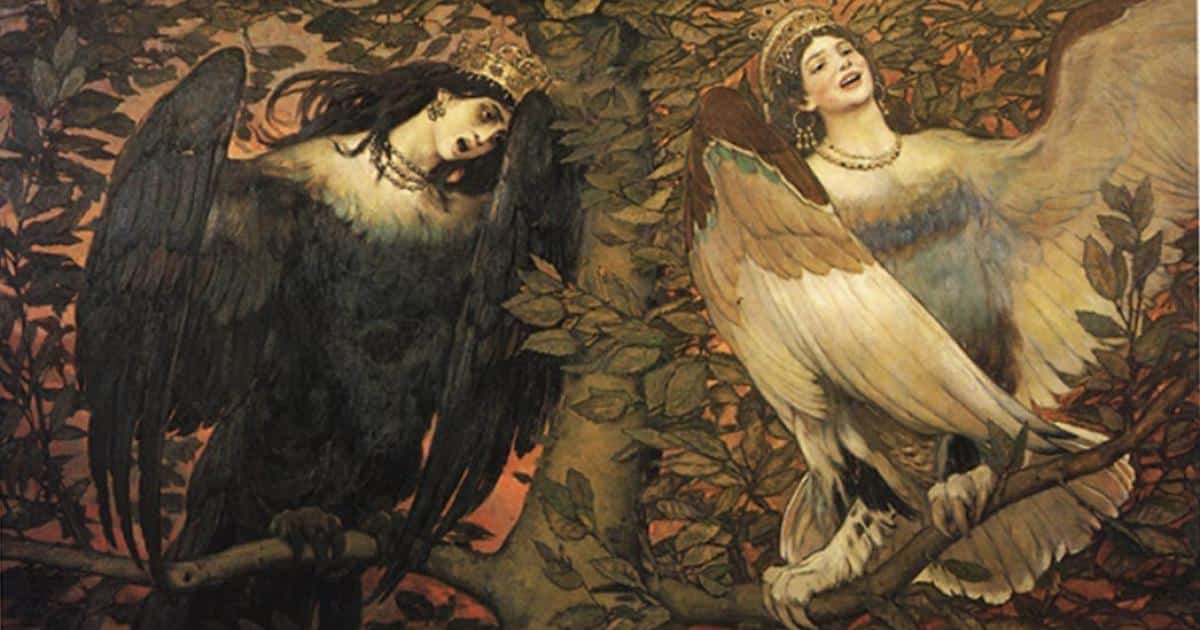
Most often, artists depict the Gamayun as a large bird with a woman’s face or head. Other depictions show the human features continuing farther down the body to include a woman’s chest. Still other variants emphasize the bird form and give it only a human face. Later artistic renditions frequently emphasized dark or black feathers. The Gamayun is generally depicted alone, sitting in a tree or above a lake, less like an ordinary animal and more like a supernatural observer. This image links the Gamayun to several other mythical bird-women, including the Russian Sirin and Alkonost and the Greek Sirens. DeMello (2024) discusses the Gamayun within the broader mythological tradition of female-headed bird beings and points out that birds have often been assigned gender in folklore through symbolism. Predatory birds, such as hawks and eagles, have typically been coded as male, whereas songbirds have generally been coded as feminine. Birds have also been connected to fertility, water, death, and the supernatural, making the combination of woman and bird particularly potent in symbolic terms (DeMello, 2024).
However, the image of the Gamayun has not always been the same. This variation is significant because modern images can create the impression that there has always been a single, fixed description of the creature. In early modern Russian culture, the legendary “birds of paradise” were diverse and did not all possess the same traits. Some were anthropomorphic, some were said to have no legs, and others were believed to possess extraordinary abilities, such as healing, rebirth, control of natural forces, or supernatural singing (Kuznetsova, 2021). Accounts of the Gamayun from the seventeenth through nineteenth centuries sometimes depicted it as a bird that never landed and lacked ordinary legs or wings. Nineteenth-century art and literature greatly reinforced its later identification as a dark-feathered, woman-headed bird (Özakın, 2024).
Behavior, Knowledge, and Prophecy
The Gamayun’s defining supernatural ability is its understanding of mysteries beyond the reach of ordinary people, including the origins of the world, gods, heroes, humans, animals, and supernatural forces. It communicates primarily through its voice and song. Rather than attacking with claws or teeth, the Gamayun exerts its power through what it reveals, making it more of an oracle than a conventional monster (DeMello, 2024; Özakın, 2024).
An encounter with the Gamayun is not necessarily safe. DeMello (2024) describes its song as capable of unveiling the secrets of life while also seducing people into abandoning their lives to follow its voice forever. Its revelations may concern death, war, starvation, political collapse, or personal catastrophe. The danger therefore lies not only in the attraction of the song but also in the consequences of hearing its message.
This danger resembles that of the Greek Sirens, whose beautiful calls drew sailors to their deaths. In ancient Greek mythology, Sirens were generally depicted as women with birdlike bodies rather than the fish-tailed creatures common in modern popular culture. DeMello (2024) identifies the Siren as an important point of comparison for Russian and Slavic bird-women. The connection is plausible considering that medieval and early modern Russian culture was influenced by Byzantine Christianity, classical traditions, and neighboring cultures. Likewise, Özakın (2024) stresses that Russian woman-headed birds emerged from a mixture of influences from Greek mythology and Eastern traditions.
The Gamayun differs from the conventional Siren in one important respect. For the Siren, the primary danger is seduction; for the Gamayun, it is revelation. This distinction gives the Gamayun a different symbolic function. Its legend suggests that discovering what one wishes to know may carry consequences that cannot be escaped.
The creature is also part of a much longer tradition of birds as omens. Flight allows birds to occupy a metaphorical space between the human and heavenly worlds. They can appear and disappear into the sky, making them natural candidates for messengers of gods, spirits, and fate. Humans have consequently interpreted bird movements and sounds as signs for thousands of years. In Russia, people sometimes viewed ordinary birds such as crows and owls as omens of death or misfortune. The Gamayun transforms this basic folkloric idea into a supernatural intermediary between everyday life and a hidden reality (DeMello, 2024).

Origins and Theories
One theory concerning the origin of the Gamayun links it to the larger family of bird-women found in Greek and Byzantine legend. Russian folklore also contains numerous mystical birds, including Sirin, Alkonost, Stratim, Rarog, and Gamayun. Some of these creatures appear to reflect foreign traditions that were adapted to a distinctly Russian cultural setting (DeMello, 2024). Kuznetsova (2021) illustrates that images of birds of paradise in early modern Russia were eclectic. Their identities were not based on a single, static pagan heritage but developed through a combination of literary, religious, artistic, and popular influences.
Another theory looks east rather than south or west. The name Gamayun is associated with the Huma or Humay, a mythical bird of Iranian and Persian mythology. The similarities are significant enough that historians have considered whether the Russian name and concept were influenced by Eastern traditions transmitted through literature and cultural contact. Özakın (2024) points out phonetic, visual, and functional parallels between Gamayun and the Persian Huma. In Persian tradition, the Huma was associated with happiness, fortune, luck, royalty, and fate. One account suggests that the Huma’s shadow may fall upon a person destined to become a monarch. Terms connected to Huma or Humayun were also used in Russian diplomatic language when addressing Eastern monarchs, which could have provided a historical channel through which the term entered Russian culture (Özakın, 2024).
This possibility complicates the conventional portrayal of the Gamayun as an ancient Slavic pagan creature. Its historical development appears to have been more complex. Elements associated with the creature may have entered Russian culture from Iranian or other Eastern sources and then combined with Russian ideas about paradise birds, Christian iconography, and human-headed supernatural beings. The result was not simply a copy of the Persian Huma. The fortunate bird of the East developed into a distinctly Russian figure with darker associations (Özakın, 2024).
There may also have been a relationship between legendary birds of paradise and European encounters with real exotic birds. During the early modern period, Europeans acquired preserved specimens and accounts of birds of paradise from distant locations. These unusual specimens sometimes circulated without feet because their legs had been removed during preservation. Such examples contributed to the European belief that birds of paradise remained perpetually in flight and never landed. Within this broader context of natural history, travel literature, religious symbolism, and folklore, Russian accounts of extraordinary paradise birds developed. The boundary between zoology and mythology was far less clearly defined than it is today. An unfamiliar species could easily be interpreted as evidence for existing stories about wondrous creatures inhabiting remote parts of the world.
The Gamayun’s supposed homeland further strengthens its association with the exotic and sacred. It is often placed in a mythical eastern land near paradise. This geography is symbolic rather than realistic. The east was associated with Eden and with regions beyond the familiar boundaries of Christian Europe. In this setting, the Gamayun occupied a position between the human and divine worlds. Kuznetsova (2021) demonstrates that paradise birds were an important part of early modern Russian culture, where religious, literary, and folk concepts could intersect.
The Gamayun’s connection to heaven also helps explain why the creature cannot simply be labeled evil. Forecasting a terrible event is not the same as causing it. The bird may be a messenger rather than an aggressor, making its moral character ambiguous. A warning may terrify the person who receives it, but that warning can also be valuable.
Cultural and Artistic Impact
The cultural identity of the Gamayun underwent a significant transformation during the late nineteenth and early twentieth centuries. One of the most influential visual representations of the creature was Viktor Vasnetsov’s Gamayun, the Prophetic Bird. Vasnetsov painted a dark-winged bird with a woman’s face in a sinister environment. The image evokes anxiety rather than simple beauty or wonder and embraces the darker tradition in which the Gamayun serves as a harbinger of calamity (Culture.RF, n.d.).
The poet Alexander Blok further developed this perspective. In his 1899 poem inspired by Vasnetsov’s Gamayun, the bird announces historical catastrophe, including invasion, executions, violence, fire, oppression, famine, and the death of the righteous. It therefore becomes more than a supernatural creature. It can symbolize Russia itself and the terrible historical burden carried by a country experiencing repeated invasion, political brutality, revolution, and social turmoil. Özakın (2024) suggests that, by the early twentieth century, the Gamayun had become a symbol of Russia’s chaotic political fate.
This creative transformation was lasting. Vasnetsov and Blok helped move the Gamayun away from earlier associations with paradise, happiness, wisdom, and divine communication toward its darker modern identity. This transformation illustrates how folklore develops. Writers and artists do not merely repeat legends. They reinterpret them, sometimes so successfully that the reinterpretation becomes inseparable from what later audiences perceive as the ancient tradition.
The Gamayun has also influenced areas beyond literature. Images of the paradise bird appeared in Russian ornamental art and heraldic traditions. Smolensk became especially associated with the Gamayun, as the city’s heraldic symbol depicts a bird perched on a cannon. The combination is striking. A mystical bird sits upon a weapon, blending supernatural symbolism with military power. Such usage helped move the Gamayun beyond folktales and into civic and political iconography.
Modern interpretations have expanded the mythology even further. The Gamayun is frequently depicted on mythology websites, in fantasy literature, neopagan traditions, artwork, games, and popular discussions of Slavic mythology as an ancient bird serving the Slavic gods. These interpretations may possess cultural importance, but they should not necessarily be treated as evidence of ancient belief. The historical record indicates a much more complex development involving written culture, artistic reinterpretation, Eastern influences, Christian concepts of paradise, and later efforts to reconstruct a systematic Slavic mythology (Kuznetsova, 2021; Özakın, 2024). This distinction is particularly important when studying folklore because modern retellings often combine historical material with much more recent innovations.
Other scholarship similarly places Sirin, Alkonost, and Gamayun within a group of celestial birds in Slavic mythic traditions. Shkolna et al. (2021) analyze Kyivan Rus kolts and their iconography, referencing Sirin and Alkonost and emphasizing their importance in Slavic mythological imagery as well as the later incorporation of Gamayun into Ruthenian tradition. The same source describes Gamayun as a “prophetic bird” in the Slavic pantheon (Shkolna et al., 2021).
The Gamayun has survived because its symbolism involves far more than the question of whether people once believed in a supernatural bird with a woman’s head. It represents a broader tension between human curiosity and fear of what may be discovered. That tension gives the creature much of its enduring power.
Conclusion
Ultimately, Gamayun is less a straightforward monster than a mystical manifestation of fate and the supernatural. Its avian body links it with the sky, paradise, omens, and heavenly communication, while its female human face gives it a recognizable and intelligible voice. Its song can attract, terrify, or even destroy those who hear it (DeMello, 2024). Theories of its origins suggest a remarkable mixture of Greek and Byzantine bird-woman traditions, Persian and Iranian concepts of the Huma, Russian beliefs about paradise birds, and later artistic interpretations (Kuznetsova, 2021; Özakın, 2024). Vasnetsov and Blok further transformed the creature into a chilling emblem of national and historical disaster. This ambiguity helps explain its lasting appeal. The Gamayun embodies a timeless human dilemma: the desire to discover what lies beyond ordinary perception while fearing what that discovery might reveal.
References
Culture.RF. (n.d.). Gamayun. https://ar.culture.ru/en/subject/gamayun
DeMello, M. (2024). Gamayun. In Bigfoot to Mothman: A global encyclopedia of legendary beasts and monsters. Bloomsbury Academic.
Elhelw, R. (2020). The human-headed bird figure in painting from the Bronze Age to early twentieth century. Journal of Art & Architecture Research Studies – JAARS, 1(1), 186–200. https://doi.org/10.47436/jaarsfa.v1i1.47
Kuznetsova, O. (2021). Birds’ Eden: Birds of paradise in early modern Russian culture. Acta Universitatis Lodziensis. Folia Litteraria Rossica, 14(1), 9–16. https://doi.org/10.18778/1427-9681.14.02
Özakın, D. (2024). Origins of the woman-headed birds in Russian folklore and their symbolic functions in the Silver Age of poetry. Folklor/Edebiyat, 30(118), 449–470.
Shkolna, O., Sosik, O. D., Барбалат, О. В., Sytnyk, I., & Kashshay, O. (2021). Kyivan Rus Kolts with enamels and Niello: Genesis, sources of inspiration, iconography, attribution issues. Linguistics and Culture Review, 5(S2), 645–677. https://doi.org/10.21744/lingcure.v5ns2.1409


Leave a Reply