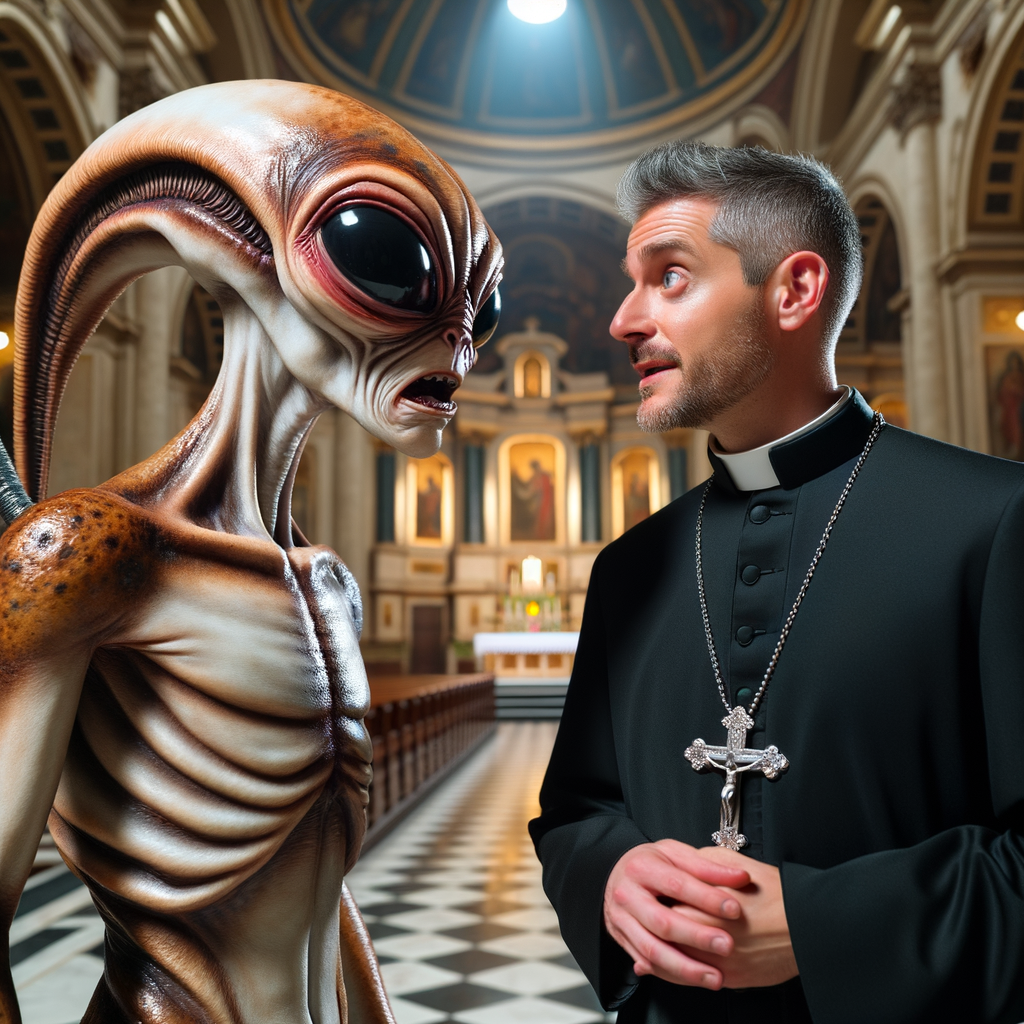
There has always been great curiosity about the potential discovery of alien life forms and conjecture over the wider ramifications for humankind. Author of Religions and Extraterrestrial Life and Vanderbilt University astronomer David Weintraub examines how different religious beliefs would respond to evidence that we are not alone in the universe. This inquiry probes the boundaries of philosophy and theology in addition to testing our comprehension of science.
Religious Responses to Discoveries of Extraterrestrial Life
According to Weintraub’s research, religious societies’ responses would differ greatly depending on the tenets upon which they were founded. For example, some evangelical and fundamentalist Christians have Earth-centric beliefs, which hold that humans are God’s special creation meant only for Earth. Since these religious texts make no reference to life beyond Earth, some may find it theologically disturbing to believe in extraterrestrial life.
On the other hand, certain Christian denominations may be more flexible. Weintraub notes that those who follow a literal reading of the Bible, which includes a young Earth and the singular creation of mankind, like Seventh-Day Adventists, may nevertheless be open to the possibility of alien life. According to their belief system, life may exist on other planets, but since they are not related to Adam and Eve and do not have the same ancestral sin, they do not have the same theological need for redemption as humans.

Historical Background and Wider Approval
The historical context in which a religion was born can have a significant impact on how open it is to the idea of extraterrestrial life. Faiths that arose in the 19th century, when telescope technology was developing and there was a general curiosity about space, such as Mormonism, Seventh-Day Adventism, Jehovah’s Witnesses, and the Baha’i Faith, are more receptive to the idea of life beyond Earth.
As astrobiology and exoplanet research continue, scientists are becoming more hopeful about finding extraterrestrial life—albeit most likely non-intelligent species. Weintraub stresses the significance of being ready for the existential and spiritual issues this finding would arouse. In order to investigate these important questions, he supports an interactive conversation between theologians and scientists.
Prospective Theological Advancements and Transcendential Morality
The history of UFO religions and cults like Heaven’s Gate demonstrates that the discovery of extraterrestrial life may also lead to new religious movements. Weintraub also makes conjectures about possible relations between religiously diverse extraterrestrial civilizations and humanity. He compares the “prime directive” from the Star Trek television series, which calls for non-interference in the advancement of alien civilizations, to the question of whether humanity will force its religious beliefs on extraterrestrial species or accept their spiritual viewpoints.
Weintraub boldly expands on the topic by addressing the consequences of extraterrestrial faiths for Earthly interfaith tolerance. Greater acceptance of religious variety within humans may result from human acceptance of the varied religious beliefs held by extraterrestrial beings. This viewpoint calls for a rethinking of how we handle religious diversity and the promotion of a more peaceful cohabitation founded on respect and understanding.
The finding of extraterrestrial life would not only represent a significant scientific advance but also have a profound impact on global theological, ethical, and philosophical ideas. We may be on the verge of finding extraterrestrial life, so it’s more crucial than ever to think about both the scientific and spiritual implications of this finding. In turn, this reflection may improve our understanding of one another and our tolerance for the various religious traditions that exist on Earth, helping us, as Weintraub puts it, “get along a little better.”
Reference: Weintraub, D. A. (2014). Religions and extraterrestrial life: how will we deal with it?. Springer.




Leave a Reply