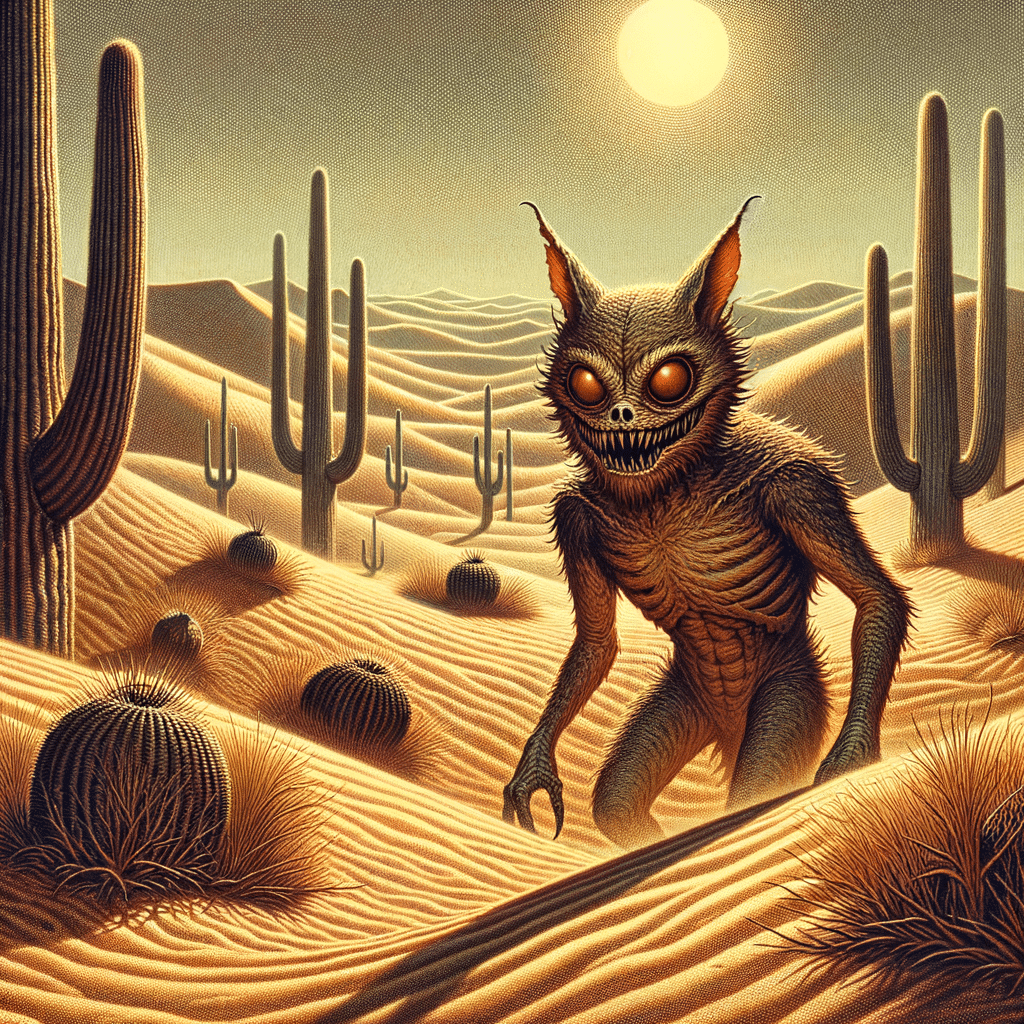
For a considerable amount of time, many people have been fascinated with the Chupacabra, a mythical animal that is as well-known to people in South America as Nessie is to people in the British Isles. Many describe the Chupacabra as a reptile animal with fangs, sharp spines or quills running down its back, and leathery or scaly greenish-gray skin. According to some, it’s a peculiar kind of wild dog with pronounced eye sockets, fangs, and claws, as well as a prominent spinal ridge. The term “Chupacabra” means “goat-sucker” in Spanish, alluding to the animal’s alleged behavior of attacking and consuming the blood of animals, especially goats.
Could this simply be a case of misidentification due to a single woman’s interpretation of a movie? Doubters undoubtedly confirm this idea, but some people remain unconvinced, especially considering the frequent and mysterious encounters that defy explanation.
Chupacabra sightings originated in Puerto Rico midway through the 1990s. In 1995, researchers found eight dead sheep with three chest puncture wounds that appeared to be completely empty of blood. A few months later, Madelyne Tolentino, a woman from Puerto Rico, claimed to have seen the monster in the municipality of Canóvanas. She described it as an alien-looking bipedal creature. Her story sparked considerable fear and conjecture, along with other sightings and animal fatalities.

Rational Explanations
American writer and detective Benjamin Radford extensively researched the Chupacabra phenomenon for his book Tracking the Chupacabra: The Vampire Beast in Fact, Fiction, and Folklore. After five years of research, Radford came to the conclusion that Tolentino drew a lot of inspiration for his description from the creature in the science fiction horror movie Species from 1995. According to Radford, the Chupacabra myth may have originated mostly from media misinformation combined with erroneous perceptions of natural predators, leading to widespread panic.
A Texan rancher took pictures of a creature in 2004 that he described as being the size of a coyote but moving more like a rabbit. Shortly before the release of Radford’s book in 2010, a farmer killed an unidentified animal that was frightening his cattle. Several facilities conducted DNA testing on the creature’s bones, but the results were equivocal, suggesting the existence of an undiscovered animal species. These occurrences highlight how intricate and elusive the Chupacabra mythology is.

Maine Monster
Residents of Maine’s Androscoggin County started reporting seeing an enigmatic animal in the early 2000s. This thing had eyes that shone strangely in the darkness, and it let forth frightening moans. As a result, numerous household dogs, even powerful breeds like Rottweilers and Doberman Pinschers, died.
In August 2006, a woman in Turner, Maine, discovered a bizarre, dead dog-like creature with blue-tinted fur, eyes, and lips. The moment she snapped pictures and submitted them to the neighborhood newspapers, the creature became well-known, and people began calling it “The Maine Monster.”
Cryptozoologist and novelist Loren Coleman of Maine proposed that the creature was most likely a hybrid dog. Other cryptozoologists, however, conjectured that it might be the Chupacabra. The University of Maine’s DNA analysis revealed that the animal’s mother belonged to the Canis family, but they were unable to identify the father’s genus, leaving the mystery unsolved.
Explanations from Cryptozoologists
Cryptozoologists have proposed numerous theories regarding the true nature of the Chupacabra. Some claim that it is a type of wild dog that has inherited a mutant gene from its progeny. Some believe that increasing human development drove this wild, unexplained animal out of South America’s deep forests.
Cryptozoologists have theorized that the Chupacabra could be a hybrid beast that escaped from a government research facility. Some people even go so far as to propose that the Chupacabra may be an extraterrestrial, entering the field of ufology.
The variety of these answers emphasizes how mysterious the Chupacabra is. Whether it’s a result of a genetic mutation, a lost species, a botched government experiment, or an extraterrestrial visitor, the Chupacabra never ceases to amaze and confound believers and skeptics alike. Every fresh encounter deepens the mythos around this elusive creature, so the mystery never really goes away.
References
Coleman, L. & Clark, J. (1999). Cryptozoology A To Z: The Encyclopedia of Loch Monsters, Sasquatch, Chupacabras, and Other Authentic Mysteries of Nature. Simon & Schuster
Radford, B. (2011). Tracking the Chupacabra: The Vampire Beast in Fact, Fiction, and Folklore. University of New Mexico Press.



Leave a Reply