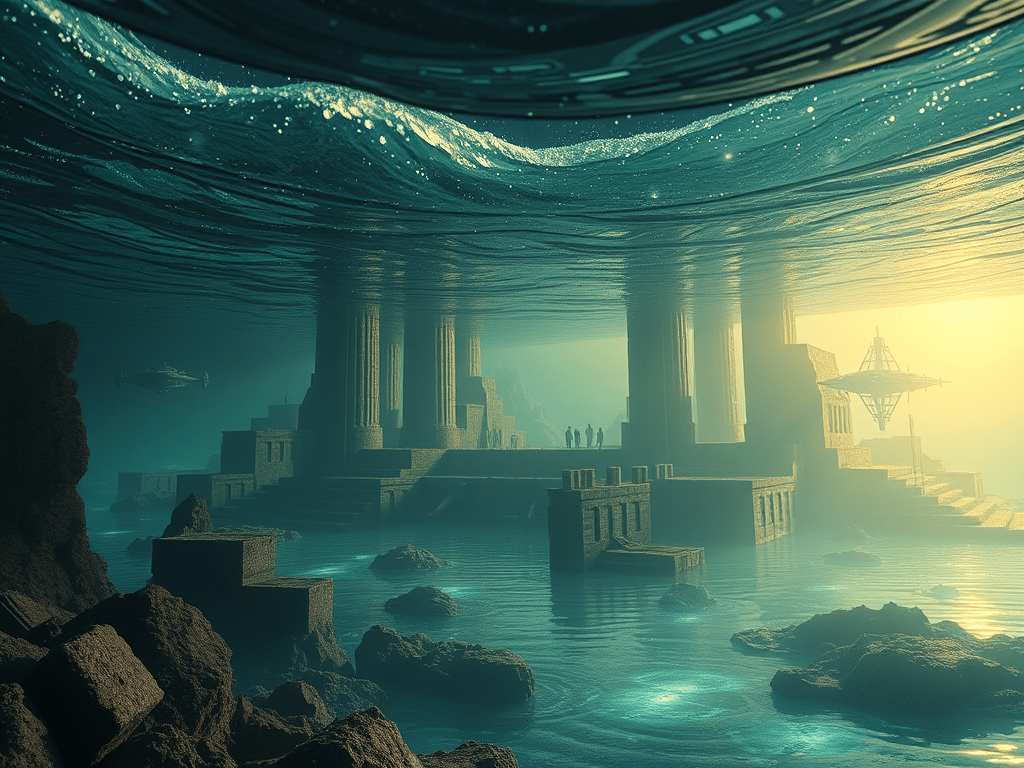
Aliens and Atlantis: Key Points
-
According to the alien-Atlantis theory, extraterrestrial beings either founded Atlantis, provided it with advanced technology, or had a connection to its existence and destruction.
-
Atlantis, described by Plato, was an advanced island civilization with sophisticated architecture that allegedly sank beneath the ocean approximately 11,000 years ago.
-
Paranormal theorists suggest Atlantis served as an alien outpost or that extraterrestrials gifted the Atlanteans with technology that survivors later spread to other ancient civilizations.
-
Mainstream scientists reject these claims due to absent physical evidence and argue that ancient peoples were fully capable of impressive achievements without extraterrestrial help.
-
Alien-Atlantis theories have substantially influenced popular culture while revealing human fascination with mystery, though critics note they can diminish our ancestors’ genuine achievements.
-
Despite lacking scientific support, these theories demonstrate human desire for meaning and cosmic significance, prompting more profound questions about our capabilities and place in the universe.

Introduction
The idea that aliens were involved in the legendary civilization of Atlantis has fascinated many fans, researchers, and storytellers for years. This intriguing convergence of ancient enigma and cosmic conjecture unites two of humanity’s most persistent mysteries: the question of our isolation in the universe and the mystery of a once-flourishing, sophisticated ancient civilization that vanished beneath the sea. Mainstream archaeology and science are still not sure about either claim, but the fact that people are still interested in connecting aliens to Atlantis shows how much we want to know where we came from and where we fit in the universe. This essay analyzes the characterizations of both phenomena, scrutinizes the paranormal theories linking them, evaluates the skeptical perspective, and contemplates the reasons these concepts persist in modern culture.
Overview
When people discuss aliens in relation to ancient mysteries, they usually mean intelligent beings from outside our planet who are said to have visited Earth a long time ago. People often say that these beings are more advanced than ancient humans in terms of technology and that they know things about advanced engineering, astronomy, and sciences that would have seemed like miracles to our ancestors. People who believe in ancient aliens say that these visitors may have shared their knowledge with early civilizations, helping them build things and come up with technologies that seem difficult to explain with the tools and knowledge they had at the time. The physical descriptions of these aliens range from the classic grey beings with big heads and eyes to more humanoid figures, reptilian beings, or even beings made of pure energy. The common thread that runs through all of these stories is that these beings had powers that humans couldn’t understand and left their mark on ancient cultures through monuments, artifacts, and legends that are still around today (Coppens, 2011).
Plato, an ancient Greek philosopher, wrote about Atlantis, which was a powerful and technologically advanced island civilization that lived about nine thousand years before his time. In his dialogues Timaeus and Critias, Plato described a wealthy society with amazing buildings, such as concentric rings of water and land, beautiful temples, and advanced irrigation systems. People said that the Atlanteans had a strong navy and controlled land outside of their island home. Their actions showed that they were both powerful in battle and effective at organizing things. Plato said that the civilization lost favor with the gods because of moral corruption and was destroyed in a single terrible day and night, sinking into the ocean and disappearing from history. People still argue about whether Plato meant this story to be true, a philosophical allegory, or a work of fiction, but it has led to many searches for physical evidence and many theories about the civilization’s true nature and location (Donnelly, 2006).
In paranormal and fringe archaeological circles, the link between aliens and Atlantis is often considered a natural and logical way to explain the mysteries surrounding both. Some theorists say that either aliens built Atlantis or that the Atlanteans were the descendants of aliens who arrived on Earth thousands of years ago. Some people think that aliens gave the Atlanteans advanced technology, which would explain why the civilization was supposed to be better at engineering, energy systems, and knowledge than other ancient cultures. This theory often uses the idea that ancient civilizations couldn’t have made certain artifacts or buildings, like stones that were cut perfectly or buildings that lined up with the stars, without help from outside sources. Supporters say that ancient buildings on different continents and in different cultures are similar, which shows that they all came from the same place. This knowledge may have come from the Atlanteans themselves or from aliens who helped them before the civilization fell apart (Carroll, 1977).
There are many different versions of the theory that aliens were involved in Atlantis, each with its reasons and evidence. One common story says that Atlantis was an alien outpost or embassy, where aliens set up shop to watch and sometimes interact with growing human civilizations. Another theory suggests that an ancient war using advanced alien technology, not a natural disaster, caused the terrible destruction of Atlantis. This hypothesis might explain why it disappeared so quickly and completely. Some scholars in this domain have posited that survivors of Atlantis evaded its annihilation and disseminated globally, imparting their extraterrestrial-influenced knowledge to other ancient cultures. This hypothesis elucidates the parallels in pyramid construction, astronomical understanding, and mythological motifs observed in civilizations that allegedly lacked interaction. Some people also believe that aliens gave Atlantis its crystal technologies or energy systems. To prevent misuse, they may have destroyed or hidden these technologies.

Analysis
Even though these ideas are popular in some groups, most scientists, historians, and archaeologists are still very skeptical of claims that aliens are connected to Atlantis. The main problem is that there is no physical evidence to support the idea that Atlantis was a real civilization or that aliens visited Earth in the past. Critics argue that Plato’s story of Atlantis serves more as a philosophical allegory than as a historical record, due to its perfect moral lesson and the suspiciously round numbers used for dating and sizing it. Archaeological evidence demonstrates that ancient civilizations possessed the capability to execute remarkable engineering and architectural feats, utilizing the tools and knowledge cultivated over generations of experimentation, failure, and accrued expertise. The similarities between old buildings from different cultures can be explained by the fact that some building methods, like stacking stones in pyramid shapes, are practical solutions to common engineering problems that different societies could identify on their own.
From a scientific perspective, investigations into geological and astrobiological domains enrich the conversation about habitability and the conditions that support extraterrestrial life. Studies of serpentinite environments, like the ones in the Lost City hydrothermal field, which people sometimes think of as Atlantis, show possible ways that life could have started in very harsh conditions (Lang & Brazelton, 2020). This scientific investigation into extraterrestrial environments may offer a concrete framework for analyzing the conjectural narratives associated with cultural artifacts and ancient civilizations.
Skeptics also say that the link between aliens and Atlantis is based on a logical fallacy called “argument from ignorance,” which says that if we can’t explain something right away, it must have come from somewhere else or from another world. Scientists and historians stress that ongoing archaeological research, better dating methods, and more profound understanding of ancient texts and artifacts are constantly filling in the gaps in our knowledge of ancient civilizations. The lack of any reliable physical proof, like alien artifacts, biological remains, or technology that humans couldn’t have made, makes these theories fragile in the eyes of scientists. Moreover, numerous assertions by ancient alien advocates have been demonstrated to depend on misinterpretations of historical texts, selective evidence presentation, or, at times, outright fabrications, thereby undermining the credibility of these concepts among diligent researchers.
Impact
Even though there isn’t much scientific evidence to back them up, theories that connect aliens to Atlantis have had a big effect on culture and still do today. They influence popular culture, entertainment, and even shape some individuals’ worldviews. Numerous books, documentaries, TV shows, and movies have explored the concept of ancient aliens and lost advanced civilizations as a result of these theories. The popularity of these theories shows that people are generally interested in mysteries, the unknown, and the idea that there is more to our history than what we usually hear. The thought that our ancestors may have met beings from other worlds provides human history a sense of wonder and cosmic importance for many people. It also shows a certain distrust of established authorities and institutions, with some people thinking that mainstream academia is too strict or closed-minded to look into other explanations for ancient mysteries.
The widespread acceptance of ancient civilization theories, like Atlantis, in public discourse presents a significant perspective. A survey revealed that nearly fifty percent of the U.S. populace believes in the existence of ancient civilizations such as Atlantis, while twenty-five percent entertain the idea of extraterrestrial visitation in antiquity (Adam‐Troian et al., 2019). Media representations, exemplified by the television series Ancient Aliens, which asserts that historical human accomplishments are attributable to extraterrestrial influences rather than indigenous populations (Hiscock, 2012), frequently propagate such beliefs. This narrative has the potential to alter people’s perception of archaeology, leading them to conclude that ancient cultures achieved nothing remarkable.
Furthermore, these theories frequently intersect with issues of nationalism and identity. Scholars caution that pseudoscientific interpretations of human advancement may perpetuate Eurocentric narratives, implying that advanced civilizations were merely the outcomes of extraterrestrial intervention rather than human innovation (Fender, 2022). People like Graham Hancock, who actively looks for Atlantis or supports theories about ancient astronauts, show how fringe ideas can gain popularity and change how people see archaeology (Brück & Stutz, 2016).
In this context, critical scholarship underscores the necessity of scrutinizing the consequences of pseudoscientific narratives, promoting a proactive stance within the archaeological community to counteract these myths that compromise traditional historical understanding (Fender, 2022). The intersection of mythology and archaeology presents a fertile domain for further investigation, especially in distinguishing the nuanced boundary between scientifically validated historical narratives and speculative or conspiratorial accounts that attempt to elucidate humanity’s past through external—often extraterrestrial—interventions.
The enduring fascination with the alien-Atlantis connection exposes unsettling aspects of our relationship with our history and capabilities. These theories can unintentionally portray our ancestors as less intelligent, creative, and skilled by suggesting that aliens assisted them in achieving remarkable accomplishments. This tendency poses particular challenges for ancient civilizations outside of Europe. Some critics have said that ancient alien theories are used more often to explain the achievements of African, Asian, and South American cultures than those of European cultures. This phenomenon reveals potential biases in the perception of human societies’ capacity for sophisticated achievement. Nevertheless, the phenomenon also illustrates human imaginative capacity and the inclination to discern patterns and connections that facilitate comprehension of our existence within the universe’s broader context.
Conclusion
The proposed connection between aliens and Atlantis presents an intriguing blend of two profound mysteries that have captivated people for generations. The romantic idea of an advanced ancient civilization helped by aliens is fun to contemplate and write stories about, but it lacks strong scientific proof and is based on ideas that most scholars consider unconvincing. The skeptical viewpoint, based on archaeological evidence and methodological precision, posits that Atlantis as a historical civilization and ancient alien contact are more plausibly manifestations of myth, misinterpretation, and wishful thinking rather than historical fact. The enduring presence of these theories in popular culture underscores significant facets of human psychology, such as our quest for meaning, our intrigue with the unknown, and our often complex relationship with authority and our own historical narrative. Whether one perceives the alien-Atlantis connection as an intriguing hypothesis or an unfounded fantasy, engaging with these concepts can stimulate profound inquiries regarding our identity, origins, and the remarkable accomplishments humans can achieve independently.
References
Adam‐Troian, J., Caroti, D., Arciszewski, T., & Ståhl, T. (2019). Unfounded beliefs among teachers: the interactive role of rationality priming and cognitive ability. Applied Cognitive Psychology, 33(4), 720-727. https://doi.org/10.1002/acp.3547
Brück, J. and Stutz, L. N. (2016). Is archaeology still the project of nation states? an editorial comment. Archaeological Dialogues, 23(1), 1-3. https://doi.org/10.1017/s1380203816000027
Carroll, M. (1977). Of Atlantis and Ancient Astronauts: A Structural Study of Two Modern Myths. Journal of Popular Culture, 11(3), 541.
Coppens, P. (2011). The Ancient Alien Question: A New Inquiry into the Existence, Evidence, and Influence of Ancient Visitors. Red Wheel/Weiser.
Donnelly, I. (2006). Atlantis: The antediluvian world. Book Tree.
Fender, C. (2022). Addressing the alien in the room: why public perception is imperative to the field of archaeology. Pathways, 3(1), 29-42. https://doi.org/10.29173/pathways38
Hiscock, P. (2012). Cinema, supernatural archaeology, and the hidden human past. Numen, 59(2-3), 156-177. https://doi.org/10.1163/156852712×630761
Lang, S. Q. and Brazelton, W. J. (2020). Habitability of the marine serpentinite subsurface: a case study of the lost city hydrothermal field. Philosophical Transactions of the Royal Society A: Mathematical, Physical and Engineering Sciences, 378(2165), 20180429. https://doi.org/10.1098/rsta.2018.0429
Plato. (360 B.C.E./1971). Timaeus (B. Jowett, Trans.). In E. Hamilton & H. Cairns (Eds.), The collected dialogues of Plato (pp. 1151-1211). Princeton University Press. (Original work written ca. 360 B.C.E.)
Plato. (360 B.C.E./1971). Critias (B. Jowett, Trans.). In E. Hamilton & H. Cairns (Eds.), The collected dialogues of Plato (pp. 1212-1223). Princeton University Press. (Original work written ca. 360 B.C.E.)



Leave a Reply