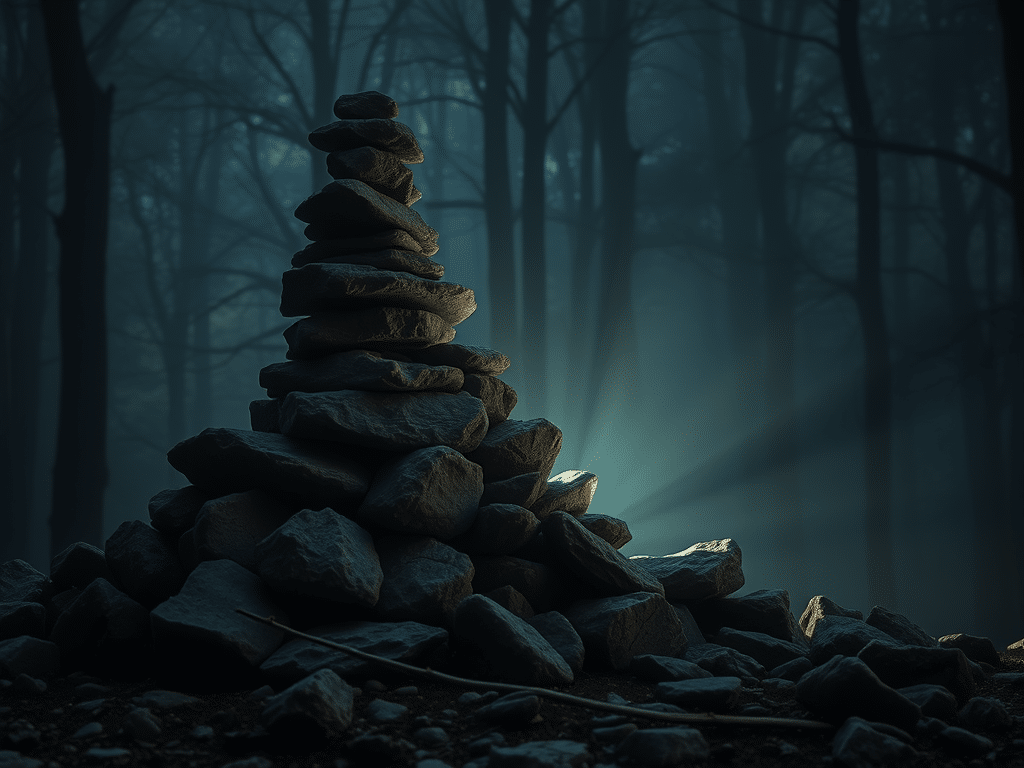
Supernatural Stone Cairns: Key Points
-
Stone cairns are deliberate human-made stacks of rocks ranging from simple trail markers to elaborate monuments that create distinctive marks separating them from natural formations.
-
Paranormal associations include reports of unease, mysterious appearances of new cairns, structures that seem to move overnight, and unusual electromagnetic readings or photographic anomalies near these stone stacks.
-
Across cultures, folklore links cairns to supernatural themes, perceiving them as portals between worlds, homes of spirits, or cursed sites that warrant no disturbance.
-
Theories range from psychological explanations about threat-detection instincts to parapsychological ideas that stones retain psychic impressions or concentrate ambient energies.
-
Modern horror fiction and internet stories have amplified cairn mythology, creating shared cultural anxiety that influences real-world behavior among hikers and paranormal enthusiasts.
-
Stone cairns demonstrate how human structures become vessels for cultural beliefs and fears, persisting as mysteries that accumulate meaning across generations.

Introduction
Stone cairns, those carefully arranged piles of rocks that dot the earth from isolated mountain trails to the resting places of the ancients, have always held a strange place in our minds, a spot where the everyday and the enigmatic converge. These structures, ranging from simple trail markers to complex monuments, serve as physical connections between the physical world and a reality that goes beyond our usual understanding. Cairns, though frequently originating for practical purposes, such as trail markers, memorials, or grave coverings, have accrued layers of supernatural meaning. This significance endures within contemporary paranormal narratives and continues to provoke unease in those who discover them in remote locations.
Overview
At their core, stone cairns are human-made rock structures. These structures are typically built without using mortar or other binding materials, relying instead on careful placement and balance. These structures come in a staggering array of sizes and intricacies. Some are as simple as a few stones, arranged to guide the way, while others, the monumental burial cairns, can dominate the scenery, built from thousands of individual rocks. Building a cairn demands purpose and work, transforming each into a conscious human imprint on the landscape. This deliberate placement of stones results in a construction that distinguishes itself from its environment, thereby capturing attention and frequently prompting speculation regarding its origin, the period of its construction, and, most captivatingly, its purpose (Williams, 2012).
Cairns, those heaps of stones, exist in a variety of shapes and sizes. They might be nothing more than a few rocks, a marker for a trail, or something much grander, a monument built for some kind of ceremony. A notable group of cairns, often called “Lappish cairns,” are found in the northwestern part of the Russian Plain. These cairns are known for their mysterious nature and the small number of artifacts discovered with them (Streltsov, 2023). In contrast, on Gotland, cairns are part of larger ritual areas. Their specific placement suggests they were used in ceremonies during the Bronze Age (Martinsson‐Wallin & Wehlin, 2021).
Across different cultures, stone cairns are often linked to the supernatural, with consistent themes of boundaries, spirits, and warnings from the afterlife. Those who stumble upon cairns in remote places often describe a sense of discomfort, even fear, or the unsettling feeling of being observed, despite the seemingly innocuous nature of these stone piles. Hikers frequently stumble upon new cairns in places they’d never seen them, often arranged in ways that feel intentional, even eerie. The patterns and numbers sometimes suggest a purpose beyond mere trail marking. Even more unsettling are the accounts of cairns that seem to shift or reassemble themselves while people sleep, or those discovered in locations so isolated or perilous that their very existence defies explanation. Certain paranormal investigators have noted strange electromagnetic fluctuations close to ancient cairns. Others have experienced camera failures, captured unexplained shadows in their photos, or witnessed the emergence of orbs and mists that appear to coalesce around these stone formations.
Archaeological evidence suggests that cairns served different purposes throughout history. The Huahaizi No. 3 site in Xinjiang, China, features a prominent cairn encircled by a stone circle, a characteristic suggesting ritualistic significance; this interpretation is corroborated by the discovery of sacrificial items in the vicinity (“The excavation of the Huahaizi No. 3 Site in Qinghe County, Xinjiang,” 2017). Furthermore, the analysis of cairns on the Isle of Arran indicated that certain structures were linked to ceremonial activities, differentiating them from non-religious settlements; this conclusion suggests a distinct spatial separation between sacred and secular functions (Barnatt & Pierpoint, 1981).
In addition, the construction of certain cairns in Scotland, which are aligned with astronomical events like the solstices, shows how prehistoric monument building was connected to cosmological beliefs. Cairns, including the Clava passage graves and ring cairns, show a careful alignment with celestial events. This suggests they were used not just for burials but also as tools for tracking the sky (Scott, 2024).
Most cultures that build cairns include supernatural elements in their folklore, which go beyond the cairns’ practical uses. In Celtic tradition, cairns were considered markers of thin places. These were locations where the boundary between our world and the otherworld was believed to be weak. These characteristics made them places where spirits could cross over or where fairies might gather. Scottish Highland tradition held that tampering with cairns was a wicked idea. The belief was that such actions could free spirits held within or bring down a curse on the person who dared to interfere. Norse mythology often associated cairns with trolls and hidden folk, entities believed to inhabit the liminal spaces of the natural world. Across different Native American tribes, certain rock formations and cairns were considered connected to spirit guardians, places of power, or markers indicating sacred or dangerous areas. People either approached these sites with respect or avoided them entirely. In many Asian cultures, roadside cairns served as memorials. Travelers would add stones to these cairns while saying prayers. This practice blurred the line between honoring the dead and appeasing spirits.

Theories
Several theories attempt to explain the persistent paranormal associations with stone cairns, ranging from psychological to supernatural. From a psychological standpoint, cairns elicit our inherent pattern-recognition capabilities and survival mechanisms. The atypical configuration of stones within a natural environment indicates human activity and potentially concealed motives, thereby engaging our threat-assessment processes. The isolation and often eerie settings of cairns might amplify this response, creating conditions that could lead to misinterpretations of natural events or increased suggestibility. From a parapsychological perspective, certain investigators suggest that stones could inherently possess qualities that allow them to record or preserve psychic impressions. This idea parallels the stone tape theory, which posits that traumatic occurrences or intense emotions can become imprinted on physical substances, subsequently becoming perceptible to those with heightened sensitivity. Some people suggest that building stone stacks creates a purposeful structure. This structure might focus or amplify existing energies, whether they are electromagnetic, psychic, or something else that science hasn’t yet fully explained. From an archaeological perspective, many old cairns are known to mark burial sites or places where important events happened. This suggests a possible connection to death, grief, and ancestral memory, which could then lead to paranormal experiences.
Archaeological evidence frequently links cairns to ritualistic practices. Archaeological research in Gotland has investigated Bronze Age rituals, especially those associated with cairns. These cairns often appear in places that suggest they were used for marking space and organizing ceremonies (Martinsson‐Wallin & Wehlin, 2021). Similarly, recent research on the Clava group monuments highlights the complex relationship between their megalithic design and the rituals performed there. People perceive these cairns as symbols of both the physical and spiritual realms (MacCarthy, 1997). Moreover, studying cairns within the context of prehistoric societies shows they were places where communities invested in both religious practices and social unity. The impressive size of these structures suggests they were important places for gatherings, offerings, and the development of shared community identities (Barnatt & Pierpoint, 1981; Bender et al., 1997).
Impact
Cairns have a lasting impact on modern paranormal culture, urban legends, and even how people behave when they spend time outdoors. Modern horror stories and online creepypasta often use cairns as warnings or signs of supernatural danger. These stories often involve hikers who ignore these unusual stone piles, leading to disastrous outcomes. The internet has accelerated the spread of these tales, fostering a collective cultural awareness that suggests we might want to steer clear of, or at the very least, tread carefully around, these enigmatic stone structures. This phenomenon has produced some curious outcomes in the real world. Hikers have reported feeling actual anxiety when stumbling upon unanticipated cairns. Some have even chosen to abandon their planned routes or camping locations. On the flip side, certain paranormal aficionados deliberately hunt for cairns. They attempt to record evidence of unusual occurrences or even establish contact with any entity they believe could be associated with these stone piles. The act of erecting cairns has sparked debate in wild places. Land management agencies, citing environmental worries, have begun to frown upon their creation. Beyond that, there’s the issue of unauthorized cairns potentially leading hikers astray or disrupting archaeological sites.
Cairns often serve as symbols of cultural identity, collective memory, and community rituals. Pilgrimage practices in places like Santiago de Compostela show how cairns have become symbols of both dedication and penance. Pilgrims, for example, add stones to these structures as a form of religious devotion (Henningsen & Laursen, 2006). Moreover, in various cultures, building cairns can symbolize a shared memory or a way to remember those who have died, serving as a focal point for community remembrance and spiritual practices.
In the Arabian Peninsula, stone monuments, including cairns, are recognized as important markers in the landscape. They reflect the social structures and cultural stories of the Bedouin people (Kennedy et al., 2021). These “works of the old men” uphold a millennia-old legacy, inextricably linking physical locations and cultural narratives.
Conclusion
Stone cairns, when considered alongside the paranormal, show how human-made structures can embody our fears, beliefs, and the need to uncover meaning in our surroundings. <Cairns undeniably stir something within us, whether we view them as straightforward markers, archaeological wonders, or gateways to the unknown. These stone piles are a testament to humanity’s enduring impulse: to shape the world around us, to leave behind markers that endure long after we’re gone, and to gather stories with every new generation. In a world dominated by GPS and precise maps, the simple cairn endures. The cairn serves as a reminder that the earth and stones still hold certain mysteries, quietly waiting in remote locations. They make us ponder the motives of those who built them and what, if anything, remains among the carefully placed rocks.
References
Barnatt, J. and Pierpoint, S. J. (1981). Field monuments on machrie moor, arran. Glasgow Archaeological Journal, 8(1), 29-31. https://doi.org/10.3366/gas.1981.8.8.29
Bender, B., Hamilton, S., & Tilley, C. (1997). Leskernick: stone worlds; alternative narratives; nested landscapes. Proceedings of the Prehistoric Society, 63, 147-178. https://doi.org/10.1017/s0079497x00002413
Henningsen, G. and Laursen, J. (2006). Stenkast. Kuml, 55(55), 243-278. https://doi.org/10.7146/kuml.v55i55.24695
Institute of Archeology, CASS, Altai Prefectural Cultural Relics Bureau, & Qinghe County Cultural Relics Bureau. (2017). The excavation of the Huahaizi No. 3 Site in Qinghe County, Xinjiang. Chinese Archaeology, 17(1), 152-161. https://doi.org/10.1515/char-2017-0012
Kennedy, M., McMahon, J., Thomas, H., Boyer, D. D., Repper, R., Dalton, M., … & AlKhaldi, K. (2021). Dating the pendant burials of north‐west arabia: first radiometric results from the khaybar oasis, saudi arabia. Arabian Archaeology and Epigraphy, 32(S1), 183-197. https://doi.org/10.1111/aae.12199
MacCarthy, C. (1997). The disclosure of sacred ground: structural developments within megalithic monuments of the clava group. Proceedings of the Society of Antiquaries of Scotland, 126, 87-102. https://doi.org/10.9750/psas.126.87.102
Martinsson‐Wallin, H. and Wehlin, J. (2021). Stones in the south: decoding bronze age ritual practices on gotland. Current Swedish Archaeology, 25(1), 227-256. https://doi.org/10.37718/csa.2017.20
Scott, D. D. (2024). The solar and lunar alignment of rock art on scottish prehistoric monuments. Journal of Skyscape Archaeology, 9(2), 230-236. https://doi.org/10.1558/jsa.27576
Streltsov, M. A. (2023). Geoecological aspects of various types of archaeological sites in the north-west of the russian plain. Vestnik of Immanuel Kant Baltic Federal University Series Natural and Medical Sciences, (2), 60-74. https://doi.org/10.5922/gikbfu-2023-2-5
Williams, D. B. (2012). Cairns: messengers in stone. Mountaineers Books.
Leave a Reply