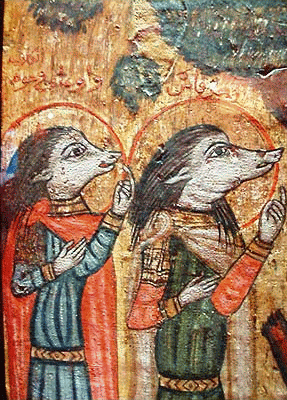
The Cynocephali: Key Points
- The cynocephali were legendary creatures with the bodies of men and the heads of dogs, said to live at the distant edges of the known world. Their name comes from the Greek for “dog-headed.”
- Physically they had upright human limbs but canine heads with snouts, sharp teeth, and pointed ears, and they could not speak, instead communicating through barks, growls, and howls.
- Their behavior was described inconsistently, ranging from violent man-eating savages to surprisingly civilized peoples who hunted, farmed, and traded with their neighbors.
- Herodotus documented them in The Histories in the fifth century BCE, while Marco Polo later described dog-headed people in the Andaman Islands in The Travels of Marco Polo, keeping the legend alive for centuries.
- In folklore and religion they became powerful symbols, most notably in certain Christian traditions where Saint Christopher was depicted as a dog-headed man before his conversion and redemption.
- The legend persists today in North American dogman sightings, and theories about its origin include misidentified baboons, the dehumanizing of foreign peoples, and a deep human fascination with the boundary between animal and man.

Introduction
Few of the weird beings who inhabit the margins of old maps and the pages of medieval bestiaries have survived in the human imagination quite as the cynocephali have. The word itself, borrowed from Greek, literally means “dog-headed,” and it is an apt description of what generations of travelers, historians, and legends said they found at the far reaches of the known globe. These were monsters with the bodies of men and the heads of dogs reported to inhabit remote areas beyond the reach of civilization. They appeared for over two thousand years in scholarly geography, religious art, and oral tradition, and their impact arguably lives on even today in modern descriptions of so-called dogmen. To understand the cynocephali is to follow one notion through the centuries, from ancient ethnography, myth, and perhaps back again into modern folklore.
The dog-headed motif recurs in Latin and vernacular writings, both illustrated and textual, and travels through manuscript culture into print in the traditions of the emblem and the fable. Studies following the circulation of mythological materials from Ovidian Metamorphoses to Natale Conti’s Mythologiae and then to Renaissance translations and emblematic literature shed light on how cynocephali (and similar beings) served as portable units for teaching, moralizing, and entertaining through the centuries (Calame, 2018; Hall, 1969; Alessi et al., 2018). Comparative discussions of the reception of classical materials (e.g., Ovid, mythological fabulae) demonstrate that medieval scholars who mediated these materials through philology, glosses, and scholastic pedagogy would shape the way monstrous beings such as cynocephali were conceived by later readers and students (Kretschmer, 2015; Ottewill‐Soulsby, 2020; Guenther, 2022).
Physical Form and Behavior
Physically the cynocephali were described with a striking uniformity over many generations. They were upright humanoids with human limbs, but their heads were definitely dog-like, with long muzzles, sharp teeth, and pointed ears. Some reports described them as having dark or hairy skin, and many focused on their robust build. Their greatest constraint was speech. They were unable to speak due to the absence of human mouths or tongues; however, they could produce sounds such as barking, growling, and howling. In some medieval portrayals they were clad in clothes or armed, a detail that put them in an ambiguous space between beast and man. They were not exactly animals, and neither were they completely human.
What these monsters did depended on whose story you heard. In other traditions, they were vicious and dangerous, hunting with the ferocity of wild dogs and even consuming visitors to their area. Others pictured them as remarkably civilized: living in organized towns, rearing cattle, and trading with other people. They were generally portrayed as skilled hunters, using bows and spears. Some writers attributed to them a sense of justice and a settled manner of life. This contrast between savagery and civilization is one of the most remarkable qualities of the cynocephali because it mirrors the way ancient peoples imagined those who lived just beyond their borders.

Documentation in History and Religion
The real documentation of the cynocephali begins with the Greek historian Herodotus, who documented them in his enormous work simply titled The Histories, written in the fifth century BCE. He described the known globe at enormous length. He wrote that in the farthest parts of Libya, there were dog-headed men and other wonders, like beings with eyes in their chests but no heads. For example, Herodotus did not need to claim to have seen these beings firsthand. Instead, he relayed what others had informed him, depicting the cynocephali as part of the unusual fauna of distant regions. His offhand mention of them, mixed together with real animals and peoples, gave the creatures a believability that would last for generations and would implant them firmly in the geographic imagination of the ancient world.
Many centuries later, the Venetian traveler Marco Polo retold his tale in The Travels of Marco Polo, the famous record of his adventures also known as Il Milione or The Description of the World. When Polo made his journeys in the late thirteenth century, he wrote that the Andaman Islands possessed residents with heads, jaws, and eyes like a dog. If they were not of his kind, he referred to them as a dreadful people who would consume anyone. It is a matter of controversy whether Polo was reporting a rumor second-hand or trying to make sense of an unknown people via the prism of an ancient and persistent mythology. What is apparent is that his report kept the cynocephali alive in the European mind much beyond the age of exploration.
The dog-headed men became more than just a geographical curiosity in mythology and religious tradition. The most notable example is seen in some strands of Christian tradition, where St. Christopher himself is occasionally represented as a cynocephalus prior to his conversion. These tales endow a grotesque, dog-headed man with the power of speech and the grace of faith and he becomes a dedicated servant of God. Sometimes Eastern Orthodox icons depict the saint with a canine head—a startling picture that turned the creature from a terrifying outsider into a symbol of redemption. Elsewhere, the Cynocephali were one method of considering the limits of humanity, raising difficult questions about whether such creatures had souls and could be saved.
From Ancient Monsters to Modern Dogmen
There is no denying the connection between the ancient cynocephali and current accounts of dogmen. In North America specifically, there are ongoing reports of humans encountering tall, erect, dog-headed or wolf-like animals who move on two legs. Now, these stories seem to center around Michigan, Wisconsin, and such, but they portray entities hauntingly similar to those of old. The physical description is virtually intact after thousands of years, a humanoid body with a canine head. Whether this is true continuity of experience or just the tenacity of an ancient template in the human mind is a matter worth contemplating. The cynocephalus in modern dress may be the dog-man of modern legend.
There are also many hypotheses regarding where the legend itself started. A common explanation is baboons, who have dog-like faces and often stand erect, leading travelers to call them dog-headed men, particularly when the stories were passed on via several tellings. Alternatively, the cynocephali may be an example of the dehumanization of alien peoples when far-off tribes are portrayed as monstrous to underline their otherness. There is also the simple risk of faulty translation and embellishment, with descriptions of strange customs, masks, or warriors slowly solidifying into tales of genuine monsters. Another, more psychological interpretation is that the dog-headed man reflects a fundamental human concern with the boundary between animal and human, a threshold that both calls us and frightens us.
Cynocephali belong to a wider medieval and late antique set of “monstrous races” deployed to test human exceptionalism and the limitations of human understanding. Augustine’s studies of numerous hideous peoples in late antiquity (mentioned through modern synthesis) are part of the tradition of collecting marvels to frame problems about humanity, rationality, and moral standing (Guenther, 2022). Pliny the Elder and other ancient compilations, later digested and reinterpreted by medieval scholars, trace this tradition (Ottewill‐Soulsby, 2020; Guenther, 2022). In the larger mythographic tradition, these figures are incorporated into allegorical and didactic enterprises that use fabulae (fables) as means of moral education, natural philosophy, or exemplary narration. Multiple authors highlight the flexible condition of mythic entities (including cynocephali) as “fabulae” whose interpretive valence varies according to educational and philosophical goals (Calame, 2018; Venuti, 2022; Praet, 2018). Such intertextual mobility may help explain the persistence of cynocephali in the medieval imagination as both curiosities and teaching instruments.
The cynocephali have no one canonical reading; rather, their meaning changes according to the epistemic purposes of their interpreters. In late antique and medieval contexts, cynocephali can serve as physical ‘monsters’ in ethnographic compendia, moral examples in allegorical readings, or intellectual devices in scholastic rhetoric (fabulae vs. historia). This plurality is represented in the literature on mythography, allegory, and emblem studies (Wolff, 2017; Calame, 2018; Vistarini & Sajó, 2007; Guenther, 2022). Others underscore the ongoing character of mythographic work, from Boccaccio and classical mythography to Conti and beyond, without supposing a preordained interpretive end. Others emphasize specific moments (e.g., allegorical readings in Fulgentius and myth as an educational tool in the Renaissance) as decisive for cynocephali usage in education and moral philosophy (Wolff, 2017; Calame, 2018; Venuti, 2022; Noacco, 2006). The modern historiography of dog-headed beings also covers studies of ethnography and urbanism in the medieval imagination (e.g., the city as a test of humanity in accounts of Cynocephali). These cross-disciplinary views illustrate how cynocephali might illuminate broader cultural ideas about humanity, civilization, and the limits of rationality in premodern thought (Guenther, 2022).
Conclusion
So the cynocephali are much more than a strange footnote in the history of ancient geography. They started as accounts of real or imaginary peoples on the fringe of the world, earned the authority of recognized writers such as Herodotus and Marco Polo, and developed into rich emblems in folklore and religious art. Even today in the era of satellites and world maps with no room for unknown lands, the image of the dog-headed man will not disappear, appearing in current dogman sightings and still inspiring speculation. It doesn’t matter if they are misidentified animals, slandered strangers, or manifestations of something deeper in the human psyche: the cynocephali are a monument to our persistent urge to envision what lies for us just beyond the familiar.
References
Alessi, N., Maiarelli, A., & Zangari, M. (2018). Columbeidos sive Vita b. Columbae virginis reatinae ordinis de Poenitentia S. Dominici. Renaissance and Reformation, 40(4), 183–185. https://doi.org/10.33137/rr.v40i4.29276
Calame, C. (2018). Lire les mythes. Formes, usages et visées des pratiques mythographiques de l’Antiquité à la Renaissance. Kernos, 31, 332–336. https://doi.org/10.4000/kernos.2966
Conti, N. (1567). Mythologiae.
Guenther, M. (2022). Therianthropes in a Cartesian and an Animistic Cosmology: Beyond-the-Pale Monsters versus Being-in-the World Others. Literatura Ludowa, 66(3), 7–35. https://doi.org/10.12775/ll.3.2022.001
Hall, C. (1969). Galileo’s Rhetoric of Fable. Quaderni D Italianistica, 31(2), 91–112. https://doi.org/10.33137/q.i..v31i2.14990
Herodotus. (ca. 430 BCE). The histories.
Kretschmer, M. T. (2015). Pierluigi Leone Gatti, Ovid in Antike und Mittelalter – Geschichte der philologischen Rezeption (Hermes – Einzelschriften 106), Stuttgart : Franz Steiner Verlag, 2014, 260 pp. + 15 ill., ISBN 978-3-515-10375-6. Exemplaria Classica, 19. https://doi.org/10.33776/ec.v19i0.2672
Noacco, C. (2006). “Lire Ovide au XIIe siècle: Arnoul d’Orléans, commentateur des Métamorphoses.” Troianalexandrina, 6, 130–149. https://doi.org/10.1484/j.troia.2.301942
Ottewill‐Soulsby, S. (2020). City of Dog. Journal of Urban History, 47(5), 1130–1148. https://doi.org/10.1177/0096144220910139
Ovid. (8 CE). Metamorphoses.
Polo, M. (ca. 1300). The travels of Marco Polo.
Praet, S. (2018). A Monk’s Tale. 81–100. https://doi.org/10.1515/9783110566536-005
Venuti, M. C. (2022). «Prima natura, secunda doctrina, tertia felicitas». Enea eroe in formazione (e modello educativo) nelle “Virgiliana continentia” di Fulgenzio. Aoqu (Achilles Orlando Quixote Ulysses) Rivista Di Epica, 3(I), 31–56. https://doi.org/10.54103/2724-3346/18435
Vistarini, A. B., & Sajó, T. (2007). Imago Veritatis. La circulación de la imagen simbólica entre fábula y emblema. Studia Aurea, 1, 1. https://doi.org/10.5565/rev/studiaaurea.20
Wolff, É. (2017). Allegorical interpretations of Hera-Juno at the end of Antiquity: The example of Fulgentius. Acta Antiqua Academiae Scientiarum Hungaricae, 57(2–3), 297–304. https://doi.org/10.1556/068.2017.57.2-3.12




Leave a Reply