Ningyo: Key Points
- The Ningyo, meaning “human fish,” is a mermaid-like creature from Japanese folklore that is often unsettling rather than alluring in appearance (Rosen, 2009).
- Physically, it combines a monkey-like mouth, shining golden scales, a flute-like voice, and an eerily human face, with that human face being its most disturbing feature (Rosen, 2009).
- The Ningyo is a mostly passive figure in the tales, functioning less as an active creature and more as a catalyst whose discovery triggers extraordinary events.
- Its most important power lies in its flesh, which is said to grant immortality or radically extended youth to whoever eats it (Rosen, 2009).
- The famous legend tells of a girl who eats a discarded Ningyo and stays youthful while outliving many husbands, eventually becoming a wandering Buddhist nun for eight hundred years, showing that immortality is an isolating burden rather than a blessing (Rosen, 2009).
- Scholars interpret the Ningyo as a warning against pursuing immortality, a reflection of Buddhist ideas about spiritual devotion, and possibly a belief inspired by unfamiliar sea animals or fabricated “mummified” specimens.

Introduction
Of the many bizarre and beautiful animals that litter Japanese legend, few are as frightening as the Ningyo. The word means “human fish” and refers to a mermaid-like figure that has caught imaginations spanning ages of storytelling (Rosen, 2009). Unlike the beautiful mermaids of European lore, the Ningyo is typically described as having a disturbing aspect, and its flesh is supposed to have a magical and frightening power. To know this creature is to know a thicket of physical description, behavior, history, supernatural properties, and the human worries that gave it birth.
Physical Description
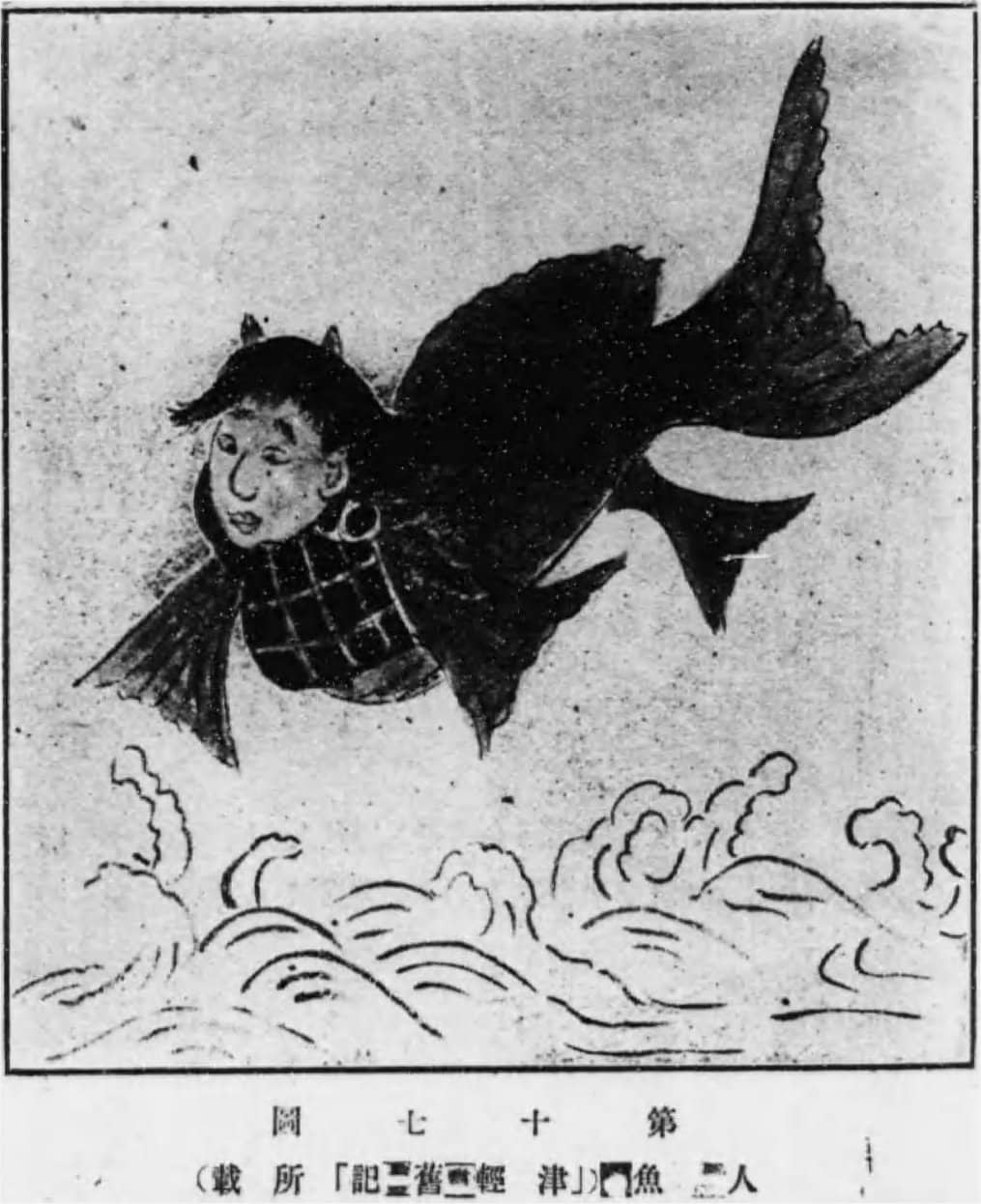
Physically the Ningyo is a chimera of familiar and bizarre pieces. Ancient texts describe a creature with the mouth of a monkey, scales that shine like gold, a voice that sounds like a flute, and a face that looks disturbingly like a human face (Rosen, 2009). Yet it is this human visage more than anything else that sets the Ningyo apart from an ordinary fish and lends it its eerie character. A shimmering golden-scaled body might look attractive at a distance. But seen close up, the creature warps the line between person and animal in a way that elicits discomfort rather than desire.
The usual folklore depiction is that of a being with the body of a fish and the upper body or head of a human, often possessing intelligence or spiritual power. This “human fish” yōkai is characterized in many studies as varying in size, form, and countenance, but it consistently features the unifying motif of a fish lower body and a human upper body or head (George, 2020; Castiglioni, 2023). These images reappear in the context of the Edo era and early modern period, where they are regarded as major symbolic figures in ningyō legend (George, 2020; Suwa, 2018; Castiglioni, 2023).

Behavior and History
Behaviorally, the Ningyo is a bit of a mystery, as much of the legend concerns what occurs after the creature is caught, rather than how it lives in the sea. In the stories the Ningyo is a passive figure, a fish caught on a line or net, then broiled and put on a table. It has a flute-like, melodious voice, suggesting a creature capable of song, but the legends rarely focus on this. The Ningyo is more a catalyst than an active actor, an object whose discovery sets amazing events in action.
The Ningyo has a lengthy history in Japanese folklore, being depicted in ancient texts cementing its unique characteristics in the cultural imagination (Rosen, 2009). The fact that it has survived through the ages is a testimony to how much it resonated with the individuals who told and retold its story. The monster became a shorthand for the boundary between the natural and the supernatural, a reminder that the sea might house creatures that disturbingly imitated humanity.
The Power of Immortality
The most essential power of the Ningyo is not the creature but its flesh. Eating a Ningyo is considered to be the key to immortality, or at the very least, to a long, young life (Rosen, 2009). This one trait is responsible for the most renowned legend related to the creature. A fisherman captures a Ningyo, barbecues it, and serves it to his guests. One diner, appalled at the fish’s human visage, folds his share in paper to take home—and throws it away. But his young daughter eats the fish that is thrown out, as her father lies drunk on sake. At first the father is concerned about her health. The girl is not hurt in the least. The ramifications slowly manifest over decades. When she is married, she stays young while her spouse becomes old and dies. She marries again, is widowed again, and so it goes. Ultimately the still-young woman becomes a Buddhist nun who travels and teaches for eight hundred years until she ultimately dies (Rosen, 2009).
This story demonstrates how thoroughly double-edged the Ningyo’s gift is. It may sound like a blessing to be immortal, but the novel portrays it as a slow, isolated story. The lady outlives every mate she has and every generation she knows. Her perpetual youth marks her off from ordinary human life and she turns to religion and teaching, possibly as the only meaningful way to fill her existence that refuses to end. The danger here is not so much the susceptibility of the Ningyo but of the human who feeds it. The real danger is the loneliness of living too long.
Scholarly Interpretations and Origins
Kimbrough and Glassman’s discussions of vernacular Buddhism and folk religious texts in Japan illuminate the placement of mermaid-like creatures and water spirits within the broader folk-religious ecosystems of medieval and post-medieval Japan. The friction between the scholarly categories (minkan shinkō vs. minzoku shūkyō) helps explain the movement of mermaid imagery between elite literature and common practice, often developing regionally resonant meanings in communities (Kimbrough & Glassman, 2009). Comparative folklore work (Wardarātā & Negoro; Nicolae; Zakirova et al.) provides a frame for how mermaid motifs travel and transform across cultures. In the Japanese case, however, the continuity of ningyō and yōkai traditions supports a strong local adaptation of mermaid symbolism into national culture, ritual spaces, and modern media narratives (Wardarita & Negoro, 2017; Nicolae, 2018; Zakirova et al., 2023).
There are several theories to explain why such a creature arose and survived. Another way to see the Ningyo is as a warning figure, a warning against recklessly pursuing immortality and assuming that a longer life is automatically a better one. Another interpretation links the narrative to Buddhist concepts, for in it, the immortal woman becomes a nun, indicating that spiritual dedication is the only significant answer to a long-extended life. More realistically, some academics speculate that sightings of bizarre sea creatures or the collection of mummified Ningyo from bits of fish or other species helped fuel belief in the entity. The act of eating something with a human face is manifested. possibly be more married, the taboo of cannibalism, the disgust of which would explain why the gagain and narrative flinches while the innocent ultimately accepts it.
The ningyō are occasionally conflated with or described as mermaid-like, especially in the sense of “mermaidification,” where ningyō are read through mermaid imagery in modern discourse but still retain distinctive Japanese material and ritual meanings (George, 2020; Suwa, 2018; Hayward, 2019). Some sources expressly describe ningyō no miira (manufactured ningyō corpses) and their importance in religious contexts, demonstrating the material culture around ningyō in the Biwako region (Hayward, 2018; Suwa, 2018). The distribution of ningyō tales intersects with Pacific Buddhist–Shintō holy landscapes, such as enshrined ningyō on lakeside islands and coastline temples surrounding Biwako, creating an aquapelagic assemblage linking such artifacts and sanctuaries to a broader sacred topography (Suwa, 2018).
Conclusion
The Ningyo persists because it contains a real human tension within one bizarre image. It is fish and man, blessing and curse, temptation and caution. Golden scales, a flute-like voice, the promise of beauty, its human face, and its gift of infinite life—a quiet dread. The story of the eight-hundred-year-old nun teaches us that some requests, once granted, cannot be undone (Rosen, 2009). granted, cannot be taken back (Rosen, 2009). Thus, the Ningyo is much more than a strange marine monster. It is a mirror to our need for stability and the loneliness that such permanence may bring.
References
Castiglioni, A. (2023). Reframing the Human-Fish in the Edo and Meiji Periods. Journal of Religion in Japan, 12(1), 33–71. https://doi.org/10.1163/22118349-01201003
George, S. (2020). Amabie goes viral: the monstrous mercreature returns to battle the Gothic Covid‐19. Critical Quarterly, 62(4), 32–40. https://doi.org/10.1111/criq.12579
Hayward, P. (2018). Mermaids, Mercultures and the Aquapelagic Imaginary. Shima, 12(2). https://doi.org/10.21463/shima.12.2.03
Hayward, P. (2019). Elaborating the Aquapelagic Imaginary: Catalina Island, Tourism and Mermaid Iconography. Journal of Marine and Island Cultures, 8(2). https://doi.org/10.21463/jmic.2019.08.2.07
Kimbrough, R. K., & Glassman, H. (2009). Editors’ Introduction: Vernacular Buddhism and Medieval Japanese Literature. Japanese Journal of Religious Studies, 36(2). https://doi.org/10.18874/jjrs.36.2.2009.201-208
Nicolae, R. (2018). The Myth of Eternal Youth: Two Japanese Perspectives. Trictrac, 10. https://doi.org/10.25159/1996-7330/2089
Rosen, B. (2009). The mythical creatures bible: The definitive guide to legendary beings. Union Square & Co.
Suwa, J. (2018). Ningyo Legends, Enshrined Islands And The Animation Of An Aquapelagic Assemblage Around Biwako. Shima, 12(2). https://doi.org/10.21463/shima.12.2.08
Wardarita, R., & Negoro, G. P. (2017). A Comparative Study: The Folktale of Jaka Tarub (Indonesia) and Tanabata (Japan). Advances in Language and Literary Studies, 8(6), 1. https://doi.org/10.7575/aiac.alls.v.8n.6p.1
Zakirova, A., Maigeldiyeva, S., & Tuyakbayev, G. (2023). Linguacultural and cognitive aspects of teaching the language of Kazakh legends. Citizenship Social and Economics Education, 22(3), 137–151. https://doi.org/10.1177/14788047231221109


Leave a Reply